
7 Best AI Agent Management Software for Customer Service (2026)

- Updated:
- Authored by
-
 Richard James Director of Organic Growth and CX
 - Reviewed by
-
 Sean Minter Founder, CEO
AI agent management software evaluates and improves deployed customer-facing AI agents across voice and digital channels. CX leaders, customer service leaders, and QA teams use AI agent management software to score interactions, investigate customer journeys and handoffs, assign corrective actions, and measure performance after changes.
As AI agents have moved from pilots into frontline customer service, responsibility for managing performance is expanding beyond any single provider or deployment environment. Customer conversations can pass between AI agents, human representatives, and BPO teams, while service failures can originate in prompts, knowledge, routing, integrations, or human handoffs. CX leaders need to trace each issue across the customer journey, identify the source, and route corrective action to the responsible team or provider.
AI agent management software is still in its infancy, with vendors approaching the category from AI-agent creation and deployment, release testing, conversation intelligence, or quality assurance, but with AI agents from multiple providers serving alongside live teams and BPOs, the need has never been greater for a unified approach to managing quality and performance across one connected hybrid workforce.
We compared the best AI agent management software vendors based on CX data unification across deployed AI agents, channels, human teams, and BPOs, shared quality and performance standards across the hybrid workforce, and accountable workflows that route corrective actions and measure customer-service outcomes.
Before selecting AI agent management software, you need to evaluate:
- Types of AI Agent Management Software: Where AI-agent creation, release testing, conversation intelligence, quality assurance, and unified CX performance management fit before and after deployment.
- AI Agent Management vs AI Agent Monitoring: How monitoring identifies production issues, while management assigns corrective actions and measures results after changes.
- What AI Agent Management Software Needs to Succeed: Why accurate evaluation depends on connected CX data and shared standards, while lasting improvement requires clear ownership and follow-up measurement.
- AI Agent Management Software Features: Which capabilities help CX teams evaluate AI agents, trace issues across customer journeys, route corrections, and measure service outcomes.
- AI Agent Management Software Evaluation Criteria: How to match vendor scope to your AI-agent providers, channels, contact center size, CX data sources, human teams, BPOs, and release requirements.
Top Pick for 2026: AmplifAI ranks #1 for AI agent management software, unifying CX data from any source across AI agents from multiple suppliers, human teams, and BPOs in one performance layer. AmplifAI evaluates 100% of human- and AI-handled interactions against shared quality and performance standards, routes findings into role-based next best actions, and measures corrective-action effectiveness. AmplifAI won Automation Solution of the Year at the 2026 CCW Excellence Awards and was named a Leading provider in the 2026 CMP Research Prism for Automated QA/QM.
Compare the 7 Best AI Agent Management Software
Compare the seven best AI agent management software vendors of 2026, evaluated based on software type, features, and evaluation criteria for customer service.
| Rank | AI Agent Management Software | Overview |
|---|---|---|
| 1 | AmplifAI | AmplifAI ranks #1 for AI agent management software, unifying CX data from any source across AI agents from multiple suppliers, human teams, and BPOs. AmplifAI evaluates 100% of interactions through conversation intelligence and quality management, applies shared quality and performance standards, routes findings into role-based next best actions, and measures corrective-action effectiveness. |
| 2 | Cresta | Cresta AI agent management software evaluates human- and AI-handled customer interactions through conversation intelligence and quality management, with native testing and deployment controls inside the Cresta environment. |
| 3 | NICE | NICE AI agent management software provides CCaaS-native conversation intelligence and quality management for human- and AI-handled customer interactions, with AI-agent testing and deployment controls inside the NICE CXone environment. |
| 4 | Observe.AI | Observe.AI AI agent management software evaluates 100% of human- and AI-handled customer interactions through conversation intelligence and quality management, with native testing and deployment controls inside the Observe.AI environment. |
| 5 | Kore.ai | Kore.ai AI agent management software manages customer-service AI-agent lifecycles through testing and quality evaluation inside the Kore.ai environment, with observability and governance for supported external frameworks. |
| 6 | Salesforce Agentforce | Salesforce Agentforce AI agent management software tests customer-service AI agents against defined scenarios, with release controls and CRM context inside the Salesforce environment. |
| 7 | Cyara | Cyara AI agent management software tests customer-service AI agents from multiple suppliers through synthetic conversations, regression suites, release validation, and continuous assurance across voice and digital channels. |
| AI agent management software rankings reflect customer-service fit across software types, features, and evaluation criteria, while final selection depends on your requirements for unified performance management, conversation intelligence, native lifecycle control, or independent assurance. | ||
2026 CMP Research Prism Report for Automated QA/QM
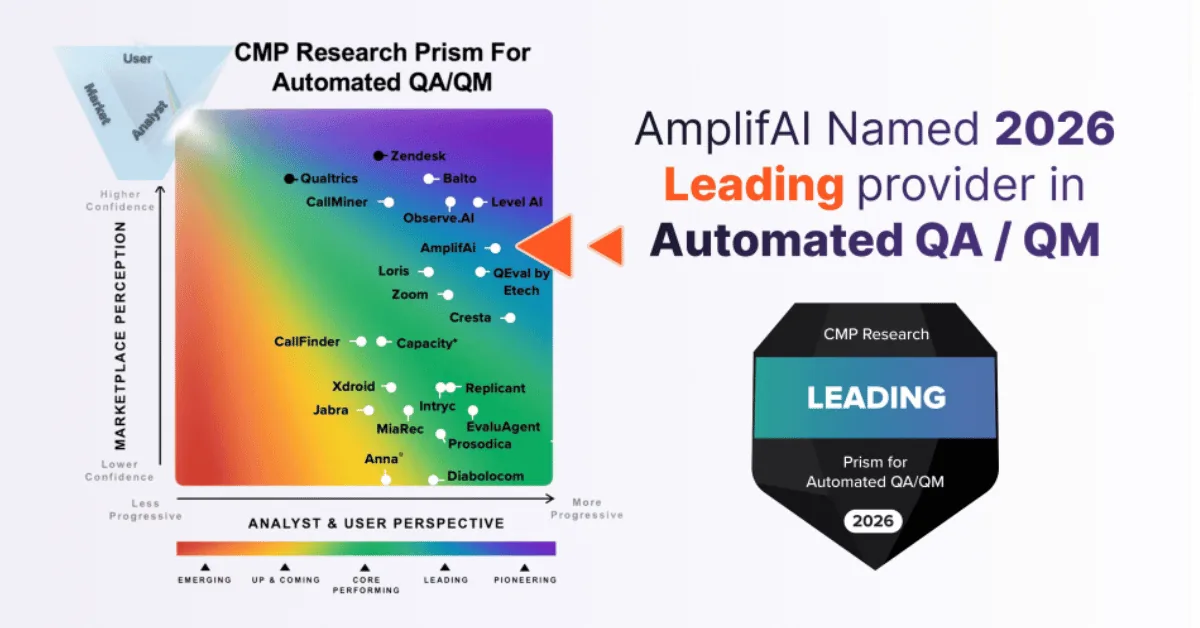
AmplifAI was named a Leading provider in the 2026 CMP Research Prism for Automated QA/QM, earning the highest possible progressive score for integration, user experience, AI accuracy, reporting, and data security.
CMP Research evaluated 22 automated QA/QM solution providers in its Q1 2026 Prism Report, scoring across ten key investment criteria.
Three of the AI agent management software vendors featured in this guide also appear in the CMP Prism evaluation, making the full report a valuable companion for validating your shortlist.
What is AI Agent Management Software?
AI agent management software gives companies oversight and control of how AI agents are created, tested, deployed, monitored, governed, and improved throughout their lifecycle. Available software varies by the lifecycle stages it covers, the AI agents and environments it can access, and whether performance findings feed into corrective action.
In customer service, AI agent management software evaluates and improves deployed customer-facing AI agents across voice and digital channels, with some types applying shared quality and performance standards across AI agents and human service teams, routing findings into accountable corrective actions, and measuring performance after changes.
Types of AI Agent Management Software
AI agent management software spans five types based on the performance standards you control, the AI agents you can evaluate, and how findings move into corrective workflows.
| AI Agent Management Software Type | Description | Vendors |
|---|---|---|
| Unified CX Performance Management | Unifies CX data and manages performance across human teams, AI agents, BPOs, channels, and suppliers through shared standards and corrective workflows. | AmplifAI |
| Conversation Intelligence and Quality Management | Evaluates human and AI customer-service conversations through conversation intelligence, scorecards, compliance monitoring, calibration, and outcome analysis. | AmplifAI, Cresta, Observe.AI |
| CCaaS-Native Management | Manages human and AI service performance through quality, coaching, workforce, and reporting capabilities contained within one CCaaS environment. | NICE, Salesforce Agentforce |
| AI Agent Platform-Native Management | Monitors, tests, and improves customer-service AI agents through controls native to the software used to build and deploy them. | Cresta, NICE, Salesforce Agentforce, Kore.ai, Observe.AI |
| Independent Testing and Assurance | Tests customer-service AI agents across suppliers through synthetic conversations, journey tests, regression suites, and production monitoring. | Cyara |
| Match AI agent management software types to your customer-service environment before comparing vendors. | ||
AI Agent Management vs AI Agent Monitoring
AI agent monitoring tracks production behavior, while AI agent management evaluates performance against quality and performance standards, routes corrective actions, and measures results.
| Comparison | AI Agent Monitoring | AI Agent Management |
|---|---|---|
| Primary Function | Tracks availability, latency, errors, task completion, escalations, and conversation outcomes. | Evaluates AI-agent behavior against quality and performance standards. |
| Issue Context | Shows where AI-agent performance changed or customer service failed. | Connects findings to customer impact, human handoffs, service outcomes, and responsible roles. |
| Corrective Action | Surfaces production issues and alerts. | Routes corrections across prompts, knowledge, routing, policies, integrations, or service processes. |
| Outcome Measurement | Continues tracking production behavior after changes. | Measures whether corrective actions improved customer-service performance. |
| Coverage | Provides visibility across supported AI agents and production environments. | Ranges from one provider environment to unified management across AI vendors, human teams, channels, and BPOs. |
| AI agent monitoring supplies production visibility, while AI agent management applies quality and performance standards, corrective ownership, and outcome measurement. | ||
AI agent monitoring remains part of a complete management program, with AI agent management adding the accountability and outcome measurement needed to confirm whether corrective actions improved customer-service outcomes.
What AI Agent Management Software Needs to Succeed
AI agent management software succeeds when its scope matches how your AI agents are deployed, with unified CX data placing each evaluation in business context so accountable workflows can route findings to the responsible team and measure whether corrective actions improved customer and service performance.
AI Agent Management Scope
AI agent management scope depends on whether your team needs AI-agent release assurance, production quality management, or both. Release assurance requires realistic testing and regression coverage before and after deployment changes, while production quality management requires conversation evaluation, calibration, corrective ownership, and performance measurement. A single-vendor deployment may fit within native AI agent management, while a multi-vendor hybrid workforce requires consistent standards across AI agents, human teams, channels, and BPO partners.
Unified CX Data Layer
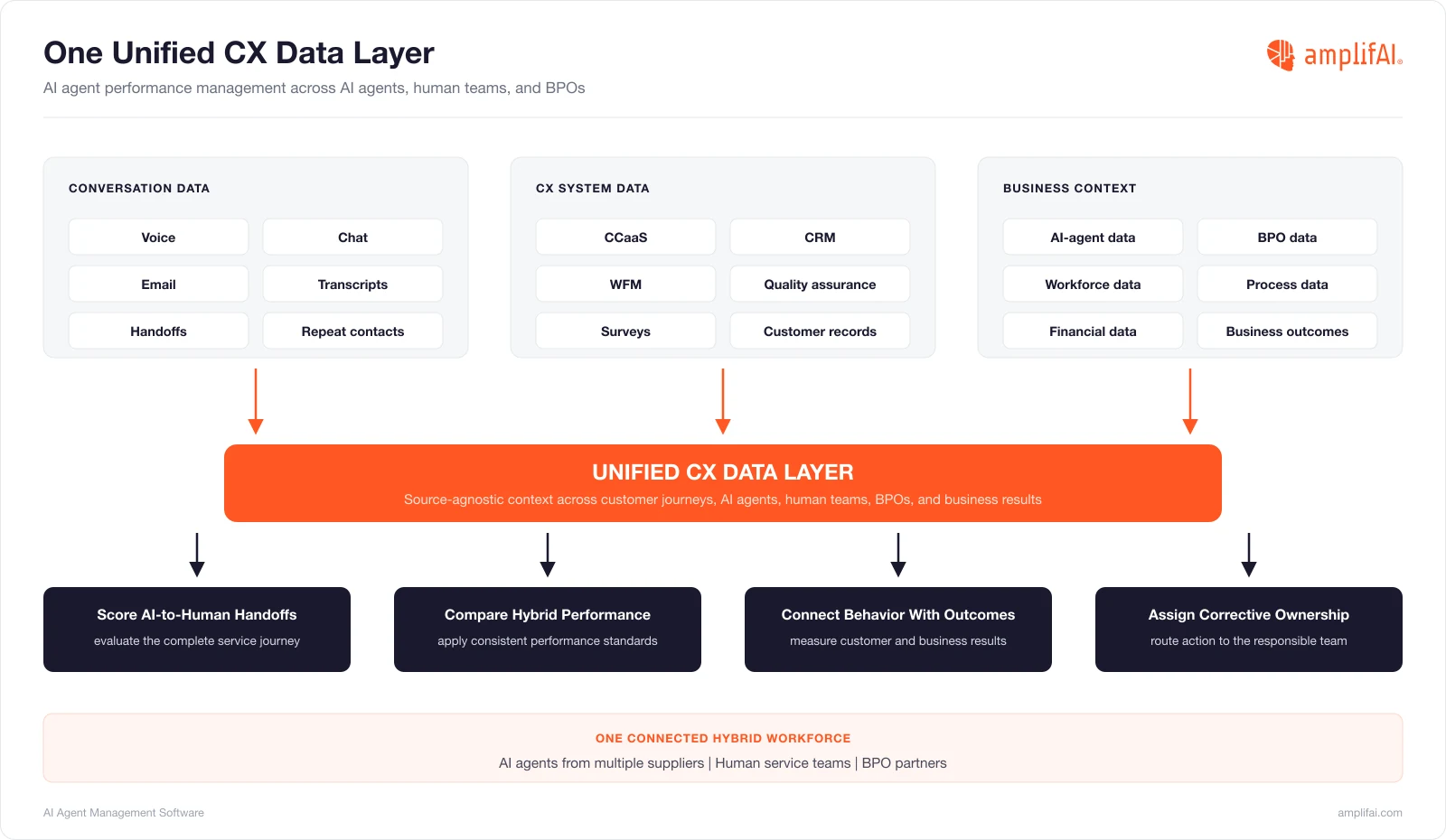
Full AI agent performance management depends on a unified CX data layer where conversation data captures what happened during an interaction, while CCaaS, CRM, WFM, QA, survey, AI-agent, BPO, customer, workforce, process, and financial data explain the surrounding conditions and business result. Source-agnostic data unification gives CX leaders the context to score AI-to-human handoffs, compare performance across the hybrid workforce, connect behavior with outcomes, and assign corrective action to the responsible team.
Corrective Actions and Outcome Measurement
Evaluation findings become measurable performance improvement when they feed into an accountable corrective workflow where quality teams can recalibrate a score, CX leaders can change routing, engineers can correct prompts or knowledge, and managers can coach human representatives, with post-intervention measurement confirming whether interventions improved customer and service performance.
AI Agent Management Software Features
Review AI agent management software features based on how each capability connects conversation evaluation with CX data, business standards, corrective workflows, and performance measurement across human and AI teams.
| AI Agent Management Software Feature | Description | Example Vendors |
|---|---|---|
| Source-Agnostic CX Data Unification | Unifies structured and unstructured data across CCaaS, CRM, WFM, QA, surveys, conversations, AI-agent systems, BPOs, homegrown applications, and business records. | AmplifAI |
| Human and AI Conversation Intelligence | Analyzes production conversations handled by human representatives and customer-facing AI agents across voice and digital channels for intent, sentiment, topics, behaviors, compliance, customer needs, and root causes. | AmplifAI, Cresta, NICE, Observe.AI |
| Cross-Vendor AI Agent Quality Evaluation | Applies shared quality standards, performance measures, scorecards, and reporting to customer-facing AI agents supplied by multiple vendors. | AmplifAI |
| Unified Human and AI Quality and Performance Standards | Applies the same company-defined scorecards, behaviors, KPIs, weights, auto-fails, thresholds, and evaluation rules across human representatives and customer-facing AI agents. | AmplifAI, Cresta, NICE |
| Full-Coverage Human and AI Interaction Evaluation | Automatically scores all human- and AI-handled customer interactions across voice and digital channels with traceable conversation evidence. | AmplifAI, Cresta, NICE, Observe.AI |
| AI Agent Quality and Reliability Evaluation | Scores goal completion, response accuracy, grounding, fabrication, policy adherence, escalation timing, context preservation, latency, action success, resolution, and repeat contact across customer-facing AI-agent interactions. | AmplifAI, Salesforce Agentforce, Kore.ai |
| Independent AI Agent Testing and Regression Assurance | Tests customer-facing AI agents across realistic voice and digital service scenarios using business-defined acceptance criteria, repeatable test suites, release validation, and continuous regression monitoring before and after deployment changes. | Cyara |
| Human-in-the-Loop Calibration and Evaluation Evidence | Aligns automated human and AI interaction scores with human judgment through transcript evidence, evaluator review, calibration, disputes, approvals, and audit history. | AmplifAI, Cresta, NICE |
| Customer Journey and AI-to-Human Handoff Scoring | Scores AI service, transfer quality, context preservation, human service, repeat contact, and final resolution across connected customer journeys. | AmplifAI |
| Hybrid Workforce and Partner Performance Comparison | Compares human teams, AI agents, BPOs, internal sites, channels, and AI suppliers using consistent customer, quality, service, productivity, and cost measures. | AmplifAI |
| Customer, Service, and Financial Outcome Intelligence | Connects conversation behaviors, process failures, and service gaps with CSAT, FCR, compliance, cost, resolution, retention, productivity, and repeat contact. | AmplifAI, Cresta, NICE, Observe.AI |
| Role-Based Corrective Workflows and Next Best Actions | Routes coaching, quality reviews, service-process tasks, and AI-agent corrections to responsible roles with priorities, owners, due dates, and follow-up actions. | AmplifAI |
| Corrective Action Effectiveness Measurement | Measures performance after human coaching and AI-agent corrections, including prompt, knowledge, routing, and deployment changes, to verify whether each intervention improved customer, service, and business outcomes. | AmplifAI |
| Prioritize AI agent management software features based on your data sources, workforce mix, quality standards, corrective workflows, and performance goals. | ||
AI Agent Management Software Evaluation Criteria
Evaluate AI agent management software against your contact center size, AI-agent portfolio, workforce model, data environment, quality program, internal ownership, security requirements, and budget. Match vendor capabilities to your quality evaluation, performance management, governance, testing, and corrective action requirements.
| AI Agent Management Software Evaluation Criteria | Why It Matters |
|---|---|
| Management Scope and Type Fit | Start with AI-agent quality, performance, governance, and testing requirements to determine whether one software type or a coordinated combination can support accountability across quality, CX, enterprise architecture, and testing teams. |
| Contact Center Size and Service Complexity | Match deployment requirements to interaction volume, human and AI agent counts, languages, channels, business units, regions, BPO relationships, and internal administration capacity. Multi-site, multilingual, and outsourced contact centers require deeper data integration, governance, configuration, reporting, and support. |
| AI Agent Portfolio and Vendor Coverage | List AI agents already in production, suppliers under consideration, customer-service channels, use cases, and expected expansion to determine whether vendor-native AI agent management fits a single AI environment or multi-vendor portfolios require consistent oversight across AI-agent environments and suppliers. |
| Feature Priorities and Use Cases | Prioritize features against current service requirements, assigning weight based on named users, dependent workflows, and supported business decisions. Named use cases keep feature comparisons grounded in current processes and measurable outcomes. |
| Data Environment and Integration Requirements | Map CCaaS, CRM, WFM, QA, survey, interaction, BPO, AI-agent, and internal data sources before comparing integration claims. Review each integration for data direction, refresh frequency, historical depth, custom-source support, identity matching, governance, and implementation ownership. |
| Quality Program and Evaluation Control | Document scorecards, behaviors, KPIs, auto-fails, calibration rules, evaluator roles, dispute processes, evidence requirements, and audit obligations. Vendor fit depends on how much control your QA and CX teams retain over standards used for human and AI evaluation. |
| Workflow and Organizational Fit | Identify who receives performance findings, who completes coaching or technical corrections, who approves changes, and who verifies results. Review role-based access, task ownership, notifications, existing task-management, ticketing, or case-management software, and manager capacity so AI agent management software fits current service responsibilities. |
| Implementation and Ongoing Administration | Compare data preparation, integration requirements, configuration, scorecard setup, testing, training, launch support, and ongoing administration. Internal capacity and vendor support shape deployment pace, maintenance requirements, and scoring accuracy after launch. |
| Security, Compliance, and Governance | Review data access, retention, residency, model use, audit logs, permissions, PII handling, regulatory controls, and approval workflows against your security and compliance requirements, including how AI agent management software connects conversation, workforce, customer, process, and financial data governed by different teams. |
| Reporting, Outcomes, and Executive Visibility | Define which decisions AI agent management reporting must support across QA review, engineering correction, BPO oversight, cost analysis, and executive reporting, while confirming each report connects interventions with customer, service, compliance, workforce, and financial outcomes at a useful cadence. |
| Vendor Expertise, Support, and Roadmap | Assess implementation expertise, customer success coverage, escalation paths, product documentation, release practices, and roadmap alignment. Request references from contact centers with comparable size, technology, AI-agent use cases, and service complexity. |
| Pricing and Total Cost | Compare pricing units, minimum commitments, implementation fees, integration costs, professional services, storage, usage, model charges, and support tiers. Model total cost against interaction volume, AI-agent count, human seats, data sources, and planned expansion. |
| Choose AI agent management software that fits your contact center environment, supports planned AI-agent growth, and gives responsible teams enough control to act on performance findings. | |
Best AI Agent Management Software for Customer Service (2026)
The best AI agent management software vendors of 2026 are ranked by coverage across software types, features, and evaluation criteria for customer service. Each vendor review includes type classification, a capability breakdown, best-fit use cases, and considerations.
Editor's note: Vendor reviews apply software types, features, and evaluation criteria defined in this guide to publicly available product information, with rankings updated as capabilities change and new vendors emerge.
1. AmplifAI AI Agent Management Software
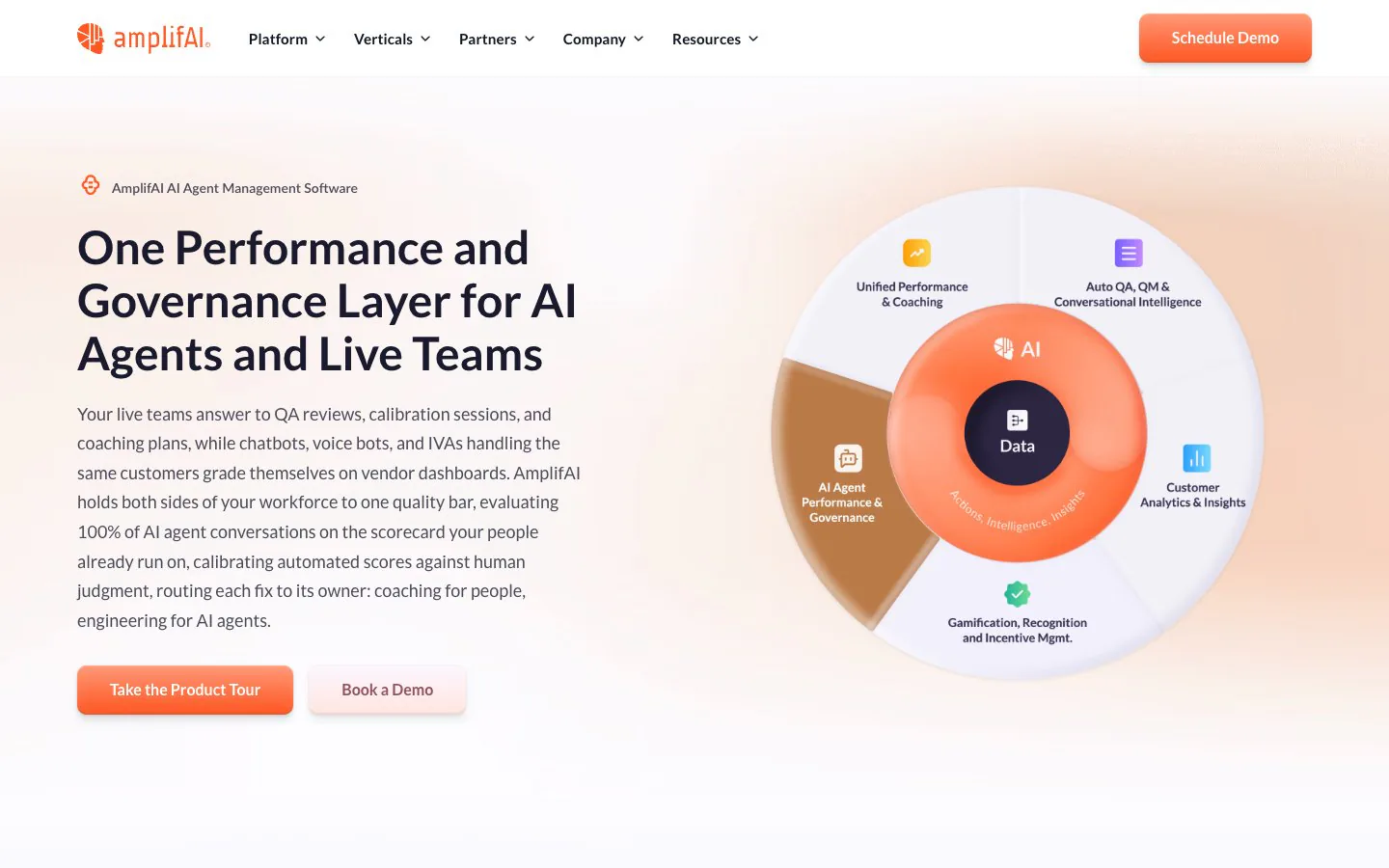
AmplifAI ranked #1 for AI agent management software is a unified CX performance management and conversation intelligence suite evaluating 100% of AI- and human-handled customer interactions across voice and digital channels, built upon a source-agnostic data foundation spanning 150+ sources, including CCaaS, CRM, WFM, QA, surveys, AI agents, and business records. AmplifAI applies shared quality and performance standards across AI vendors, human teams, BPOs, channels, and customer journeys, feeding findings into role-based next best actions for teams responsible for prompts, knowledge, routing, quality, and coaching, then measuring whether those changes improved customer service performance.
AmplifAI won Automation Solution of the Year at the 2026 CCW Excellence Awards, named a Leading provider in the 2026 CMP Research Prism for Automated QA/QM.
AmplifAI AI Agent Management Software Types
| AI Agent Management Software Type | Description | AmplifAI Classification |
|---|---|---|
| Unified CX Performance Management | Unifies CX data for human and AI performance management. | ✅ |
| Conversation Intelligence and Quality Management | Evaluates human and AI conversations through conversation intelligence and quality management. | ✅ |
| CCaaS-Native Management | Manages human and AI service performance within one CCaaS environment. | − |
| AI Agent Platform-Native Management | Manages customer-service AI agents through native build and deployment controls. | − |
| Independent Testing and Assurance | Tests customer-service AI agents across suppliers before and after deployment. | − |
AmplifAI AI Agent Management Software Features
| AI Agent Management Software Feature | AI Agent Management Software Feature Details | AmplifAI Capability |
|---|---|---|
| Source-Agnostic CX Data Unification | Unifies CX data across customer, workforce, conversation, AI-agent, process, and business sources. | ✅ |
| Human and AI Conversation Intelligence | Analyzes production human and AI conversations across voice and digital channels. | ✅ |
| Cross-Vendor AI Agent Quality Evaluation | Evaluates AI agents from multiple suppliers through shared quality standards. | ✅ |
| Unified Human and AI Quality and Performance Standards | Applies the same quality and performance standards across human and AI agents. | ✅ |
| Full-Coverage Human and AI Interaction Evaluation | Scores all human- and AI-handled customer interactions with traceable evidence. | ✅ |
| AI Agent Quality and Reliability Evaluation | Scores customer-facing AI-agent quality, reliability, escalation, and resolution. | ✅ |
| Independent AI Agent Testing and Regression Assurance | Tests AI agents through independent simulations, release validation, and regression monitoring. | ❌ |
| Human-in-the-Loop Calibration and Evaluation Evidence | Aligns automated human and AI scores with human judgment and evaluation evidence. | ✅ |
| Customer Journey and AI-to-Human Handoff Scoring | Scores AI service, transfers, context, human service, repeat contact, and resolution. | ✅ |
| Hybrid Workforce and Partner Performance Comparison | Compares human, AI, BPO, site, channel, and supplier performance. | ✅ |
| Customer, Service, and Financial Outcome Intelligence | Connects conversation behaviors and process failures with customer, service, and financial outcomes. | ✅ |
| Role-Based Corrective Workflows and Next Best Actions | Routes prioritized coaching, reviews, tasks, and AI-agent corrections to responsible roles. | ✅ |
| Corrective Action Effectiveness Measurement | Measures whether human coaching and AI-agent corrections improved performance. | ✅ |
Standout Features and Capabilities of AmplifAI
- Source-Agnostic CX Data Unification: Unifies structured and unstructured data from 150+ sources across CCaaS, CRM, WFM, QA, surveys, conversations, AI-agent environments, BPOs, homegrown applications, and business records in one CX performance layer powering human and AI conversation intelligence.
- Unified Human and AI Quality and Performance Standards: Applies company-defined scorecards, behaviors, KPIs, weights, auto-fails, thresholds, and evaluation rules across human and AI agents, with quality management and calibration aligning automated scores against human judgment.
- Cross-Vendor AI Agent Quality Evaluation: Evaluates customer-facing AI agents from multiple suppliers against shared quality standards, giving CX leaders independent performance visibility across the AI-agent portfolio.
- Customer Journey and AI-to-Human Handoff Scoring: Scores AI service, transfer quality, context preservation, human service, repeat contact, and final resolution across connected customer journeys.
- Role-Based Corrective Workflows and Next Best Actions: Routes coaching, quality reviews, service-process tasks, and AI-agent corrections to responsible roles with priorities, owners, due dates, and follow-up actions.
- Corrective Action Effectiveness Measurement: Measures performance after human coaching and prompt, knowledge, routing, or deployment changes, verifying whether each corrective action improved customer, service, and business outcomes.
Best Fit: Who Should Use AmplifAI
- Enterprise, mid-market, and BPO contact centers managing deployed AI agents alongside human service teams.
- Regulated contact centers in healthcare, financial services, and collections that need quality and compliance evaluation across 100% of human and AI interactions.
- CX, QA, and performance teams that need AI-agent findings connected to prompt changes, knowledge updates, routing corrections, quality reviews, and coaching actions.
- Contact centers using multiple AI-agent suppliers that need one performance layer for the full hybrid workforce.
AmplifAI Considerations
- Smaller contact centers in one AI-agent environment may not require source-agnostic data unification or role-based corrective workflows.
- AmplifAI manages deployed AI agents, while CCaaS infrastructure, AI-agent creation, and deployment controls remain with your existing providers.
- Independent simulations, reusable test suites, release validation, and regression monitoring require a dedicated testing and assurance product alongside AmplifAI.
AmplifAI AI Agent Management Software Overview
AmplifAI AI agent management software is built for contact centers that need AI-agent quality evaluation connected to accountable corrective action and measurable customer-service outcomes. For enterprise contact centers and BPOs, AmplifAI brings customer-facing AI agents from multiple suppliers and live teams into one CX performance model, managing the full hybrid workforce from a unified data foundation.
Speak to the #1 AI Agent Management Software Vendor
2. Cresta AI Agent Management Software
Cresta AI agent management software applies conversation intelligence and quality management to conversations handled by human service teams and Cresta AI Agent. Contact centers using Cresta AI Agent can evaluate human and AI conversations through shared quality standards, then test, deploy, monitor, and improve the AI agent within the Cresta product environment.
Cresta AI Agent Management Software Types
| AI Agent Management Software Type | Description | Cresta Classification |
|---|---|---|
| Unified CX Performance Management | Unifies CX data for human and AI performance management. | − |
| Conversation Intelligence and Quality Management | Evaluates human and AI conversations through conversation intelligence and quality management. | ✅ |
| CCaaS-Native Management | Manages human and AI service performance within one CCaaS environment. | − |
| AI Agent Platform-Native Management | Manages customer-service AI agents through native build and deployment controls. | ✅ |
| Independent Testing and Assurance | Tests customer-service AI agents across suppliers before and after deployment. | − |
Cresta AI Agent Management Software Features
| AI Agent Management Software Feature | AI Agent Management Software Feature Details | Cresta Capability |
|---|---|---|
| Source-Agnostic CX Data Unification | Unifies CX data across customer, workforce, conversation, AI-agent, process, and business sources. | ❌ |
| Human and AI Conversation Intelligence | Analyzes production human and AI conversations across voice and digital channels. | ✅ |
| Cross-Vendor AI Agent Quality Evaluation | Evaluates AI agents from multiple suppliers through shared quality standards. | ❌ |
| Unified Human and AI Quality and Performance Standards | Applies the same quality and performance standards across human and AI agents. | ✅ |
| Full-Coverage Human and AI Interaction Evaluation | Scores all human- and AI-handled customer interactions with traceable evidence. | ✅ |
| AI Agent Quality and Reliability Evaluation | Scores customer-facing AI-agent quality, reliability, escalation, and resolution. | ⚠️ |
| Independent AI Agent Testing and Regression Assurance | Tests AI agents through independent simulations, release validation, and regression monitoring. | ❌ |
| Human-in-the-Loop Calibration and Evaluation Evidence | Aligns automated human and AI scores with human judgment and evaluation evidence. | ✅ |
| Customer Journey and AI-to-Human Handoff Scoring | Scores AI service, transfers, context, human service, repeat contact, and resolution. | ❌ |
| Hybrid Workforce and Partner Performance Comparison | Compares human, AI, BPO, site, channel, and supplier performance. | ❌ |
| Customer, Service, and Financial Outcome Intelligence | Connects conversation behaviors and process failures with customer, service, and financial outcomes. | ✅ |
| Role-Based Corrective Workflows and Next Best Actions | Routes prioritized coaching, reviews, tasks, and AI-agent corrections to responsible roles. | ❌ |
| Corrective Action Effectiveness Measurement | Measures whether human coaching and AI-agent corrections improved performance. | ⚠️ |
Standout Features and Capabilities of Cresta
- Conversation Intelligence: Analyzes conversations handled by human service teams and Cresta AI Agent for behaviors, sentiment, compliance, root causes, and outcomes.
- Custom Scorecards and Evaluator Calibration: Supports human review, scoring consistency, appeals, assignments, and conversation evidence for human service teams and Cresta AI Agent.
- AI Agent Lifecycle Management: Builds, tests, deploys, monitors, and improves Cresta AI Agent inside the Cresta product environment.
Best Fit: Who Should Use Cresta
- Enterprise contact centers already using Cresta Conversation Intelligence or Quality Management.
- Customer service teams building and deploying Cresta AI Agent that want native testing, monitoring, and optimization.
- QA teams that need full-coverage evaluation across conversations handled by human service teams and Cresta AI Agent.
Cresta Considerations
- Cresta centers quality management on conversation records and selected integrations, while source-agnostic CX data unification requires additional software.
- AI-agent testing, deployment, monitoring, and optimization remain native to Cresta AI Agent, while multi-vendor portfolios require separate evaluation and management coverage.
Cresta AI Agent Management Software Overview
Cresta AI agent management software is built for enterprise contact centers deploying Cresta AI Agent alongside human service teams. Organizations standardized on Cresta keep conversation quality and native AI-agent lifecycle controls in one vendor environment, while source-agnostic CX data unification and multi-vendor performance management require additional coverage.
Compare Cresta to AmplifAI for AI Agent Management Software
Compare Cresta Alternatives Across 9 Software Categories
3. NICE AI Agent Management Software
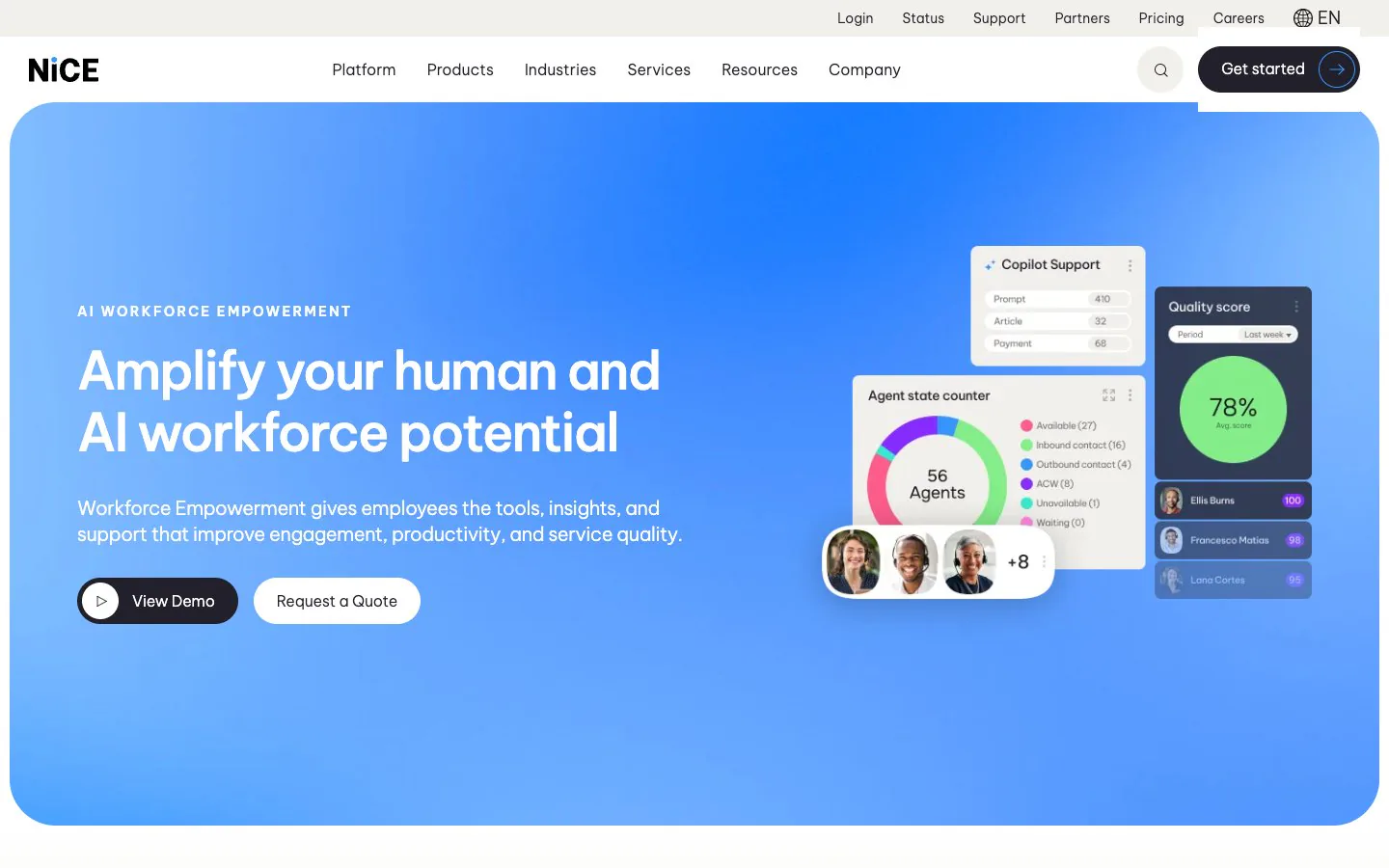
NICE AI agent management software is CCaaS-native, combining human and AI conversation intelligence, quality management, workforce management, and performance visibility inside CXone. Enterprise contact centers using NICE CXone Mpower Agents keep AI-agent creation, deployment, evaluation, and optimization within the NICE environment.
NICE AI Agent Management Software Types
| AI Agent Management Software Type | Description | NICE Classification |
|---|---|---|
| Unified CX Performance Management | Unifies CX data for human and AI performance management. | − |
| Conversation Intelligence and Quality Management | Evaluates human and AI conversations through conversation intelligence and quality management. | − |
| CCaaS-Native Management | Manages human and AI service performance within one CCaaS environment. | ✅ |
| AI Agent Platform-Native Management | Manages customer-service AI agents through native build and deployment controls. | ✅ |
| Independent Testing and Assurance | Tests customer-service AI agents across suppliers before and after deployment. | − |
NICE AI Agent Management Software Features
| AI Agent Management Software Feature | AI Agent Management Software Feature Details | NICE Capability |
|---|---|---|
| Source-Agnostic CX Data Unification | Unifies CX data across customer, workforce, conversation, AI-agent, process, and business sources. | ❌ |
| Human and AI Conversation Intelligence | Analyzes production human and AI conversations across voice and digital channels. | ✅ |
| Cross-Vendor AI Agent Quality Evaluation | Evaluates AI agents from multiple suppliers through shared quality standards. | ❌ |
| Unified Human and AI Quality and Performance Standards | Applies the same quality and performance standards across human and AI agents. | ✅ |
| Full-Coverage Human and AI Interaction Evaluation | Scores all human- and AI-handled customer interactions with traceable evidence. | ✅ |
| AI Agent Quality and Reliability Evaluation | Scores customer-facing AI-agent quality, reliability, escalation, and resolution. | ⚠️ |
| Independent AI Agent Testing and Regression Assurance | Tests AI agents through independent simulations, release validation, and regression monitoring. | ❌ |
| Human-in-the-Loop Calibration and Evaluation Evidence | Aligns automated human and AI scores with human judgment and evaluation evidence. | ✅ |
| Customer Journey and AI-to-Human Handoff Scoring | Scores AI service, transfers, context, human service, repeat contact, and resolution. | ❌ |
| Hybrid Workforce and Partner Performance Comparison | Compares human, AI, BPO, site, channel, and supplier performance. | ❌ |
| Customer, Service, and Financial Outcome Intelligence | Connects conversation behaviors and process failures with customer, service, and financial outcomes. | ✅ |
| Role-Based Corrective Workflows and Next Best Actions | Routes prioritized coaching, reviews, tasks, and AI-agent corrections to responsible roles. | ❌ |
| Corrective Action Effectiveness Measurement | Measures whether human coaching and AI-agent corrections improved performance. | ❌ |
Standout Features and Capabilities of NICE
- Native AI Agent Lifecycle Management: Builds, deploys, monitors, evaluates, and optimizes customer-service AI agents through native CCaaS controls.
- Human and AI Conversation Intelligence: Analyzes voice and digital conversations handled by human service teams and native AI agents for sentiment, intent, behaviors, compliance, root causes, and outcomes.
- Integrated Quality and Workforce Management: Connects full-coverage interaction evaluation, custom scorecards, evaluator calibration, workforce planning, and performance visibility across human service teams and native AI agents.
Best Fit: Who Should Use NICE
- Enterprise contact centers standardized on NICE CXone for routing, quality management, workforce management, and analytics.
- Customer service organizations building and deploying native AI agents alongside human service teams.
- CX and QA teams seeking full-coverage interaction evaluation, shared quality standards, and performance visibility within existing CCaaS infrastructure.
NICE Considerations
- Native AI-agent management centers on NICE and Cognigy AI agents within CXone, while external AI-agent suppliers require separate evaluation and management coverage.
- Suite consolidation connects NICE applications and selected third-party sources, while source-agnostic CX data unification across CCaaS providers, BPOs, AI-agent suppliers, and homegrown applications requires additional software.
NICE AI Agent Management Software Overview
NICE AI agent management software is built for enterprise contact centers extending existing CXone investments to customer-service AI agents. Organizations standardized on NICE can evaluate human and native AI service performance through one CCaaS suite, while multi-vendor AI-agent management and source-agnostic CX data unification require additional coverage.
Compare NICE to AmplifAI for AI Agent Management Software
Compare NICE Alternatives Across 13 Software Categories
4. Observe.AI AI Agent Management Software
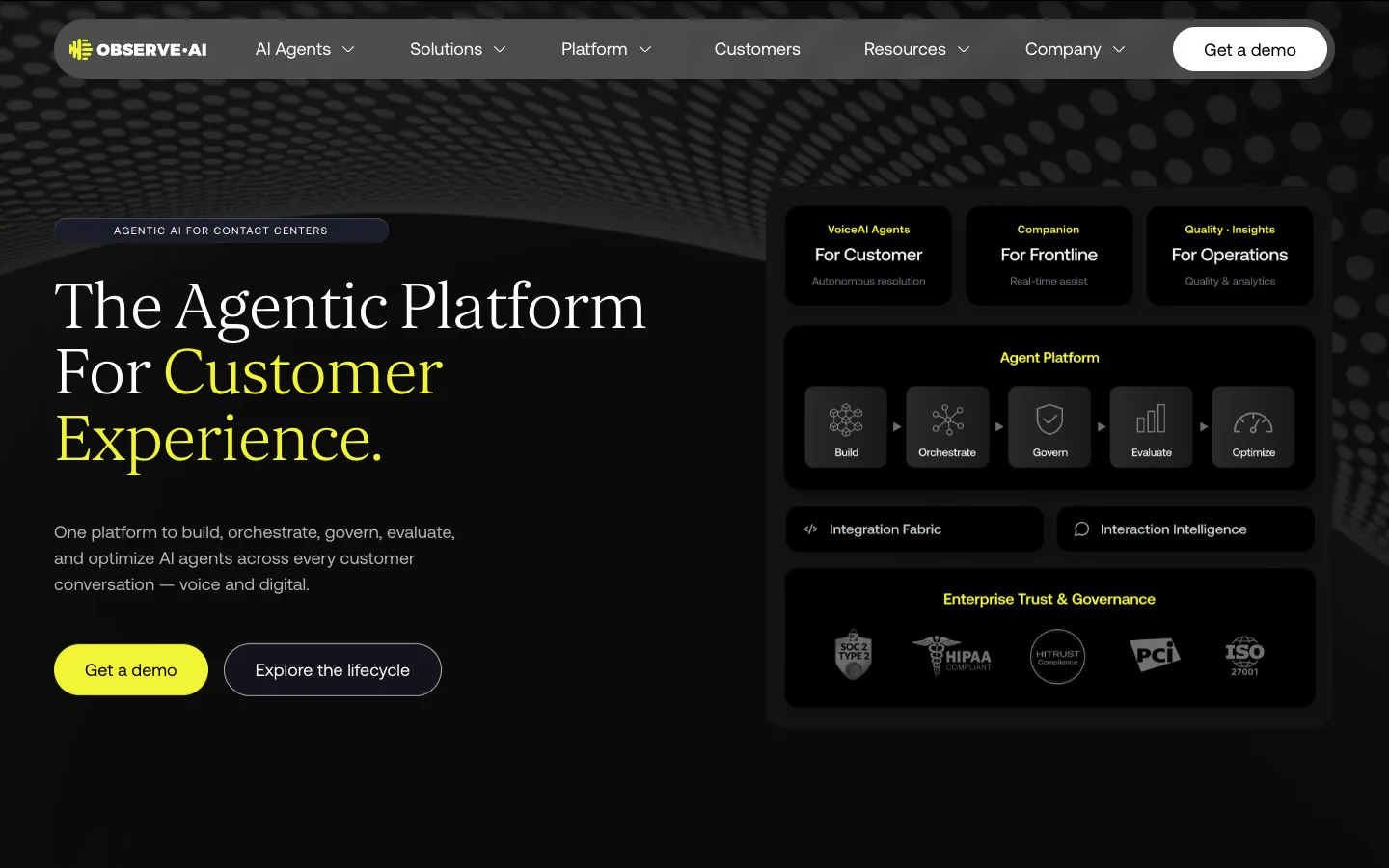
Observe.AI AI agent management software combines conversation intelligence and quality management for human service teams with native creation, testing, deployment, and optimization for Observe.AI agents. Contact centers using Observe.AI agents can evaluate 100% of human- and AI-handled conversations across voice and digital channels, connecting interaction behaviors and quality findings with customer and service outcomes.
Observe.AI AI Agent Management Software Types
| AI Agent Management Software Type | Description | Observe.AI Classification |
|---|---|---|
| Unified CX Performance Management | Unifies CX data for human and AI performance management. | − |
| Conversation Intelligence and Quality Management | Evaluates human and AI conversations through conversation intelligence and quality management. | ✅ |
| CCaaS-Native Management | Manages human and AI service performance within one CCaaS environment. | − |
| AI Agent Platform-Native Management | Manages customer-service AI agents through native build and deployment controls. | ✅ |
| Independent Testing and Assurance | Tests customer-service AI agents across suppliers before and after deployment. | − |
Observe.AI AI Agent Management Software Features
| AI Agent Management Software Feature | AI Agent Management Software Feature Details | Observe.AI Capability |
|---|---|---|
| Source-Agnostic CX Data Unification | Unifies CX data across customer, workforce, conversation, AI-agent, process, and business sources. | ❌ |
| Human and AI Conversation Intelligence | Analyzes production human and AI conversations across voice and digital channels. | ✅ |
| Cross-Vendor AI Agent Quality Evaluation | Evaluates AI agents from multiple suppliers through shared quality standards. | ❌ |
| Unified Human and AI Quality and Performance Standards | Applies the same quality and performance standards across human and AI agents. | ⚠️ |
| Full-Coverage Human and AI Interaction Evaluation | Scores all human- and AI-handled customer interactions with traceable evidence. | ✅ |
| AI Agent Quality and Reliability Evaluation | Scores customer-facing AI-agent quality, reliability, escalation, and resolution. | ⚠️ |
| Independent AI Agent Testing and Regression Assurance | Tests AI agents through independent simulations, release validation, and regression monitoring. | ❌ |
| Human-in-the-Loop Calibration and Evaluation Evidence | Aligns automated human and AI scores with human judgment and evaluation evidence. | ⚠️ |
| Customer Journey and AI-to-Human Handoff Scoring | Scores AI service, transfers, context, human service, repeat contact, and resolution. | ❌ |
| Hybrid Workforce and Partner Performance Comparison | Compares human, AI, BPO, site, channel, and supplier performance. | ❌ |
| Customer, Service, and Financial Outcome Intelligence | Connects conversation behaviors and process failures with customer, service, and financial outcomes. | ✅ |
| Role-Based Corrective Workflows and Next Best Actions | Routes prioritized coaching, reviews, tasks, and AI-agent corrections to responsible roles. | ❌ |
| Corrective Action Effectiveness Measurement | Measures whether human coaching and AI-agent corrections improved performance. | ❌ |
Standout Features and Capabilities of Observe.AI
- Human and AI Conversation Intelligence: Analyzes voice and digital conversations for intent, sentiment, entities, behaviors, compliance, customer needs, outcomes, and root causes across human service teams and native AI agents.
- Full-Coverage Interaction Evaluation: Evaluates 100% of human- and AI-handled conversations with scorecards, transcript evidence, Auto QA, and manual review.
- Native AI Agent Lifecycle Management: Builds, tests, deploys, governs, monitors, and improves customer-service AI agents using simulations, release gates, production feedback, and optimization controls.
Best Fit: Who Should Use Observe.AI
- Enterprise contact centers already using Observe.AI for conversation intelligence, Auto QA, quality management, or coaching.
- Customer service organizations building and deploying Observe.AI agents alongside human service teams.
- CX and QA teams prioritizing 100% interaction evaluation, transcript-linked evidence, and outcome analysis across human and AI conversations.
Observe.AI Considerations
- Native AI-agent testing, release controls, and optimization apply to Observe.AI agents, while external AI-agent suppliers require separate evaluation and lifecycle coverage.
- Human quality management and AI-agent evaluation share interaction intelligence, while identical scorecards, weights, auto-fails, thresholds, and one calibration process across both populations require additional coverage.
- Conversation, quality, customer-context, and outcome data remain centered on Observe.AI, while source-agnostic CX data unification, partner performance comparison, role-based corrective workflows, and intervention-level effectiveness measurement require additional software.
Observe.AI AI Agent Management Software Overview
Observe.AI AI agent management software is built for enterprise contact centers expanding an existing conversation intelligence and quality program to native AI agents. Organizations can evaluate 100% of human- and AI-handled conversations and connect interaction findings with customer and service outcomes, while source-agnostic CX data unification, multi-vendor AI-agent management, and role-based corrective actions require additional coverage.
Compare Observe.AI to AmplifAI for AI Agent Management Software
5. Kore.ai AI Agent Management Software
Kore.ai AI agent management software is AI-agent-platform-native, supporting lifecycle control from testing and deployment through production tracing, evaluation, optimization, and rollback for native agents. Kore.ai extends governance, monitoring, evaluation, and value measurement across external agent frameworks, while Quality AI manages human contact-center quality through a separate product layer.
Kore.ai AI Agent Management Software Types
| AI Agent Management Software Type | Description | Kore.ai Classification |
|---|---|---|
| Unified CX Performance Management | Unifies CX data for human and AI performance management. | − |
| Conversation Intelligence and Quality Management | Evaluates human and AI conversations through conversation intelligence and quality management. | − |
| CCaaS-Native Management | Manages human and AI service performance within one CCaaS environment. | − |
| AI Agent Platform-Native Management | Manages customer-service AI agents through native build and deployment controls. | ✅ |
| Independent Testing and Assurance | Tests customer-service AI agents across suppliers before and after deployment. | − |
Kore.ai AI Agent Management Software Features
| AI Agent Management Software Feature | AI Agent Management Software Feature Details | Kore.ai Capability |
|---|---|---|
| Source-Agnostic CX Data Unification | Unifies CX data across customer, workforce, conversation, AI-agent, process, and business sources. | ❌ |
| Human and AI Conversation Intelligence | Analyzes production human and AI conversations across voice and digital channels. | ❌ |
| Cross-Vendor AI Agent Quality Evaluation | Evaluates AI agents from multiple suppliers through shared quality standards. | ⚠️ |
| Unified Human and AI Quality and Performance Standards | Applies the same quality and performance standards across human and AI agents. | ❌ |
| Full-Coverage Human and AI Interaction Evaluation | Scores all human- and AI-handled customer interactions with traceable evidence. | ❌ |
| AI Agent Quality and Reliability Evaluation | Scores customer-facing AI-agent quality, reliability, escalation, and resolution. | ✅ |
| Independent AI Agent Testing and Regression Assurance | Tests AI agents through independent simulations, release validation, and regression monitoring. | ⚠️ |
| Human-in-the-Loop Calibration and Evaluation Evidence | Aligns automated human and AI scores with human judgment and evaluation evidence. | ❌ |
| Customer Journey and AI-to-Human Handoff Scoring | Scores AI service, transfers, context, human service, repeat contact, and resolution. | ❌ |
| Hybrid Workforce and Partner Performance Comparison | Compares human, AI, BPO, site, channel, and supplier performance. | ❌ |
| Customer, Service, and Financial Outcome Intelligence | Connects conversation behaviors and process failures with customer, service, and financial outcomes. | ⚠️ |
| Role-Based Corrective Workflows and Next Best Actions | Routes prioritized coaching, reviews, tasks, and AI-agent corrections to responsible roles. | ❌ |
| Corrective Action Effectiveness Measurement | Measures whether human coaching and AI-agent corrections improved performance. | ❌ |
Standout Features and Capabilities of Kore.ai
- Native AI Agent Lifecycle Management: Manages testing, deployment, production tracing, evaluation, optimization, versioning, rollout, and rollback for natively built agents.
- Cross-Framework Agent Governance: Registers externally built agents for inventory, monitoring, evaluation, policy oversight, and value tracking.
- AI Agent Quality and Reliability Evaluation: Scores safety, accuracy, task success, tool use, guardrails, handoffs, grounding, latency, errors, drift, cost, and outcomes through simulations and production traces.
Best Fit: Who Should Use Kore.ai
- Enterprise customer service organizations building and deploying Kore.ai agents for voice and digital channels.
- AI engineering and governance teams managing native and externally built agents across multiple frameworks.
- Teams prioritizing simulation-based evaluation, production tracing, safety and reliability scoring, version control, and rollback.
Kore.ai Considerations
- Quality AI scores human service representatives, while Agent Platform evaluates AI-agent sessions through a separate product layer. Shared standards and full-coverage evaluation across both populations require additional software.
- Kore.ai cross-framework capabilities center on enterprise AI governance, observability, evaluation, and value measurement, while unified customer-service performance management requires separate coverage for human teams, BPOs, customer journeys, corrective workflows, and business outcomes.
- Cross-framework evaluation and testing support external agents, while complete independent assurance across voice and digital simulations, customer-journey test suites, integration regression, and continuous production validation requires additional coverage.
Kore.ai AI Agent Management Software Overview
Kore.ai AI agent management software is built for enterprises managing native AI-agent lifecycles and broader agent governance across multiple frameworks. Customer service organizations can use Kore.ai for AI-agent testing, observability, quality evaluation, and lifecycle control, while unified hybrid-workforce performance management and source-agnostic CX data unification require additional coverage.
6. Salesforce Agentforce AI Agent Management Software
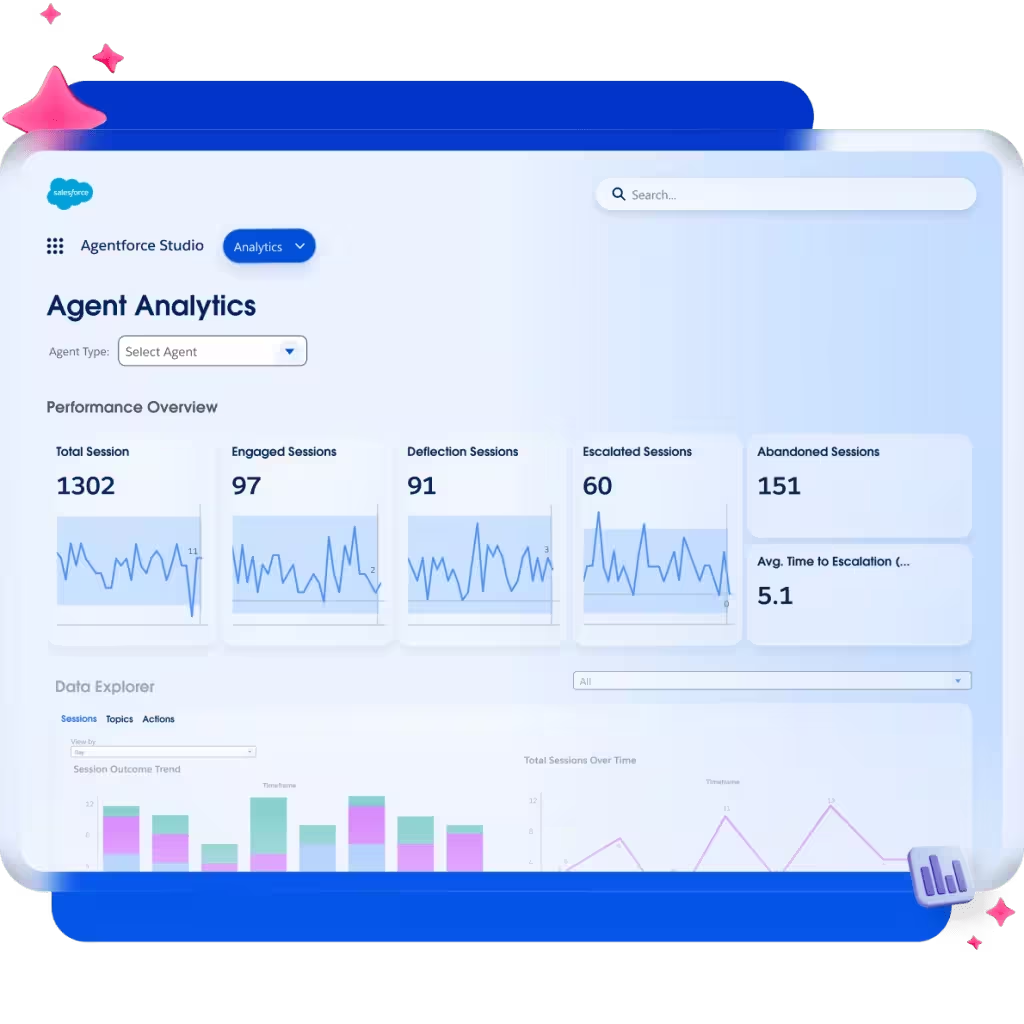
Salesforce Agentforce AI agent management software is CCaaS-native, combining voice and digital service, CRM data, workforce engagement, and quality management for human service teams with native AI-agent lifecycle controls inside Agentforce Contact Center. Customer service organizations building Agentforce agents use Testing Center and Observability to test release behavior, trace production sessions, apply custom scorers, monitor health, and guide optimization.
Salesforce Agentforce AI Agent Management Software Types
| AI Agent Management Software Type | Description | Salesforce Agentforce Classification |
|---|---|---|
| Unified CX Performance Management | Unifies CX data for human and AI performance management. | − |
| Conversation Intelligence and Quality Management | Evaluates human and AI conversations through conversation intelligence and quality management. | − |
| CCaaS-Native Management | Manages human and AI service performance within one CCaaS environment. | ✅ |
| AI Agent Platform-Native Management | Manages customer-service AI agents through native build and deployment controls. | ✅ |
| Independent Testing and Assurance | Tests customer-service AI agents across suppliers before and after deployment. | − |
Salesforce Agentforce AI Agent Management Software Features
| AI Agent Management Software Feature | AI Agent Management Software Feature Details | Salesforce Agentforce Capability |
|---|---|---|
| Source-Agnostic CX Data Unification | Unifies CX data across customer, workforce, conversation, AI-agent, process, and business sources. | ❌ |
| Human and AI Conversation Intelligence | Analyzes production human and AI conversations across voice and digital channels. | ⚠️ |
| Cross-Vendor AI Agent Quality Evaluation | Evaluates AI agents from multiple suppliers through shared quality standards. | ❌ |
| Unified Human and AI Quality and Performance Standards | Applies the same quality and performance standards across human and AI agents. | ❌ |
| Full-Coverage Human and AI Interaction Evaluation | Scores all human- and AI-handled customer interactions with traceable evidence. | ❌ |
| AI Agent Quality and Reliability Evaluation | Scores customer-facing AI-agent quality, reliability, escalation, and resolution. | ✅ |
| Independent AI Agent Testing and Regression Assurance | Tests AI agents through independent simulations, release validation, and regression monitoring. | ❌ |
| Human-in-the-Loop Calibration and Evaluation Evidence | Aligns automated human and AI scores with human judgment and evaluation evidence. | ❌ |
| Customer Journey and AI-to-Human Handoff Scoring | Scores AI service, transfers, context, human service, repeat contact, and resolution. | ❌ |
| Hybrid Workforce and Partner Performance Comparison | Compares human, AI, BPO, site, channel, and supplier performance. | ❌ |
| Customer, Service, and Financial Outcome Intelligence | Connects conversation behaviors and process failures with customer, service, and financial outcomes. | ⚠️ |
| Role-Based Corrective Workflows and Next Best Actions | Routes prioritized coaching, reviews, tasks, and AI-agent corrections to responsible roles. | ❌ |
| Corrective Action Effectiveness Measurement | Measures whether human coaching and AI-agent corrections improved performance. | ❌ |
Standout Features and Capabilities of Salesforce Agentforce
- Generated Test Cases and Multi-Turn Simulations: Tests native AI agents against realistic customer-service scenarios and custom evaluation metrics before release.
- Production Session Tracing: Tracks native AI-agent topic and action sequences, latency, failures, escalations, resolution, and custom business measures after deployment.
- CRM-Grounded Customer Context: Grounds native AI-agent responses in customer records, service knowledge, and conversation history while preserving context through AI-to-human handoffs.
Best Fit: Who Should Use Salesforce Agentforce
- Enterprise contact centers already standardized on Salesforce CRM, Service Cloud, and Data 360.
- Customer service organizations building and deploying Agentforce agents alongside human service teams.
- AI and service teams prioritizing native testing, production session tracing, custom scoring, and CRM-grounded context within existing Salesforce infrastructure.
Salesforce Agentforce Considerations
- Agentforce Observability and Testing Center manage native AI agents, while external AI-agent suppliers require separate quality evaluation and lifecycle coverage.
- Human-service quality management and AI-agent evaluation remain distinct Salesforce capabilities, while shared standards, full-coverage evaluation, and measured corrective actions across both workforces require additional software.
- Data 360 harmonizes Salesforce and connected customer data for CRM context, while source-agnostic CX data unification across CCaaS, WFM, QA, BPO, external AI-agent suppliers, homegrown applications, and business sources requires additional coverage.
Salesforce Agentforce AI Agent Management Software Overview
Salesforce Agentforce AI agent management software is built for enterprises extending Salesforce customer data and service infrastructure to native AI agents. Organizations standardized on Salesforce can keep AI-agent testing, observability, and CRM context inside existing infrastructure, while shared human and AI performance management, multi-vendor quality evaluation, and source-agnostic CX data unification require additional coverage.
7. Cyara AI Agent Management Software
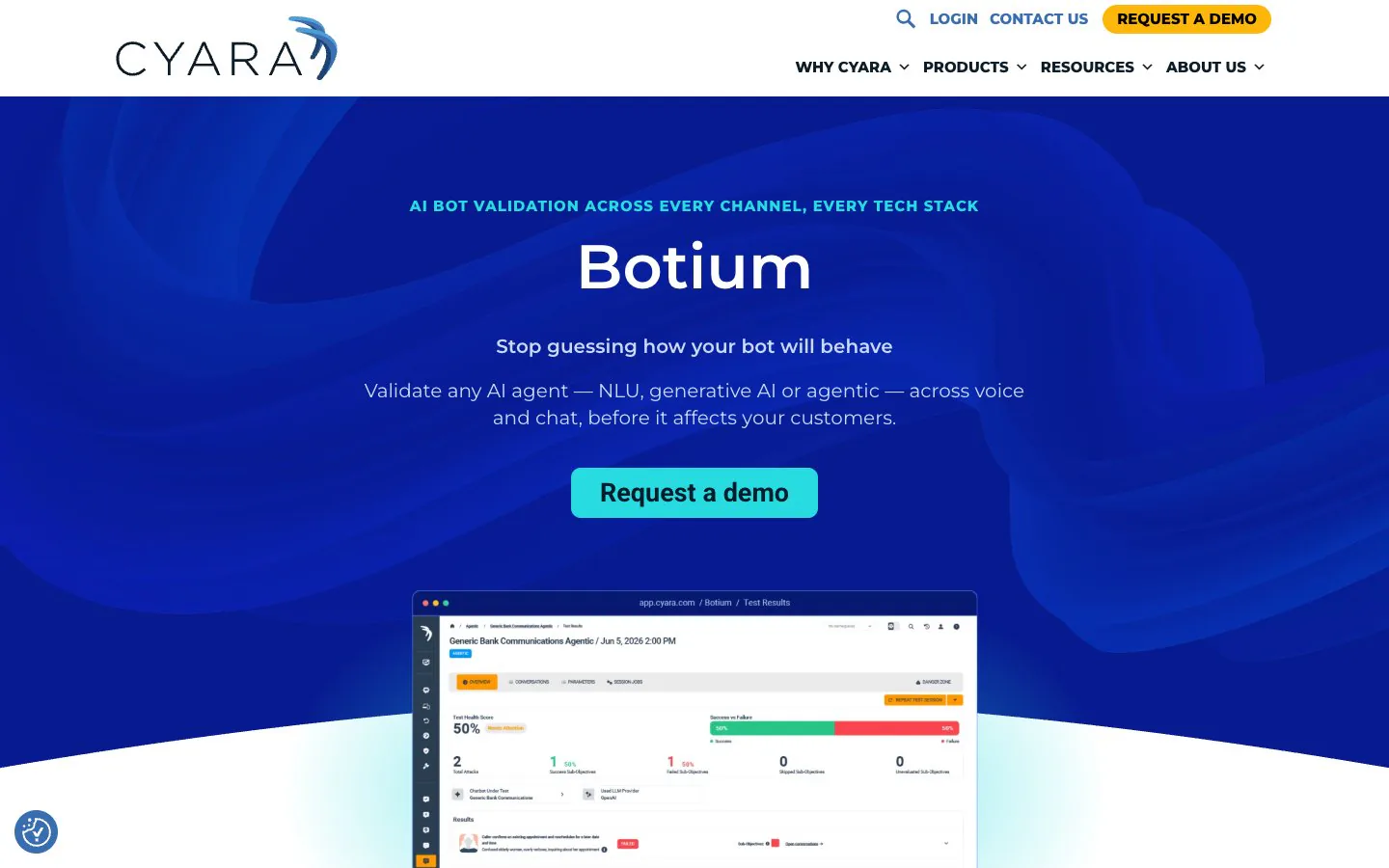
Cyara AI agent management software provides independent testing and assurance for customer-service AI agents on voice and digital channels. CX and quality teams use business-defined objectives, synthetic conversations, reusable test suites, release validation, regression monitoring, load testing, and production assurance to evaluate AI-agent behavior.
Cyara AI Agent Management Software Types
| AI Agent Management Software Type | Description | Cyara Classification |
|---|---|---|
| Unified CX Performance Management | Unifies CX data for human and AI performance management. | − |
| Conversation Intelligence and Quality Management | Evaluates human and AI conversations through conversation intelligence and quality management. | − |
| CCaaS-Native Management | Manages human and AI service performance within one CCaaS environment. | − |
| AI Agent Platform-Native Management | Manages customer-service AI agents through native build and deployment controls. | − |
| Independent Testing and Assurance | Tests customer-service AI agents across suppliers before and after deployment. | ✅ |
Cyara AI Agent Management Software Features
| AI Agent Management Software Feature | AI Agent Management Software Feature Details | Cyara Capability |
|---|---|---|
| Source-Agnostic CX Data Unification | Unifies CX data across customer, workforce, conversation, AI-agent, process, and business sources. | ❌ |
| Human and AI Conversation Intelligence | Analyzes production human and AI conversations across voice and digital channels. | ❌ |
| Cross-Vendor AI Agent Quality Evaluation | Evaluates AI agents from multiple suppliers through shared quality standards. | ⚠️ |
| Unified Human and AI Quality and Performance Standards | Applies the same quality and performance standards across human and AI agents. | ❌ |
| Full-Coverage Human and AI Interaction Evaluation | Scores all human- and AI-handled customer interactions with traceable evidence. | ❌ |
| AI Agent Quality and Reliability Evaluation | Scores customer-facing AI-agent quality, reliability, escalation, and resolution. | ⚠️ |
| Independent AI Agent Testing and Regression Assurance | Tests AI agents through independent simulations, release validation, and regression monitoring. | ✅ |
| Human-in-the-Loop Calibration and Evaluation Evidence | Aligns automated human and AI scores with human judgment and evaluation evidence. | ❌ |
| Customer Journey and AI-to-Human Handoff Scoring | Scores AI service, transfers, context, human service, repeat contact, and resolution. | ❌ |
| Hybrid Workforce and Partner Performance Comparison | Compares human, AI, BPO, site, channel, and supplier performance. | ❌ |
| Customer, Service, and Financial Outcome Intelligence | Connects conversation behaviors and process failures with customer, service, and financial outcomes. | ❌ |
| Role-Based Corrective Workflows and Next Best Actions | Routes prioritized coaching, reviews, tasks, and AI-agent corrections to responsible roles. | ❌ |
| Corrective Action Effectiveness Measurement | Measures whether human coaching and AI-agent corrections improved performance. | ❌ |
Standout Features and Capabilities of Cyara
- Synthetic Voice and Digital Testing: Simulates customer conversations across AI-agent suppliers, contact-center infrastructure, integrations, and backend paths before deployment.
- Release and Regression Assurance: Repeats business-defined test suites after prompt, model, routing, integration, or infrastructure changes.
- Production Assurance Monitoring: Samples live AI-agent conversations and alerts teams to regressions, failures, compliance risks, and service degradation after deployment.
Best Fit: Who Should Use Cyara
- Enterprise contact centers using customer-service AI agents from multiple suppliers across voice and digital channels.
- CX, QA, and engineering teams validating prompt, model, routing, integration, and infrastructure changes before release.
- Regulated or high-volume service environments requiring repeatable safety, compliance, load, regression, and production-assurance testing.
Cyara Considerations
- Cyara tests and monitors customer-service AI agents from external suppliers, while creation and deployment controls remain with existing AI-agent providers.
- Synthetic tests and sampled production monitoring validate AI-agent behavior, while full-population evaluation across actual human and AI interactions requires additional software.
- Independent assurance focuses on agent behavior, customer journeys, integrations, infrastructure, load, and regressions, while source-agnostic CX data unification, unified quality standards, role-based corrective workflows, and hybrid-workforce performance management require separate coverage.
Cyara AI Agent Management Software Overview
Cyara AI agent management software is built for contact centers that need independent AI-agent testing, regression assurance, and production monitoring across voice and digital service. Cyara complements AI-agent providers and unified performance-management software by validating release behavior before deployment and monitoring reliability after changes.
How to Choose AI Agent Management Software
Choosing AI agent management software starts with how customer-facing AI agents are deployed, which suppliers and environments support each deployment, how customers move between AI and human service, and who is accountable for correcting AI-agent performance.
Conversation intelligence types evaluate human and AI interactions, while native AI agent management types keep testing, deployment, and oversight inside existing CCaaS or AI-agent provider environments. Independent AI agent quality assurance tests AI-agent releases across suppliers, while unified AI agent management software like AmplifAI applies conversation intelligence and quality management across AI agents, human teams, BPOs, channels, and customer journeys on source-agnostic CX data, routing findings into role-based next best actions and measuring customer-service outcomes after changes.
Use the following decision criteria when reviewing AI agent management software vendors:
- Management Responsibility: Match each AI-agent quality, performance, governance, testing, corrective action, and outcome-measurement requirement to conversation intelligence and quality management, native AI agent management, independent assurance, or unified CX performance management, while confirming clear ownership when requirements span more than one software type.
- AI-Agent Portfolio: Inventory production AI agents, suppliers, channels, use cases, languages, and homegrown deployments to determine whether native AI agent management within one provider environment covers your portfolio or consistent evaluation must extend across multiple suppliers.
- Hybrid Workforce Coverage: Confirm whether a vendor supports shared standards with performance comparisons extending across AI agents, human teams, BPOs, sites, channels, and handoffs when customers move between service teams and suppliers.
- Data and Evaluation Foundation: Evaluate how each AI agent management software vendor connects CCaaS, CRM, WFM, QA, survey, conversation, AI-agent, and business sources, while confirming whether human and AI evaluations use the same scorecards, behaviors, KPIs, weights, auto-fails, thresholds, calibration, and evidence.
- Corrective Action and Measurement: Confirm whether the AI agent management software vendor routes AI-agent or human-agent performance findings to an accountable role with a required response, deadline, and follow-up. AI-agent findings should drive prompt, knowledge, routing, integration, or deployment changes, while human-agent findings should drive quality review or coaching, with the ability to measure customer, service, and business results post intervention.
If you need assistance conducting a full comparison of AI agent management software vendors, speak to a CX leader at AmplifAI.
Speak to a CX Leader at AmplifAI
Customer Service and Support Software Buyer’s Guides
Our CX specialists at AmplifAI research and evaluate customer service and support software for CX leaders, AI program owners, quality teams, workforce planners, and contact center decision-makers. Alongside this guide to AI agent management software, AmplifAI’s buyer’s guides compare vendors across the broader customer service and support software market, covering category features, best-fit use cases, key considerations, and evaluation criteria for developing your shortlist.
| Software Buyer's Guide | What It Covers | Top Vendors |
|---|---|---|
| Call Center Software | Complete taxonomy of call center software categories with top vendors for customer service and support | AmplifAI, NICE, Genesys, Verint, CallMiner |
| Contact Center as a Service (CCaaS) Software | Full review and comparison of the best Contact Center as a Service (CCaaS) software in 2026 | NICE CXone, Genesys Cloud CX, Five9, Zoom, Talkdesk |
| Call Center CRM Software | Full review and comparison of the best call center CRM software in 2026 | Salesforce Service Cloud, Microsoft Dynamics 365, HubSpot Service Hub, Zoho CRM, Oracle CX |
| Contact Center AI Software | Full review and comparison of the best contact center AI software in 2026 | AmplifAI, Dialpad, Five9, Genesys, NICE |
| AI Agent Management Software | Full review and comparison of the best AI agent management software for customer service in 2026 | AmplifAI, Cresta, NICE, Observe.AI, Kore.ai |
| Call Center Workforce Management Software | Full review and comparison of the best call center workforce management software in 2026 | NICE CXone, Verint, Genesys Cloud, Assembled, Five9 |
| Call Center Speech Analytics Software | Full review and comparison of the best call center speech analytics software in 2026 | AmplifAI, CallMiner, NICE, Observe.AI, Verint |
| Call Center Analytics Software | Full review and comparison of the best call center analytics software in 2026 | AmplifAI, NICE CXone, Verint, Genesys Cloud, CallMiner |
| Call Center QA Software | Full review and comparison of the best call center QA software in 2026 | AmplifAI, CallMiner, Dialpad, NICE, Observe.AI |
| Call Center Performance Management Software | Full review and comparison of the best call center performance management software in 2026 | AmplifAI, Genesys, NICE, Talkdesk, Verint |
| Call Center Coaching Software | Full review and comparison of the best call center coaching software in 2026 | AmplifAI, Centrical, Cresta, EvaluAgent, Observe.AI |
| Call Center Gamification Software | Full review and comparison of the best call center gamification software in 2026 | AmplifAI, Centrical, Cresta, Genesys, NICE |
| Customer Insights Software | Full review and comparison of the best customer insights software in 2026 | AmplifAI, CallMiner, Cresta, Observe.AI, Tethr |
AI Agent Management Software FAQs
What is AI agent management software?
AI agent management software evaluates and improves deployed customer-facing AI agents across voice and digital channels. Customer-service teams use AI agent management software to apply shared quality and performance standards across AI agents and human teams, route findings into accountable corrective actions, and measure results after changes.
What's the difference between AI agent management and AI agent monitoring?
AI agent monitoring tracks production behavior such as availability, latency, errors, task completion, escalations, and conversation outcomes, while AI agent management evaluates monitoring evidence against quality and performance standards, assigns findings to accountable roles, routes corrective actions across prompts, knowledge, routing, or service processes, and measures results after changes.
Can AI agent management software evaluate AI agents from multiple vendors alongside human teams?
Yes, but cross-vendor AI-agent evaluation depends on the type of AI agent management software. Native AI agent management applies to AI agents built within one provider environment, while unified CX performance management software like AmplifAI evaluates customer-facing AI agents from multiple suppliers alongside human teams and BPOs using shared standards, connected CX data, role-based next best actions, and outcome measurement.
Do contact centers need more than one type of AI agent management software?
Contact centers may need more than one type of AI agent management software when customer-facing AI agents span multiple provider environments. Native AI-agent lifecycle controls support development and release within each provider environment, while unified CX performance management like AmplifAI applies shared quality standards across AI agents, human teams, and BPOs, routes corrective actions to accountable roles, and measures whether changes improve customer-service outcomes.