
9 Best Call Center Speech Analytics Software (2026)

- Published:
- Updated:
- Authored by
-
 Richard James Director of Organic Growth and CX
 - Reviewed by
-
 Sean Minter Founder, CEO
Call center speech analytics software transcribes and analyzes voice conversations to identify sentiment, intent, topics, call reasons, compliance risks, agent behaviors,and customer experience patterns. CX leaders, QA and compliance teams use speech analytics software to understand why customers call, and evaluate interaction quality to determine where coaching or service changes are needed.
Transcription and sentiment detection are the baseline capabilities for call center speech analytics software in 2026, with vendors differentiating on speech analysis accuracy, conversation and data coverage, and whether speech analytics findings feed into quality, compliance, performance and coaching workflows used by CX leaders, quality and compliance teams, and frontline trainers.
The best call center speech analytics software vendors of 2026 in our review are AmplifAI, CallMiner, NICE, Verint, Observe.AI, Genesys, Cresta, Convin, and Level AI. Our team of CX specialists ranked each vendor by coverage across speech analytics software types, features, and evaluation criteria.
Before selecting a speech analytics software vendor evaluate:
- Types of Call Center Speech Analytics Software: Unified speech analytics, post-call speech analytics, real-time speech analytics, predictive speech analytics, and conversation intelligence.
- Call Center Speech Analytics Software Features: Transcription accuracy, sentiment analysis, topic detection, compliance monitoring, Auto QA integration, coaching priorities, real-time guidance, unified data integration, role-based reporting, and outcome measurement.
- Call Center Speech Analytics Software Limitations: Siloed point solutions, CCaaS-native ecosystem limits, disconnected workflows, manual follow-up, and speech insights without measurable action.
- Evaluation Criteria: Data integration, analytics coverage, workflow connection, AI accuracy, scalability, ROI, and implementation fit.
Top Pick for 2026: AmplifAI ranks #1 on our list of call center speech analytics software for turning conversation data into action by feeding findings from transcription, sentiment analysis, topic detection, intent analysis, call reason analysis, root cause analysis, and behavioral pattern detection into Auto QA scoring, coaching priorities, compliance monitoring, customer intelligence, performance visibility, and role-based dashboards. AmplifAI brings structured and unstructured data from CCaaS, CRM, WFM, QA, surveys, and legacy systems into one unified, source-agnostic CX data layer through 150+ integrations. AmplifAI won Automation Solution of the Year at the 2026 CCW Excellence Awards and was named a Leading provider in the 2026 CMP Research Prism for Automated QA/QM.
Compare the Best Call Center Speech Analytics Software
Compare the best call center speech analytics software of 2026, evaluated based on speech analytics software types, features, and evaluation criteria.
| Rank | Call Center Speech Analytics Software | Overview |
|---|---|---|
| 1 | AmplifAI | AmplifAI ranked #1 for call center speech analytics software, applying transcription, sentiment analysis, topic detection, intent analysis, call reason analysis, root cause analysis, and behavioral pattern detection across voice, chat, email, and messaging. AmplifAI connects speech analytics to customer intelligence, Auto QA, quality management, compliance monitoring, coaching recommendations, coaching workflows, performance management, predictive NPS, and role-based leader dashboards through unified data from CCaaS, CRM, WFM, QA, surveys, and legacy systems. CMP Research named AmplifAI a Leading provider in the 2026 CMP Research Prism Report for Automated QA/QM. |
| 2 | CallMiner | CallMiner call center speech analytics software analyzes voice and digital interactions for sentiment analysis, topic detection, call reason analysis, compliance risk detection, behavioral pattern detection, and interaction trend reporting. |
| 3 | NICE | NICE call center speech analytics software analyzes voice and digital interactions inside the NICE CXone CCaaS environment for sentiment analysis, topic detection, compliance risk detection, quality management, workforce engagement, and customer experience reporting. |
| 4 | Verint | Verint call center speech analytics software analyzes voice and digital interactions inside the Verint workforce engagement ecosystem for transcription, sentiment analysis, topic detection, compliance risk detection, quality management, and customer experience reporting. |
| 5 | Observe.AI | Observe.AI call center speech analytics software analyzes voice and digital interactions for sentiment analysis, topic detection, automated QA scoring, compliance monitoring, behavioral pattern detection, and real-time agent guidance. |
| 6 | Genesys | Genesys call center speech analytics software analyzes voice and digital interactions inside the Genesys Cloud CX CCaaS environment for sentiment analysis, topic detection, intent analysis, customer journey insights, workflow automation, and customer experience reporting. |
| 7 | Cresta | Cresta call center speech analytics software analyzes live voice and digital interactions for sentiment analysis, topic detection, behavioral pattern detection, real-time agent guidance, sales prompts, and service prompts. |
| 8 | Convin | Convin call center speech analytics software analyzes voice and digital interactions for sentiment analysis, topic detection, automated QA scoring, compliance monitoring, behavioral pattern detection, and real-time agent guidance. |
| 9 | Level AI | Level AI call center speech analytics software analyzes voice and digital interactions for sentiment analysis, topic detection, automated QA scoring, compliance monitoring, behavioral pattern detection, and real-time agent guidance. |
| Review Methodology: The best call center speech analytics software vendors are ranked by speech analytics actionability across software types, transcription, sentiment analysis, topic detection, compliance monitoring, real-time agent guidance, and connection to QA, coaching, customer intelligence, and performance management workflows. The 2026 CMP Research Prism Report for Automated QA/QM is referenced as companion evidence for vendors appearing in both analyses. | ||
2026 CMP Research Prism for Automated QA/QM
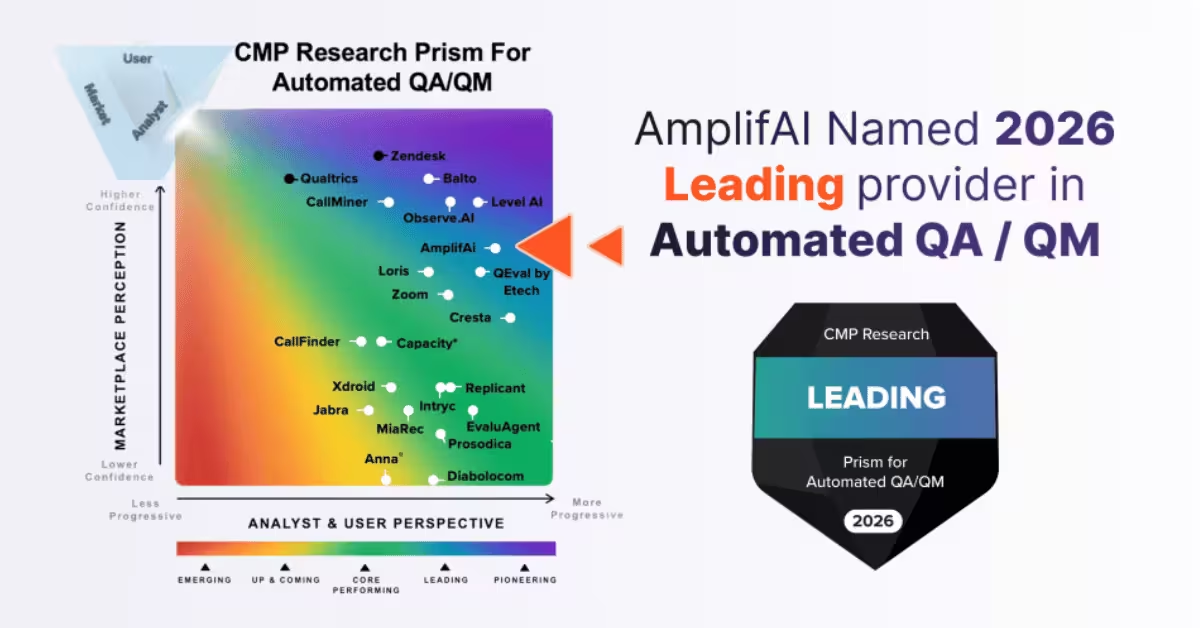
AmplifAI was named a Leading provider in the 2026 CMP Research Prism for Automated QA/QM, earning the highest possible progressive score for integration, user experience, AI accuracy, reporting, and data security.
CMP Research evaluated 22 automated QA/QM solution providers in its Q1 2026 Prism Report, scoring each across ten key investment criteria.
Four of the call center speech analytics software featured in this guide also appear in the CMP Prism evaluation, making the full report a valuable companion for validating your shortlist.
What is Call Center Speech Analytics Software
Call center speech analytics software transcribes and analyzes voice conversations to identify sentiment, intent, topics, call reasons, compliance risks, root causes, agent behaviors, and customer experience patterns.
Types of Call Center Speech Analytics Software
Call center speech analytics software spans five types based on how each vendor analyzes conversation data, from unified speech analytics and post-interaction analysis to real-time agent guidance, predictive intelligence, and cross-channel conversation intelligence.
| Speech Analytics Software Type | What It Does | Vendors |
|---|---|---|
| Unified Speech Analytics Software | Unifies calls, conversations, QA, CRM, WFM, VOC, surveys, performance, agent activity, and legacy data into one AI-ready layer, using speech analytics to turn conversation patterns into CX insights, quality scores, coaching priorities, recognition, follow-up, and next best actions through role-based dashboards. | AmplifAI |
| Post-Call Speech Analytics Software | Analyzes completed interactions to identify coaching opportunities, compliance risks, sentiment patterns, call drivers, and recurring customer experience issues. | AmplifAI, CallMiner, NICE |
| Real-Time Speech Analytics Software | Monitors live conversations to trigger agent guidance, compliance alerts, escalation prompts, and supervisor intervention during active customer interactions. | Convin, Cresta, Level AI |
| Predictive Speech Analytics Software | Uses historical conversation patterns, sentiment trends, and AI modeling to forecast customer behavior, satisfaction risk, churn likelihood, and emerging service issues. | AmplifAI, CallMiner, Verint |
| Conversation Intelligence Software | Analyzes customer interactions across voice, chat, email, messaging, and social channels to identify intent, sentiment, topics, objections, and experience trends. | AmplifAI, CallMiner, Cresta |
| Use this table to separate call center speech analytics software by operating moment, channel scope, prediction, and data layer before comparing vendors. Decide whether your contact center needs post-interaction analysis, live agent guidance, forecasting, cross-channel conversation intelligence, or unified speech analytics that turns conversation patterns into role-specific action. | ||
Call Center Speech Analytics vs Conversation Intelligence vs Voice Analytics Software
Call center speech analytics, conversation intelligence, and voice analytics describe overlapping approaches to extracting insights from customer conversations using AI. Vendors use these terms inconsistently, but each term points to a different scope of analysis.
Speech Analytics Software
Speech analytics software analyzes voice conversations to identify sentiment, compliance risks, agent behaviors, keywords, phrases, call drivers, and recurring interaction patterns. Speech analytics software usually starts with transcription, then applies AI and natural language processing to make large volumes of call data searchable, measurable, and usable for QA, coaching, and customer experience analysis.
Conversation Intelligence Software
Conversation intelligence software analyzes conversation data across voice and digital channels, including calls, chat transcripts, email, messaging, and social interactions. Conversation intelligence software is broader than voice-only speech analytics because it connects customer intent, sentiment, topics, objections, and experience patterns across multiple interaction types.
Voice Analytics Software
Voice analytics software emphasizes the acoustic and voice-specific characteristics of customer conversations, including pitch, tone, speaking rate, silence, interruptions, stress indicators, and emotional patterns. Voice analytics software overlaps with speech analytics, but the term usually points more directly to how something was said, not only which words appeared in the conversation.
The label a vendor uses matters less than the capability behind it. Strong speech analytics and conversation intelligence should analyze the channels your contact center uses, identify the insights your teams need, and support the QA, coaching, compliance, customer intelligence, and performance management work those insights inform.
Call Center Speech Analytics Software Limitations
Call center speech analytics software limitations fall into two categories, siloed speech analytics point solutions and CCaaS-native speech analytics. Both speech analytics models analyze conversations, but each creates a different barrier between insight generation and measurable improvement.
Siloed Speech Analytics Point Solutions
Siloed call center speech analytics software can generate large volumes of conversation insights without giving the teams responsible for action a clear workflow from insight to improvement. Quality teams learn why interactions fail but still need separate workflows to turn those findings into coaching. Compliance teams detect violations after customer exposure or regulatory risk already exists. Performance leaders review dashboards full of sentiment, topic, and call driver data without seeing which agent behaviors, coaching actions, or process gaps caused those patterns.
Siloed speech analytics software creates value at the detection layer but leaves the improvement layer disconnected, resulting in more reporting and manual interpretation for the teams expected to convert insights into performance gains.
CCaaS-Native Speech Analytics Limitations
CCaaS-native speech analytics software creates a different limitation because conversation analysis usually stays inside the vendor’s contact center ecosystem. NICE CXone, Genesys Cloud CX, and other CCaaS vendors analyze conversations handled inside their own environments, but external QA, coaching, CRM, WFM, BPO, and performance data require additional integrations to create a complete view.
CCaaS-native speech analytics works well when your contact center already runs on that vendor’s infrastructure and only needs analytics inside that environment. Limitations appear when leaders need speech data connected to external systems, multi-vendor environments, BPO networks, or existing performance management workflows. Enterprise CCaaS vendors also tend to add cost and complexity through premium integrations, custom field mapping, API work, and services needed to move conversation data beyond their own ecosystem.
Call Center Speech Analytics Software Features
Call center speech analytics software features vary by software type, from standalone conversation analysis and CCaaS-native analytics to real-time agent guidance and unified speech analytics that turns conversation patterns into role-specific action.
| Speech Analytics Software Feature | What It Does | Vendors |
|---|---|---|
| Unified Data Integration | Unifies calls, conversations, QA, CRM, WFM, VOC, surveys, performance, agent activity, and legacy data into one AI-ready layer so speech analytics supports CX insights, quality scores, coaching priorities, recognition, follow-up, and role-based action. | AmplifAI |
| Coaching Workflow Integration | Turns conversation patterns, QA findings, agent behaviors, and customer issues into coaching priorities, follow-up actions, and leader workflows for post-interaction performance improvement. | AmplifAI |
| Auto QA Integration | Combines speech analytics with automated quality assurance to score interactions at scale. Auto QA integration connects what customers and agents say to quality evaluations, compliance checks, scorecards, and calibration workflows. | AmplifAI, CallMiner, NICE |
| Performance Management Analytics | Links speech patterns to performance outcomes, showing which behaviors, topics, and interaction trends correlate with KPIs. Performance management analytics connects conversation data to scorecards, goals, leader visibility, and team-level performance trends. | AmplifAI, Genesys, Verint |
| Compliance Monitoring & Risk Detection | Identifies missing disclosures, prohibited language, escalation risks, and regulatory issues inside customer conversations. Compliance monitoring gives QA and compliance teams earlier visibility into risks that require review, coaching, or corrective action. | AmplifAI, CallMiner, NICE |
| AI-Enabled Sentiment Analysis | Detects customer emotion, agent empathy, frustration, satisfaction signals, and escalation patterns using AI analysis of words, tone, and conversation context. Sentiment analysis helps teams understand how customer experience changes across interactions, teams, and service issues. | AmplifAI, CallMiner, Genesys |
| Root Cause Analysis | Analyzes patterns across large volumes of interactions to identify why customer issues occur. Root cause analysis connects recurring call drivers, process breakdowns, policy confusion, and agent behavior patterns to the outcomes appearing in contact center reports. | AmplifAI, NICE, Verint |
| Topic Categorization & Intent Models | Groups conversations by topic, customer intent, issue type, and interaction reason. Topic categorization and intent models show why customers contact your business and which topics drive volume, dissatisfaction, escalations, or repeat contact. | AmplifAI, Level AI, Observe.AI |
| Ask Your Transcripts (Unscripted Q&A) | Allows users to query conversation data using natural language questions instead of predefined reports. Ask Your Transcripts gives leaders, QA teams, and analysts direct access to patterns, examples, and customer language inside analyzed transcripts. | AmplifAI |
| Real-Time Agent Guidance | Provides live prompts, suggestions, compliance alerts, and in-call guidance during active customer conversations. Real-time agent guidance supports agents when they need help handling objections, disclosures, process steps, or escalation risks. | Cresta, Level AI, Observe.AI |
| Conversation Intelligence (Omnichannel Analytics) | Analyzes interactions across voice, chat, email, messaging, and social channels. Omnichannel conversation intelligence connects customer intent, sentiment, topics, and experience patterns across the communication channels your contact center supports. | AmplifAI, Cresta, Observe.AI |
| Customer Survey Commentary Analysis | Analyzes open-text survey responses alongside conversation data. Customer survey commentary analysis connects what customers say after an interaction to what happened during the interaction, giving CX teams more context than survey scores alone. | AmplifAI, CallMiner |
| Predictive NPS | Forecasts likely Net Promoter Score outcomes using conversation patterns, sentiment signals, issue types, and historical customer experience data. Predictive NPS identifies customer experience risk before survey results arrive. | AmplifAI, Verint |
| Experience Sequence Analysis | Maps patterns across multiple interactions, channels, and time periods to show how customer experiences unfold. Experience sequence analysis identifies repeat contact patterns, escalation paths, handoff issues, and friction points across the customer journey. | AmplifAI, NICE |
| Workflow Automation | Triggers actions from speech analytics insights, including coaching tasks, escalation alerts, compliance reviews, QA evaluations, and follow-up workflows. Workflow automation moves conversation patterns into the systems and teams responsible for action. | AmplifAI, Genesys, NICE |
| AI-Enabled AutoDiscovery | Surfaces emerging topics, customer issues, sentiment shifts, and interaction patterns without relying only on predefined categories. AI-enabled AutoDiscovery helps contact centers identify changes in customer behavior before those patterns appear in standard reports. | AmplifAI, CallMiner |
| CX Analytics Outcome Metrics | Measures the relationship between conversation patterns and business outcomes such as CSAT, NPS, retention, revenue, complaints, repeat contact, and resolution. CX analytics outcome metrics show which interaction patterns are connected to measurable customer and business results. | AmplifAI, Genesys, Verint |
| Agent Behavior Analysis | Identifies agent behaviors, language patterns, empathy signals, adherence issues, and conversation techniques associated with stronger or weaker outcomes. Agent behavior analysis gives coaching and QA teams evidence for improving performance at the behavior level. | AmplifAI, Level AI, Observe.AI |
| Customer Journey Mapping | Visualizes customer interactions across touchpoints, channels, and time. Customer journey mapping shows where customers encounter friction, repeat themselves, escalate, abandon, or require multiple contacts to resolve an issue. | AmplifAI, NICE, Verint |
| Use this table to compare which speech analytics capabilities each vendor supports across analysis, scoring, guidance, prediction, customer intelligence, and workflow action. Prioritize features that match how your teams need to use conversation data, from transcript search and topic detection to QA scoring, coaching priorities, CX analytics, and role-specific follow-up. | ||
Call Center Speech Analytics Software Evaluation Criteria
Call center speech analytics software evaluation criteria include data integration, analytics coverage, action enablement, AI accuracy, scalability, measurable impact, and implementation requirements.
| Evaluation Criteria | What to Evaluate | Why It Matters |
|---|---|---|
| Data Integration Approach | Confirm how the vendor handles conversation data, QA, coaching, WFM, CRM, CCaaS, performance, and external system data. Look for unified data access, integration flexibility, field mapping, and support for existing systems. | Speech analytics insights create more value when conversation data reaches the workflows responsible for QA, coaching, compliance, customer intelligence, and performance management. Isolated speech analytics increase manual interpretation slowing time to value. |
| Operational Coverage | Confirm which speech analytics software types the vendor supports, including unified speech analytics, post-call analysis, real-time guidance, predictive analytics, and conversation intelligence. Review channel coverage across voice, chat, email, messaging, and social interactions. | Analytics coverage defines which use cases the vendor supports across QA, coaching, compliance, customer intelligence, and real-time assistance. Narrow coverage forces teams to manage separate vendors for adjacent conversation intelligence needs. |
| Action Enablement | Review how conversation insights become coaching actions, compliance reviews, QA evaluations, escalation alerts, performance tasks, or leader follow-up. Confirm how quickly teams can move from detection to action. | Speech analytics software creates the most impact when insights trigger the workflows responsible for improvement. Detection without a clear path to action leaves teams with more dashboards, manual review, and disconnected follow-through. |
| AI Sophistication & Accuracy | Review transcription accuracy, sentiment accuracy, context understanding, intent detection, predictive modeling, accent handling, background noise handling, and support for industry terminology. | AI accuracy affects trust in automated scoring, coaching recommendations, compliance flags, and customer intelligence. Weak context understanding increases manual review and limits confidence in AI-generated actions. |
| Scalability & Coverage | Review the percentage of interactions analyzed, processing speed, concurrent user support, language coverage, site-level reporting, and ability to support multi-site or BPO environments. | Scalable speech analytics should analyze enough interaction volume to support reliable QA, coaching, compliance, and CX analysis across teams, locations, and business units. Limited scalability creates data gaps and future migration risk. |
| ROI & Measurable Impact | Review documented impact on CSAT, NPS, AHT, FCR, compliance rates, coaching effectiveness, retention, revenue, or repeat contact. Confirm how the vendor measures performance movement after insights trigger action. | Measurable impact connects speech analytics investment to business outcomes. Vendors should show how conversation insights influence performance, not only how many interactions were transcribed or categorized. |
| Implementation & Requirements | Review deployment timeline, IT resource needs, data access requirements, training effort, integration scope, and support for existing enterprise systems. | Implementation requirements shape time to value, internal resource burden, and long-term ownership cost. Complex integrations, custom data work, and disconnected systems will delay value even when the analytics capabilities are strong. |
| Use this table to evaluate whether speech analytics software matches the outcomes your contact center needs to improve. Start with category fit and data coverage, then test whether each vendor can turn conversation analysis into QA, coaching, compliance, customer intelligence, performance visibility, and measurable action. | ||
Best Call Center Speech Analytics Software (2026)
The best call center speech analytics software vendors of 2026 were reviewed by our team of CX specialists based on coverage across speech analytics software types, features, and evaluation criteria. Vendor reviews include capability breakdown, best-fit use cases, and considerations.
1. AmplifAI Call Center Speech Analytics Software
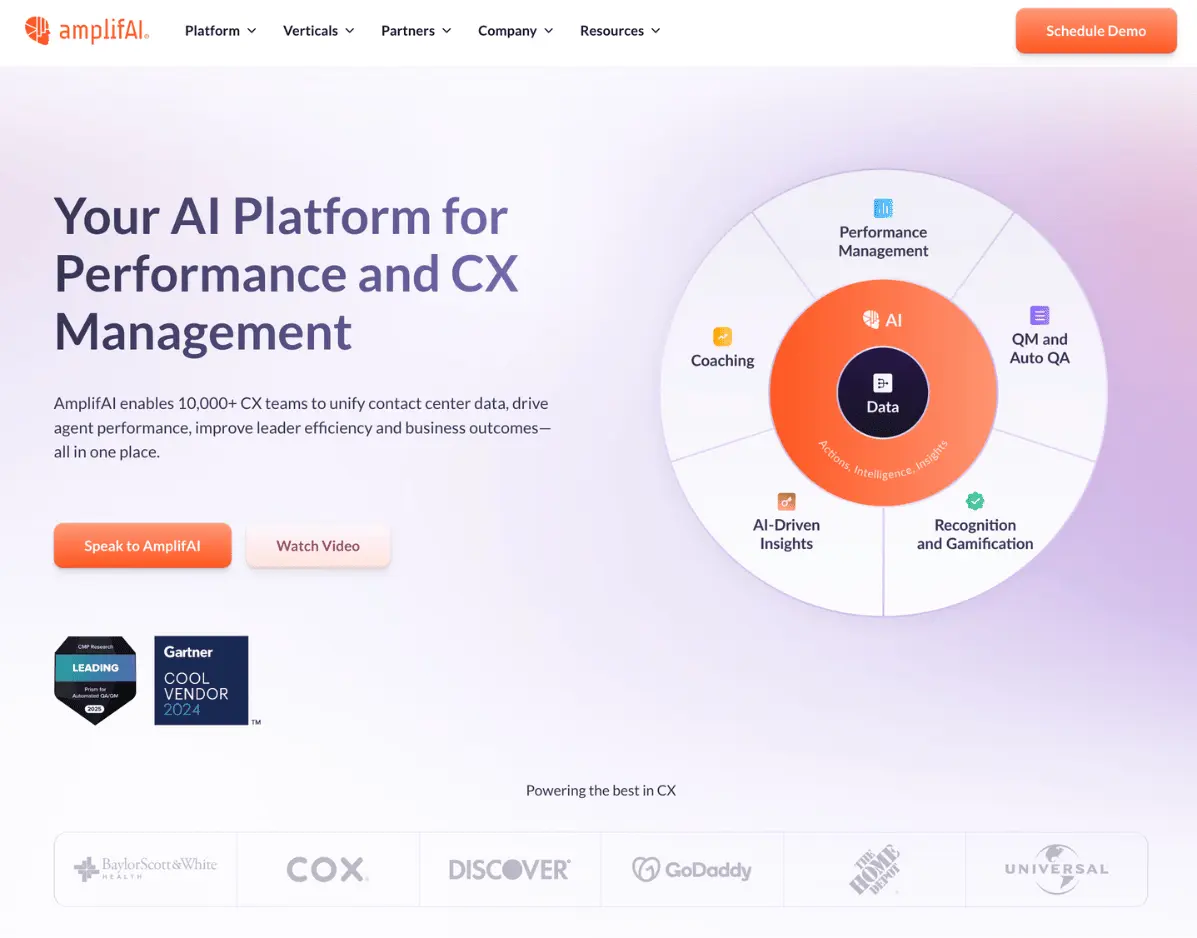
AmplifAI call center speech analytics software unifies calls, conversations, QA, CRM, WFM, surveys, performance, and legacy data into one AI-ready layer, delivering transcription, sentiment analysis, intent analysis, call reason analysis, root cause analysis, compliance monitoring, customer intelligence, and CX insights through role-based dashboards for QA teams, team leaders, CX leaders, and executives. AmplifAI turns conversation patterns into quality scores, coaching priorities, follow-up actions, performance visibility, and measurable improvement across the contact center.
AmplifAI is named a Leading provider in the 2026 CMP Research Prism Report for Automated QA/QM.
AmplifAI Call Center Speech Analytics Software Types
| Speech Analytics Software Type | What It Does | AmplifAI Capability |
|---|---|---|
| Unified Speech Analytics | Unifies conversation, QA, CRM, WFM, survey, performance, and legacy data for role-based action | ✅ |
| Post-Call Speech Analytics | Analyzes completed interactions for sentiment, topics, call reasons, quality trends, and coaching priorities | ✅ |
| Real-Time Speech Analytics | Live agent guidance during active customer conversations | ❌ |
| Predictive Speech Analytics | Forecasts customer experience risk and performance patterns from historical data | ✅ |
| Conversation Intelligence | Analyzes voice, chat, email, messaging, and social interactions for intent, sentiment, topics, and experience trends | ✅ |
AmplifAI Call Center Speech Analytics Software Features
| Speech Analytics Software Feature | What It Does | AmplifAI |
|---|---|---|
| Unified Data Integration | Unifies conversation, QA, CRM, WFM, survey, performance, and legacy data into one AI-ready layer | ✅ |
| Coaching Workflow Integration | Turns conversation patterns, QA findings, agent behaviors, and customer issues into coaching priorities, follow-up actions, and leader workflows for post-interaction performance improvement. | ✅ |
| Auto QA Integration | Combines speech analytics with automated quality scoring | ✅ |
| Performance Management Analytics | Shows how conversation patterns, behaviors, and interaction trends relate to KPIs and performance movement | ✅ |
| Compliance Monitoring & Risk Detection | Identifies violations and regulatory risks in conversations | ✅ |
| AI-Enabled Sentiment Analysis | Detects customer emotion, agent empathy, frustration, satisfaction signals, and escalation patterns | ✅ |
| Root Cause Analysis | Identifies underlying issues across interaction patterns | ✅ |
| Topic Categorization & Intent Models | Groups conversations by topic, intent, issue type, and interaction reason | ✅ |
| Ask Your Transcripts (Unscripted Q&A) | Natural language queries of conversation data | ✅ |
| Real-Time Agent Guidance | Live prompts, suggestions, and compliance alerts during active customer conversations | ❌ |
| Conversation Intelligence (Omnichannel) | Analyzes voice, chat, email, messaging, and social interactions for intent, sentiment, topics, and experience trends | ✅ |
| Customer Survey Commentary Analysis | Analyzes open-text survey responses alongside conversations | ✅ |
| Predictive NPS | Forecasts Net Promoter Score from conversation patterns | ✅ |
| Experience Sequence Analysis | Maps customer journey patterns across interactions | ✅ |
| Workflow Automation | Moves conversation patterns into coaching tasks, compliance reviews, QA evaluations, and follow-up workflows | ✅ |
| AI-Enabled AutoDiscovery | Surfaces emerging trends without predefined categories | ✅ |
| CX Analytics Outcome Metrics | Measures relationship between conversations and business outcomes | ✅ |
| Agent Behavior Analysis | Identifies agent behaviors, language patterns, empathy signals, adherence issues, and conversation techniques | ✅ |
| Customer Journey Mapping | Visualizes complete customer interactions across touchpoints | ✅ |
Standout Features and Capabilities of AmplifAI
- Conversation Intelligence and Sentiment Analysis: AmplifAI transcribes and analyzes interactions across voice, chat, email, and messaging, surfacing sentiment trends, customer intent, compliance risks, call reasons, root causes, and CX drivers.
- Ask Your Transcripts: AmplifAI lets leaders and analysts query conversation data directly, surfacing customer patterns, agent behaviors, coaching priorities, and customer insights without custom reports.
- Speech-to-QA Automation: AmplifAI uses conversation analysis to support automated QA scoring, compliance monitoring, quality reviews, scorecards, and calibration workflows.
- Role-Based Speech Insights: AmplifAI delivers speech analytics through role-based dashboards for QA teams, team leaders, CX leaders, and executives, giving each role the conversation data, trends, and actions they need.
- BPO and Multi-Vendor Oversight: AmplifAI unifies speech analytics across outsourcers, sites, and business units with cross-vendor quality calibration, performance benchmarking, and consolidated visibility.
- Customer Intelligence: AmplifAI surfaces CSAT and NPS drivers, sentiment trends, interaction patterns, call reasons, and voice-of-the-customer insights from conversation data.
Best Fit: Who Should Use AmplifAI
- Enterprise and BPO contact centers with 50+ agents using conversation data to improve QA, coaching, customer intelligence, and performance management.
- BPOs and multi-site contact centers managing speech analytics across multiple clients, vendors, locations, and lines of business.
- QA, CX, and operations teams that need conversation patterns turned into quality scores, coaching priorities, customer insights, and performance visibility.
AmplifAI Considerations
- Smaller contact centers with fewer than 20 agents may not require the full breadth of conversation analytics configurations and cross-system data unification at launch.
- AmplifAI works with existing CCaaS, telephony, and call recording infrastructure rather than replacing those systems.
- Contact centers seeking standalone speech analytics without QA, coaching, customer intelligence, or performance management may find AmplifAI broader than their current needs.
AmplifAI Call Center Speech Analytics Software Overview
AmplifAI call center speech analytics software fits enterprise contact centers and BPOs that need more than transcription, sentiment analysis, and conversation reporting. AmplifAI uses unified contact center data to give QA teams, team leaders, CX leaders, and executives the speech analytics, customer intelligence, quality context, coaching priorities, and performance visibility needed to improve outcomes across teams, sites, and vendors.
Speak to the #1 Speech Analytics Software Vendor
2. CallMiner Call Center Speech Analytics Software
CallMiner call center speech analytics software analyzes customer conversations across voice, chat, email, and social channels for sentiment, compliance risks, topics, behavioral patterns, and customer experience trends. CallMiner fits large contact centers with dedicated analytics teams that need standalone conversation analytics, compliance review, and real-time agent alerts.
CallMiner Call Center Speech Analytics Software Types
| Speech Analytics Software Type | What It Does | CallMiner Capability |
|---|---|---|
| Unified Speech Analytics | Unifies conversation, QA, CRM, WFM, survey, performance, and legacy data for role-based action | ⚠️ |
| Post-Call Speech Analytics | Analyzes completed interactions for sentiment, topics, call reasons, quality trends, and coaching priorities | ✅ |
| Real-Time Speech Analytics | Live agent guidance during active customer conversations | ✅ |
| Predictive Speech Analytics | Forecasts customer experience risk and performance patterns from historical data | ⚠️ |
| Conversation Intelligence | Analyzes voice, chat, email, messaging, and social interactions for intent, sentiment, topics, and experience trends | ✅ |
CallMiner Call Center Speech Analytics Software Features
| Speech Analytics Software Feature | What It Does | CallMiner |
|---|---|---|
| Unified Data Integration | Unifies conversation, QA, CRM, WFM, survey, performance, and legacy data into one AI-ready layer | ❌ |
| Coaching Workflow Integration | Turns conversation patterns, QA findings, agent behaviors, and customer issues into coaching priorities, follow-up actions, and leader workflows for post-interaction performance improvement. | ⚠️ |
| Auto QA Integration | Combines speech analytics with automated quality scoring | ✅ |
| Performance Management Analytics | Shows how conversation patterns, behaviors, and interaction trends relate to KPIs and performance movement | ❌ |
| Compliance Monitoring & Risk Detection | Identifies violations and regulatory risks in conversations | ✅ |
| AI-Enabled Sentiment Analysis | Detects customer emotion, agent empathy, frustration, satisfaction signals, and escalation patterns | ✅ |
| Root Cause Analysis | Identifies underlying issues across interaction patterns | ✅ |
| Topic Categorization & Intent Models | Groups conversations by topic, intent, issue type, and interaction reason | ✅ |
| Ask Your Transcripts (Unscripted Q&A) | Natural language queries of conversation data | ❌ |
| Real-Time Agent Guidance | Live prompts, suggestions, and compliance alerts during active customer conversations | ✅ |
| Conversation Intelligence (Omnichannel) | Analyzes voice, chat, email, messaging, and social interactions for intent, sentiment, topics, and experience trends | ✅ |
| Customer Survey Commentary Analysis | Analyzes open-text survey responses alongside conversations | ✅ |
| Predictive NPS | Forecasts Net Promoter Score from conversation patterns | ❌ |
| Experience Sequence Analysis | Maps customer journey patterns across interactions | ⚠️ |
| Workflow Automation | Moves conversation patterns into coaching tasks, compliance reviews, QA evaluations, and follow-up workflows | ⚠️ |
| AI-Enabled AutoDiscovery | Surfaces emerging trends without predefined categories | ✅ |
| CX Analytics Outcome Metrics | Measures relationship between conversations and business outcomes | ⚠️ |
| Agent Behavior Analysis | Identifies agent behaviors, language patterns, empathy signals, adherence issues, and conversation techniques | ✅ |
| Customer Journey Mapping | Visualizes complete customer interactions across touchpoints | ⚠️ |
Standout Features and Capabilities of CallMiner
- Conversation Coverage Across Channels: CallMiner analyzes voice, chat, email, and social interactions with automated transcription, categorization, sentiment analysis, and rule-based scoring.
- Real-Time Agent Alerts: CallMiner displays on-screen notifications during live conversations for compliance warnings, script adherence reminders, and supervisor-defined interaction triggers.
Best Fit: Who Should Use CallMiner
- Large contact centers with dedicated analytics teams managing speech analytics configuration, category configuration, reporting, and interaction analysis.
- Regulated contact centers that need conversation recording, compliance review, risk detection, and audit-ready interaction analysis.
- Contact centers with existing QA, coaching, and performance management systems that need conversation analytics as an input layer.
CallMiner Considerations
- CallMiner speech analytics works best when contact centers have analytics resources available to configure categories, manage reports, and interpret conversation trends.
- CallMiner supports coaching workflows and real-time agent alerts, with fit depending on how each contact center manages QA, performance management, leader workflows, and follow-up outside the conversation analytics system.
- CallMiner functions primarily as a conversation analytics system, with broader performance management, coaching measurement, and cross-system action tracking handled through configuration, integrations, or adjacent systems.
CallMiner Call Center Speech Analytics Software Overview
CallMiner call center speech analytics software functions as a standalone conversation analytics layer for contact centers analyzing voice and digital interactions. CallMiner supports speech analytics programs focused on compliance monitoring, category configuration, interaction search, sentiment trends, topic discovery, and customer experience analysis across large volumes of conversations.
3. NICE Call Center Speech Analytics Software
NICE call center speech analytics software analyzes voice and digital interactions for sentiment, compliance risk, topic discovery, behavioral patterns, and customer experience trends. NICE fits enterprises already using NICE CXone for CCaaS, workforce engagement, quality management, and customer experience workflows, with speech analytics working inside the broader NICE CXone environment.
NICE Call Center Speech Analytics Software Types
| Speech Analytics Software Type | What It Does | NICE Capability |
|---|---|---|
| Unified Speech Analytics | Unifies conversation, QA, CRM, WFM, survey, performance, and legacy data for role-based action | ⚠️ |
| Post-Call Speech Analytics | Analyzes completed interactions for sentiment, topics, call reasons, quality trends, and coaching priorities | ✅ |
| Real-Time Speech Analytics | Live agent guidance during active customer conversations | ⚠️ |
| Predictive Speech Analytics | Forecasts customer experience risk and performance patterns from historical data | ⚠️ |
| Conversation Intelligence | Analyzes voice, chat, email, messaging, and social interactions for intent, sentiment, topics, and experience trends | ✅ |
NICE Call Center Speech Analytics Software Features
| Speech Analytics Software Feature | What It Does | NICE Capability |
|---|---|---|
| Unified Data Integration | Unifies conversation, QA, CRM, WFM, survey, performance, and legacy data into one AI-ready layer | ❌ |
| Coaching Workflow Integration | Turns conversation patterns, QA findings, agent behaviors, and customer issues into coaching priorities, follow-up actions, and leader workflows for post-interaction performance improvement. | ⚠️ |
| Auto QA Integration | Combines speech analytics with automated quality scoring | ✅ |
| Performance Management Analytics | Shows how conversation patterns, behaviors, and interaction trends relate to KPIs and performance movement | ⚠️ |
| Compliance Monitoring & Risk Detection | Identifies violations and regulatory risks in conversations | ✅ |
| AI-Enabled Sentiment Analysis | Detects customer emotion, agent empathy, frustration, satisfaction signals, and escalation patterns | ✅ |
| Root Cause Analysis | Identifies underlying issues across interaction patterns | ✅ |
| Topic Categorization & Intent Models | Groups conversations by topic, intent, issue type, and interaction reason | ✅ |
| Ask Your Transcripts (Unscripted Q&A) | Natural language queries of conversation data | ❌ |
| Real-Time Agent Guidance | Live prompts, suggestions, and compliance alerts during active customer conversations | ⚠️ |
| Conversation Intelligence (Omnichannel) | Analyzes voice, chat, email, messaging, and social interactions for intent, sentiment, topics, and experience trends | ✅ |
| Customer Survey Commentary Analysis | Analyzes open-text survey responses alongside conversations | ⚠️ |
| Predictive NPS | Forecasts Net Promoter Score from conversation patterns | ⚠️ |
| Experience Sequence Analysis | Maps customer journey patterns across interactions | ⚠️ |
| Workflow Automation | Moves conversation patterns into coaching tasks, compliance reviews, QA evaluations, and follow-up workflows | ✅ |
| AI-Enabled AutoDiscovery | Surfaces emerging trends without predefined categories | ✅ |
| CX Analytics Outcome Metrics | Measures relationship between conversations and business outcomes | ⚠️ |
| Agent Behavior Analysis | Identifies agent behaviors, language patterns, empathy signals, adherence issues, and conversation techniques | ✅ |
| Customer Journey Mapping | Visualizes complete customer interactions across touchpoints | ⚠️ |
Standout Features and Capabilities of NICE
- Conversation Analytics: NICE analyzes customer interactions for sentiment, compliance, behavioral patterns, topics, and recurring customer issues.
- CCaaS-Native Workflow Orchestration: NICE coordinates service workflows across routing, workforce engagement, quality management, and reporting inside the NICE CXone environment.
Best Fit: Who Should Use NICE
- Large enterprises already using NICE CXone for CCaaS infrastructure, workforce engagement, quality management, or customer experience management.
- Contact centers that want speech analytics inside the same environment as routing, workforce engagement, QA, and reporting.
- Regulated contact centers that need conversation analytics, compliance monitoring, and quality management within an enterprise CCaaS environment.
NICE Considerations
- NICE speech analytics operates inside the NICE CXone ecosystem, so contact centers with external QA, coaching, CRM, WFM, BPO, or performance management systems should evaluate data access and integration requirements.
- NICE pricing can expand as enterprises add analytics, workforce engagement, quality management, integrations, and services.
- Contact centers with multi-vendor environments may need additional integration work to use NICE speech analytics data across external systems and workflows.
NICE Call Center Speech Analytics Software Overview
NICE call center speech analytics software functions as a CCaaS-native analytics layer for contact centers already using the NICE CXone environment. NICE supports conversation analytics, workforce engagement, quality management, reporting, and workflow orchestration inside its CCaaS ecosystem, with external coaching, performance management, BPO, or multi-vendor data requirements depending on integration scope.
Compare NICE to AmplifAI for Speech Analytics Software
Compare NICE Alternatives Across 13 Software Categories
4. Verint Call Center Speech Analytics Software
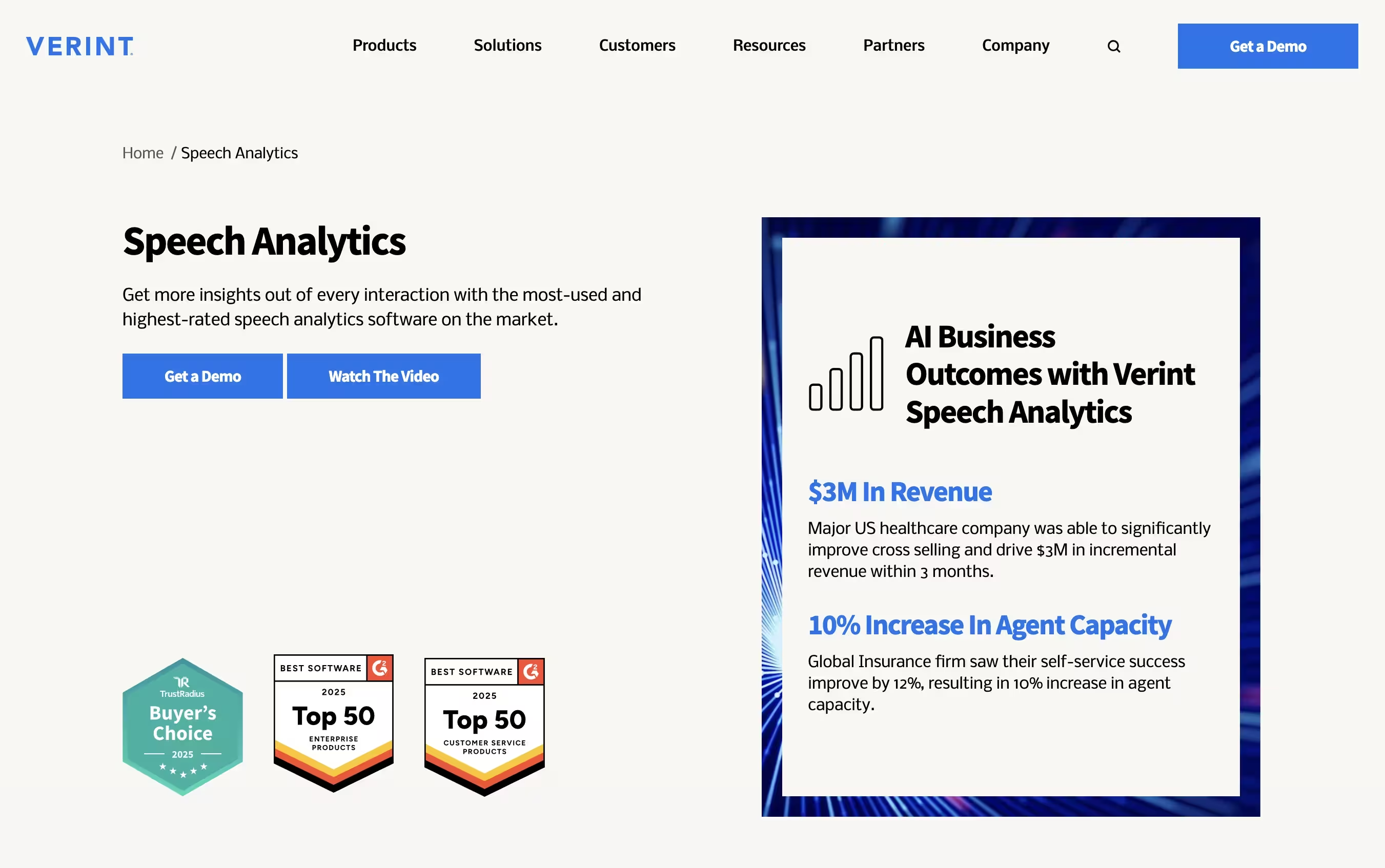
Verint call center speech analytics software analyzes voice and digital interactions through modular AI capabilities for transcription, quality scoring, coaching support, compliance review, and workforce engagement. Verint fits large enterprises already using Verint workforce engagement, quality management, or analytics software, with speech analytics operating inside a modular WFM and quality management environment.
Verint Call Center Speech Analytics Software Types
| Speech Analytics Software Type | What It Does | Verint Capability |
|---|---|---|
| Unified Speech Analytics | Unifies conversation, QA, CRM, WFM, survey, performance, and legacy data for role-based action | ❌ |
| Post-Call Speech Analytics | Analyzes completed interactions for sentiment, topics, call reasons, quality trends, and coaching priorities | ✅ |
| Real-Time Speech Analytics | Live agent guidance during active customer conversations | ✅ |
| Predictive Speech Analytics | Forecasts customer experience risk and performance patterns from historical data | ⚠️ |
| Conversation Intelligence | Analyzes voice, chat, email, messaging, and social interactions for intent, sentiment, topics, and experience trends | ✅ |
Verint Call Center Speech Analytics Software Features
| Speech Analytics Software Feature | What It Does | Verint |
|---|---|---|
| Unified Data Integration | Unifies conversation, QA, CRM, WFM, survey, performance, and legacy data into one AI-ready layer | ❌ |
| Coaching Workflow Integration | Turns conversation patterns, QA findings, agent behaviors, and customer issues into coaching priorities, follow-up actions, and leader workflows for post-interaction performance improvement. | ⚠️ |
| Auto QA Integration | Combines speech analytics with automated quality scoring | ✅ |
| Performance Management Analytics | Shows how conversation patterns, behaviors, and interaction trends relate to KPIs and performance movement | ❌ |
| Compliance Monitoring & Risk Detection | Identifies violations and regulatory risks in conversations | ✅ |
| AI-Enabled Sentiment Analysis | Detects customer emotion, agent empathy, frustration, satisfaction signals, and escalation patterns | ✅ |
| Root Cause Analysis | Identifies underlying issues across interaction patterns | ✅ |
| Topic Categorization & Intent Models | Groups conversations by topic, intent, issue type, and interaction reason | ✅ |
| Ask Your Transcripts (Unscripted Q&A) | Natural language queries of conversation data | ⚠️ |
| Real-Time Agent Guidance | Live prompts, suggestions, and compliance alerts during active customer conversations | ✅ |
| Conversation Intelligence (Omnichannel) | Analyzes voice, chat, email, messaging, and social interactions for intent, sentiment, topics, and experience trends | ✅ |
| Customer Survey Commentary Analysis | Analyzes open-text survey responses alongside conversations | ✅ |
| Predictive NPS | Forecasts Net Promoter Score from conversation patterns | ❌ |
| Experience Sequence Analysis | Maps customer journey patterns across interactions | ⚠️ |
| Workflow Automation | Moves conversation patterns into coaching tasks, compliance reviews, QA evaluations, and follow-up workflows | ✅ |
| AI-Enabled AutoDiscovery | Surfaces emerging trends without predefined categories | ✅ |
| CX Analytics Outcome Metrics | Measures relationship between conversations and business outcomes | ⚠️ |
| Agent Behavior Analysis | Identifies agent behaviors, language patterns, empathy signals, adherence issues, and conversation techniques | ✅ |
| Customer Journey Mapping | Visualizes complete customer interactions across touchpoints | ⚠️ |
Standout Features and Capabilities of Verint
- Modular AI Capabilities: Verint uses specialized AI capabilities for transcription, quality scoring, coaching support, data queries, and workflow automation across Verint applications.
- Speech Transcription and Conversation Playback: Verint provides speaker-separated transcription and conversation playback context for speech analytics, quality evaluation, and automation workflows.
Best Fit: Who Should Use Verint
- Large enterprises using Verint workforce engagement, quality management, or analytics software.
- Contact centers already using Verint WFM, quality management, or workforce engagement capabilities.
- Teams that prefer modular AI capabilities for transcription, quality scoring, coaching support, and data queries.
Verint Considerations
- The Verint modular AI model requires coordination across multiple applications, AI capabilities, and workflows.
- Contact centers should evaluate data access and workflow requirements across QA, coaching, performance management, CRM, and customer intelligence systems.
- Verint pricing and implementation scope can expand as enterprises add AI capabilities, modules, integrations, and services.
Verint Call Center Speech Analytics Software Overview
Verint call center speech analytics software functions as a modular conversation analytics layer for enterprises using Verint workforce engagement, quality management, and automation capabilities. Verint supports speech analytics programs focused on transcription, quality scoring, compliance monitoring, topic analysis, coaching support, and workflow automation inside a broader Verint environment.
Compare Verint to AmplifAI for Speech Analytics Software
5. Observe.AI Call Center Speech Analytics Software
Observe.AI call center speech analytics software analyzes voice, chat, and email interactions for automated QA, compliance review, sentiment trends, topic detection, and real-time agent guidance. Observe.AI fits contact centers focused on expanding QA coverage, reducing manual interaction review, and delivering agent-facing guidance from conversation insights.
Observe.AI Call Center Speech Analytics Software Types
| Speech Analytics Software Type | What It Does | Observe.AI Capability |
|---|---|---|
| Unified Speech Analytics | Unifies conversation, QA, CRM, WFM, survey, performance, and legacy data for role-based action | ❌ |
| Post-Call Speech Analytics | Analyzes completed interactions for sentiment, topics, call reasons, quality trends, and coaching priorities | ✅ |
| Real-Time Speech Analytics | Live agent guidance during active customer conversations | ✅ |
| Predictive Speech Analytics | Forecasts customer experience risk and performance patterns from historical data | ❌ |
| Conversation Intelligence | Analyzes voice, chat, email, messaging, and social interactions for intent, sentiment, topics, and experience trends | ✅ |
Observe.AI Call Center Speech Analytics Software Features
| Speech Analytics Software Feature | What It Does | Observe.AI |
|---|---|---|
| Unified Data Integration | Unifies conversation, QA, CRM, WFM, survey, performance, and legacy data into one AI-ready layer | ❌ |
| Coaching Workflow Integration | Turns conversation patterns, QA findings, agent behaviors, and customer issues into coaching priorities, follow-up actions, and leader workflows for post-interaction performance improvement. | ❌ |
| Auto QA Integration | Combines speech analytics with automated quality scoring | ✅ |
| Performance Management Analytics | Shows how conversation patterns, behaviors, and interaction trends relate to KPIs and performance movement | ⚠️ |
| Compliance Monitoring & Risk Detection | Identifies violations and regulatory risks in conversations | ✅ |
| AI-Enabled Sentiment Analysis | Detects customer emotion, agent empathy, frustration, satisfaction signals, and escalation patterns | ✅ |
| Root Cause Analysis | Identifies underlying issues across interaction patterns | ⚠️ |
| Topic Categorization & Intent Models | Groups conversations by topic, intent, issue type, and interaction reason | ✅ |
| Ask Your Transcripts (Unscripted Q&A) | Natural language queries of conversation data | ❌ |
| Real-Time Agent Guidance | Live prompts, suggestions, and compliance alerts during active customer conversations | ✅ |
| Conversation Intelligence (Omnichannel) | Analyzes voice, chat, email, messaging, and social interactions for intent, sentiment, topics, and experience trends | ✅ |
| Customer Survey Commentary Analysis | Analyzes open-text survey responses alongside conversations | ❌ |
| Predictive NPS | Forecasts Net Promoter Score from conversation patterns | ❌ |
| Experience Sequence Analysis | Maps customer journey patterns across interactions | ❌ |
| Workflow Automation | Moves conversation patterns into coaching tasks, compliance reviews, QA evaluations, and follow-up workflows | ⚠️ |
| AI-Enabled AutoDiscovery | Surfaces emerging trends without predefined categories | ⚠️ |
| CX Analytics Outcome Metrics | Measures relationship between conversations and business outcomes | ⚠️ |
| Agent Behavior Analysis | Identifies agent behaviors, language patterns, empathy signals, adherence issues, and conversation techniques | ✅ |
| Customer Journey Mapping | Visualizes complete customer interactions across touchpoints | ❌ |
Standout Features and Capabilities of Observe.AI
- Automated Quality Review: Observe.AI evaluates customer interactions with AI-assisted scoring, configurable QA rules, calibration support, and human review controls.
- Real-Time Agent Guidance: Observe.AI delivers live prompts, script reminders, compliance alerts, and knowledge guidance during active customer conversations.
Best Fit: Who Should Use Observe.AI
- Mid-market and enterprise contact centers focused on automated QA and interaction review.
- QA teams that want to expand evaluation coverage while maintaining human oversight for scoring, calibration, and review.
- Contact centers that want real-time agent guidance connected to conversation analysis and QA findings.
Observe.AI Considerations
- Observe.AI centers on automated QA, conversation analysis, and real-time agent guidance.
- Contact centers should evaluate data access and workflow requirements across performance management, customer intelligence, WFM, CRM, and BPO oversight.
- Teams seeking leader-enabled coaching workflows, predictive analytics, and cross-system performance management should evaluate integration depth before choosing Observe.AI.
Observe.AI Call Center Speech Analytics Software Overview
Observe.AI call center speech analytics software functions as a conversation intelligence and automated QA layer for contact centers analyzing voice and digital interactions. Observe.AI supports speech analytics programs focused on QA coverage, compliance review, sentiment trends, topic detection, agent behavior analysis, and real-time agent guidance.
Compare Observe.AI to AmplifAI for Speech Analytics Software
6. Genesys Call Center Speech Analytics Software
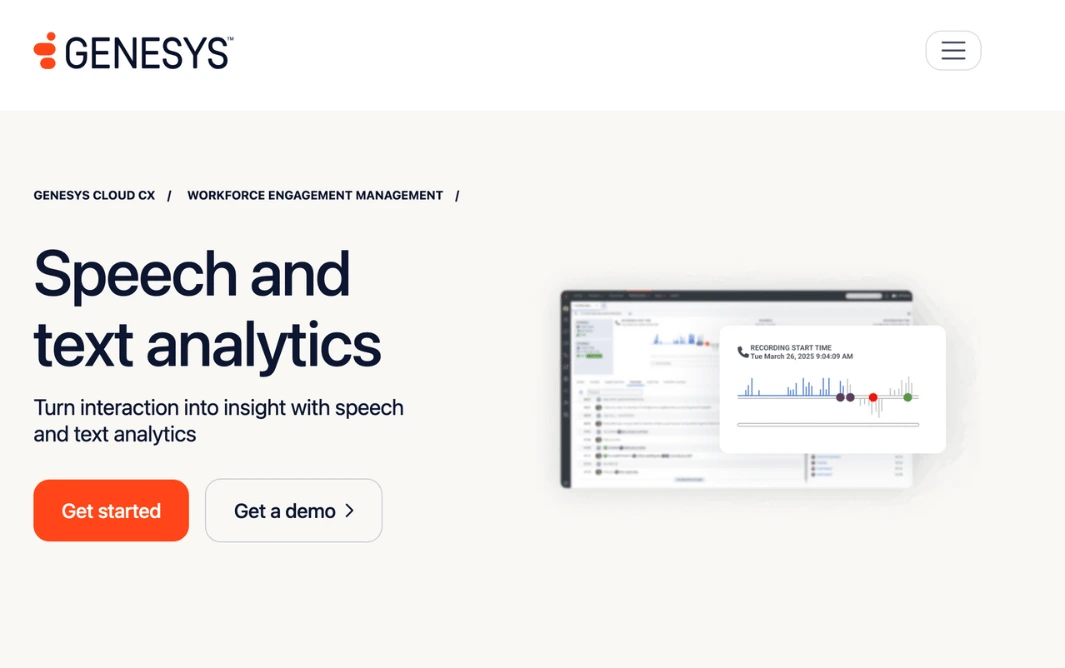
Genesys call center speech analytics software analyzes voice and digital interactions inside Genesys Cloud CX for sentiment, empathy signals, topic detection, customer intent, interaction categories, and conversation trends. Genesys fits enterprises already using Genesys Cloud CX for CCaaS, workforce engagement, quality management, performance reporting, and customer journey analytics inside the same CCaaS-native environment.
Genesys Call Center Speech Analytics Software Types
| Speech Analytics Software Type | What It Does | Genesys Capability |
|---|---|---|
| Unified Speech Analytics | Unifies conversation, QA, CRM, WFM, survey, performance, and legacy data for role-based action | ❌ |
| Post-Call Speech Analytics | Analyzes completed interactions for sentiment, topics, call reasons, quality trends, and coaching priorities | ✅ |
| Real-Time Speech Analytics | Live agent guidance during active customer conversations | ✅ |
| Predictive Speech Analytics | Forecasts customer experience risk and performance patterns from historical data | ✅ |
| Conversation Intelligence | Analyzes voice, chat, email, messaging, and social interactions for intent, sentiment, topics, and experience trends | ✅ |
Genesys Call Center Speech Analytics Software Features
| Speech Analytics Software Feature | What It Does | Genesys |
|---|---|---|
| Unified Data Integration | Unifies conversation, QA, CRM, WFM, survey, performance, and legacy data into one AI-ready layer | ❌ |
| Coaching Workflow Integration | Turns conversation patterns, QA findings, agent behaviors, and customer issues into coaching priorities, follow-up actions, and leader workflows for post-interaction performance improvement. | ⚠️ |
| Auto QA Integration | Combines speech analytics with automated quality scoring | ✅ |
| Performance Management Analytics | Shows how conversation patterns, behaviors, and interaction trends relate to KPIs and performance movement | ✅ |
| Compliance Monitoring & Risk Detection | Identifies violations and regulatory risks in conversations | ✅ |
| AI-Enabled Sentiment Analysis | Detects customer emotion, agent empathy, frustration, satisfaction signals, and escalation patterns | ✅ |
| Root Cause Analysis | Identifies underlying issues across interaction patterns | ✅ |
| Topic Categorization & Intent Models | Groups conversations by topic, intent, issue type, and interaction reason | ✅ |
| Ask Your Transcripts (Unscripted Q&A) | Natural language queries of conversation data | ❌ |
| Real-Time Agent Guidance | Live prompts, suggestions, and compliance alerts during active customer conversations | ✅ |
| Conversation Intelligence (Omnichannel) | Analyzes voice, chat, email, messaging, and social interactions for intent, sentiment, topics, and experience trends | ✅ |
| Customer Survey Commentary Analysis | Analyzes open-text survey responses alongside conversations | ✅ |
| Predictive NPS | Forecasts Net Promoter Score from conversation patterns | ❌ |
| Experience Sequence Analysis | Maps customer journey patterns across interactions | ✅ |
| Workflow Automation | Moves conversation patterns into coaching tasks, compliance reviews, QA evaluations, and follow-up workflows | ✅ |
| AI-Enabled AutoDiscovery | Surfaces emerging trends without predefined categories | ✅ |
| CX Analytics Outcome Metrics | Measures relationship between conversations and business outcomes | ✅ |
| Agent Behavior Analysis | Identifies agent behaviors, language patterns, empathy signals, adherence issues, and conversation techniques | ✅ |
| Customer Journey Mapping | Visualizes complete customer interactions across touchpoints | ✅ |
Standout Features and Capabilities of Genesys
- CCaaS-Native Conversation Analytics: Genesys analyzes voice and digital interactions inside Genesys Cloud CX for sentiment, empathy signals, topics, categories, and customer intent.
- Workforce Engagement Analytics: Genesys connects conversation analytics with quality management, performance reporting, workforce engagement, and supervisor workflows inside Genesys Cloud CX.
Best Fit: Who Should Use Genesys
- Enterprises already using Genesys Cloud CX for CCaaS, workforce engagement, quality management, or performance reporting.
- Contact centers that want conversation analytics inside the same environment as routing, QA, WEM, reporting, and customer journey analytics.
- Teams prioritizing Genesys Cloud CX-native analytics over standalone speech analytics or external performance management systems.
Genesys Considerations
- Genesys speech analytics operates inside Genesys Cloud CX, so external QA, coaching, CRM, WFM, BPO, and performance management workflows require integration planning.
- Contact centers not already using Genesys Cloud CX should evaluate total cost across CCaaS infrastructure, workforce engagement, quality management, analytics, integrations, and services.
- Multi-vendor environments should evaluate how Genesys speech analytics data moves into external systems responsible for QA, coaching, customer intelligence, and performance improvement.
Genesys Call Center Speech Analytics Software Overview
Genesys call center speech analytics software functions as a CCaaS-native conversation analytics layer inside Genesys Cloud CX. Genesys supports speech analytics programs focused on transcription, sentiment analysis, empathy signals, topic detection, interaction categories, quality management, performance reporting, and customer journey analytics inside the Genesys Cloud CX environment.
Compare Genesys to AmplifAI for Speech Analytics Software
7. Cresta Call Center Speech Analytics Software
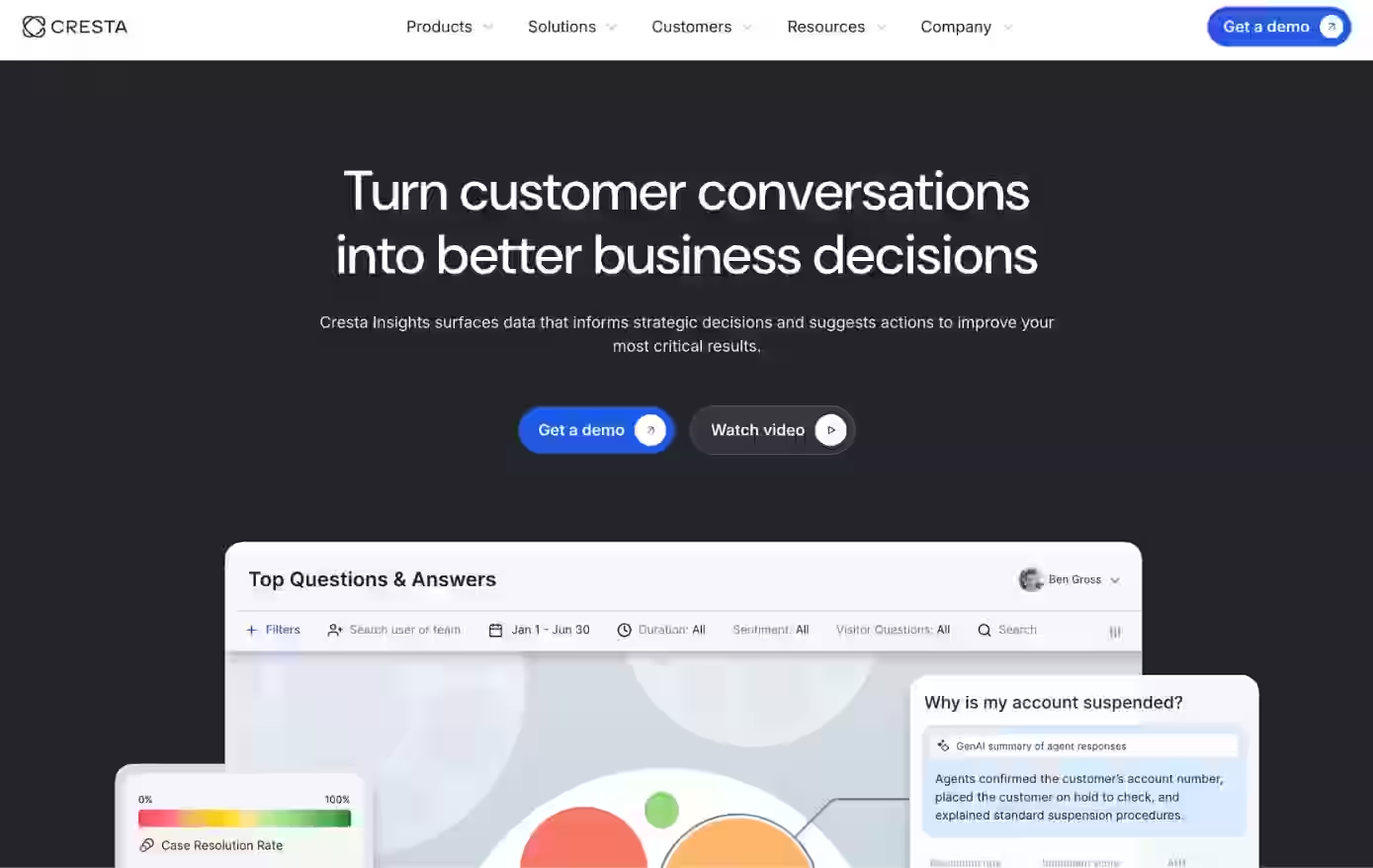
Cresta call center speech analytics software analyzes live and completed customer conversations across voice, chat, and email for real-time agent guidance, behavioral pattern detection, sentiment trends, topic detection, outcome analysis, and conversation trends. Cresta fits contact centers focused on in-the-moment agent assistance, sales conversations, and natural language access to interaction data.
Cresta Call Center Speech Analytics Software Types
| Speech Analytics Software Type | What It Does | Cresta Capability |
|---|---|---|
| Unified Speech Analytics | Unifies conversation, QA, CRM, WFM, survey, performance, and legacy data for role-based action | ❌ |
| Post-Call Speech Analytics | Analyzes completed interactions for sentiment, topics, call reasons, quality trends, and coaching priorities | ✅ |
| Real-Time Speech Analytics | Live agent guidance during active customer conversations | ✅ |
| Predictive Speech Analytics | Forecasts customer experience risk and performance patterns from historical data | ❌ |
| Conversation Intelligence | Analyzes voice, chat, email, messaging, and social interactions for intent, sentiment, topics, and experience trends | ✅ |
Cresta Call Center Speech Analytics Software Features
| Speech Analytics Software Feature | What It Does | Cresta |
|---|---|---|
| Unified Data Integration | Unifies conversation, QA, CRM, WFM, survey, performance, and legacy data into one AI-ready layer | ❌ |
| Coaching Workflow Integration | Turns conversation patterns, QA findings, agent behaviors, and customer issues into coaching priorities, follow-up actions, and leader workflows for post-interaction performance improvement. | ❌ |
| Auto QA Integration | Combines speech analytics with automated quality scoring | ✅ |
| Performance Management Analytics | Shows how conversation patterns, behaviors, and interaction trends relate to KPIs and performance movement | ✅ |
| Compliance Monitoring & Risk Detection | Identifies violations and regulatory risks in conversations | ✅ |
| AI-Enabled Sentiment Analysis | Detects customer emotion, agent empathy, frustration, satisfaction signals, and escalation patterns | ✅ |
| Root Cause Analysis | Identifies underlying issues across interaction patterns | ✅ |
| Topic Categorization & Intent Models | Groups conversations by topic, intent, issue type, and interaction reason | ✅ |
| Ask Your Transcripts (Unscripted Q&A) | Natural language queries of conversation data | ✅ |
| Real-Time Agent Guidance | Live prompts, suggestions, and compliance alerts during active customer conversations | ✅ |
| Conversation Intelligence (Omnichannel) | Analyzes voice, chat, email, messaging, and social interactions for intent, sentiment, topics, and experience trends | ✅ |
| Customer Survey Commentary Analysis | Analyzes open-text survey responses alongside conversations | ❌ |
| Predictive NPS | Forecasts Net Promoter Score from conversation patterns | ❌ |
| Experience Sequence Analysis | Maps customer journey patterns across interactions | ❌ |
| Workflow Automation | Moves conversation patterns into coaching tasks, compliance reviews, QA evaluations, and follow-up workflows | ✅ |
| AI-Enabled AutoDiscovery | Surfaces emerging trends without predefined categories | ✅ |
| CX Analytics Outcome Metrics | Measures relationship between conversations and business outcomes | ✅ |
| Agent Behavior Analysis | Identifies agent behaviors, language patterns, empathy signals, adherence issues, and conversation techniques | ✅ |
| Customer Journey Mapping | Visualizes complete customer interactions across touchpoints | ❌ |
Standout Features and Capabilities of Cresta
- Real-Time Agent Guidance: Cresta surfaces live prompts, suggested responses, objection-handling guidance, and compliance reminders during active customer conversations.
- AI Analyst Natural Language Queries: Cresta lets users ask natural language questions about conversation data and retrieve answers supported by transcript evidence.
- Behavior-to-Outcome Analysis: Cresta analyzes which agent behaviors correlate with outcomes such as conversion, resolution, handle time, and customer satisfaction.
Best Fit: Who Should Use Cresta
- Contact centers focused on real-time agent assistance during live customer conversations.
- Sales and revenue teams that want conversation guidance tied to objection handling, suggested responses, and agent behavior patterns.
- Teams that want natural language access to conversation insights and outcome trends.
Cresta Considerations
- Cresta centers on real-time agent guidance and conversation analysis.
- Contact centers should evaluate data access and workflow requirements across QA, leader coaching, performance management, customer intelligence, WFM, CRM, and BPO oversight.
- Teams seeking predictive analytics, journey analytics, leader-enabled coaching workflows, and cross-system performance management should evaluate integration depth before choosing Cresta.
Cresta Call Center Speech Analytics Software Overview
Cresta call center speech analytics software functions as a real-time agent guidance and conversation intelligence layer for contact centers analyzing voice and digital interactions. Cresta supports speech analytics programs focused on live prompts, behavioral pattern detection, sentiment trends, topic analysis, natural language transcript queries, outcome analysis, and conversation trends.
Compare Cresta to AmplifAI for Speech Analytics Software
Compare Cresta Alternatives Across 9 Software Categories
8. Convin Call Center Speech Analytics Software
Convin call center speech analytics software analyzes voice, chat, and email interactions for automated QA, compliance review, sentiment patterns, topic detection, agent behavior analysis, and real-time agent assistance. Convin fits mid-size contact centers focused on expanding QA coverage, reducing manual interaction review, and delivering agent-facing guidance from conversation insights.
Convin Call Center Speech Analytics Software Types
| Speech Analytics Software Type | What It Does | Convin Capability |
|---|---|---|
| Unified Speech Analytics | Unifies conversation, QA, CRM, WFM, survey, performance, and legacy data for role-based action | ❌ |
| Post-Call Speech Analytics | Analyzes completed interactions for sentiment, topics, call reasons, quality trends, and coaching priorities | ✅ |
| Real-Time Speech Analytics | Live agent guidance during active customer conversations | ✅ |
| Predictive Speech Analytics | Forecasts customer experience risk and performance patterns from historical data | ⚠️ |
| Conversation Intelligence | Analyzes voice, chat, email, messaging, and social interactions for intent, sentiment, topics, and experience trends | ✅ |
Convin Call Center Speech Analytics Software Features
| Speech Analytics Software Feature | What It Does | Convin |
|---|---|---|
| Unified Data Integration | Unifies conversation, QA, CRM, WFM, survey, performance, and legacy data into one AI-ready layer | ❌ |
| Coaching Workflow Integration | Turns conversation patterns, QA findings, agent behaviors, and customer issues into coaching priorities, follow-up actions, and leader workflows for post-interaction performance improvement. | ❌ |
| Auto QA Integration | Combines speech analytics with automated quality scoring | ✅ |
| Performance Management Analytics | Shows how conversation patterns, behaviors, and interaction trends relate to KPIs and performance movement | ⚠️ |
| Compliance Monitoring & Risk Detection | Identifies violations and regulatory risks in conversations | ✅ |
| AI-Enabled Sentiment Analysis | Detects customer emotion, agent empathy, frustration, satisfaction signals, and escalation patterns | ✅ |
| Root Cause Analysis | Identifies underlying issues across interaction patterns | ⚠️ |
| Topic Categorization & Intent Models | Groups conversations by topic, intent, issue type, and interaction reason | ✅ |
| Ask Your Transcripts (Unscripted Q&A) | Natural language queries of conversation data | ❌ |
| Real-Time Agent Guidance | Live prompts, suggestions, and compliance alerts during active customer conversations | ✅ |
| Conversation Intelligence (Omnichannel) | Analyzes voice, chat, email, messaging, and social interactions for intent, sentiment, topics, and experience trends | ✅ |
| Customer Survey Commentary Analysis | Analyzes open-text survey responses alongside conversations | ❌ |
| Predictive NPS | Forecasts Net Promoter Score from conversation patterns | ❌ |
| Experience Sequence Analysis | Maps customer journey patterns across interactions | ⚠️ |
| Workflow Automation | Moves conversation patterns into coaching tasks, compliance reviews, QA evaluations, and follow-up workflows | ✅ |
| AI-Enabled AutoDiscovery | Surfaces emerging trends without predefined categories | ⚠️ |
| CX Analytics Outcome Metrics | Measures relationship between conversations and business outcomes | ✅ |
| Agent Behavior Analysis | Identifies agent behaviors, language patterns, empathy signals, adherence issues, and conversation techniques | ✅ |
| Customer Journey Mapping | Visualizes complete customer interactions across touchpoints | ❌ |
Standout Features and Capabilities of Convin
- Automated Quality Review: Convin analyzes customer interactions with automated QA scoring, compliance checks, evaluation forms, and interaction review workflows.
- Real-Time Agent Assist: Convin provides live monitoring, supervisor alerts, violation detection, and contextual guidance during active customer conversations.
- Agent Training Recommendations: Convin surfaces agent performance gaps, call examples, and training actions from conversation analysis and QA findings.
Best Fit: Who Should Use Convin
- Mid-size contact centers moving from manual QA sampling to automated interaction review.
- QA teams focused on expanding coverage across voice, chat, and email interactions.
- Contact centers that want automated QA, conversation intelligence, agent training recommendations, and real-time guidance in a standalone conversation intelligence environment.
Convin Considerations
- Convin centers on automated QA, conversation intelligence, agent training recommendations, and real-time agent assistance.
- Contact centers should evaluate data access and workflow requirements across performance management, customer intelligence, WFM, CRM, and BPO oversight.
- Teams seeking leader-enabled coaching workflows, predictive analytics, journey analytics, and cross-system performance management should evaluate integration depth before choosing Convin.
Convin Call Center Speech Analytics Software Overview
Convin call center speech analytics software functions as an automated QA, conversation intelligence, and real-time agent assist layer for contact centers analyzing voice and digital interactions. Convin supports speech analytics programs focused on QA coverage, compliance review, sentiment analysis, topic detection, agent behavior analysis, agent training recommendations, and real-time guidance.
9. Level AI Call Center Speech Analytics Software
Level AI call center speech analytics software uses natural language understanding to analyze voice, chat, and email interactions for automated QA, sentiment analysis, topic detection, customer intent, agent behavior analysis, and real-time agent assistance. Level AI fits mid-market contact centers focused on automated quality review, conversation analytics, and real-time support across digital and voice interactions.
Level AI Call Center Speech Analytics Software Types
| Speech Analytics Software Type | What It Does | Level AI Capability |
|---|---|---|
| Unified Speech Analytics | Unifies conversation, QA, CRM, WFM, survey, performance, and legacy data for role-based action | ❌ |
| Post-Call Speech Analytics | Analyzes completed interactions for sentiment, topics, call reasons, quality trends, and coaching priorities | ✅ |
| Real-Time Speech Analytics | Live agent guidance during active customer conversations | ✅ |
| Predictive Speech Analytics | Forecasts customer experience risk and performance patterns from historical data | ❌ |
| Conversation Intelligence | Analyzes voice, chat, email, messaging, and social interactions for intent, sentiment, topics, and experience trends | ✅ |
Level AI Call Center Speech Analytics Software Features
| Speech Analytics Software Feature | What It Does | Level AI Capability |
|---|---|---|
| Unified Data Integration | Unifies conversation, QA, CRM, WFM, survey, performance, and legacy data into one AI-ready layer | ❌ |
| Coaching Workflow Integration | Turns conversation patterns, QA findings, agent behaviors, and customer issues into coaching priorities, follow-up actions, and leader workflows for post-interaction performance improvement. | ❌ |
| Auto QA Integration | Combines speech analytics with automated quality scoring | ✅ |
| Performance Management Analytics | Shows how conversation patterns, behaviors, and interaction trends relate to KPIs and performance movement | ⚠️ |
| Compliance Monitoring & Risk Detection | Identifies violations and regulatory risks in conversations | ✅ |
| AI-Enabled Sentiment Analysis | Detects customer emotion, agent empathy, frustration, satisfaction signals, and escalation patterns | ✅ |
| Root Cause Analysis | Identifies underlying issues across interaction patterns | ⚠️ |
| Topic Categorization & Intent Models | Groups conversations by topic, intent, issue type, and interaction reason | ✅ |
| Ask Your Transcripts (Unscripted Q&A) | Natural language queries of conversation data | ⚠️ |
| Real-Time Agent Guidance | Live prompts, suggestions, and compliance alerts during active customer conversations | ✅ |
| Conversation Intelligence (Omnichannel) | Analyzes voice, chat, email, messaging, and social interactions for intent, sentiment, topics, and experience trends | ✅ |
| Customer Survey Commentary Analysis | Analyzes open-text survey responses alongside conversations | ❌ |
| Predictive NPS | Forecasts Net Promoter Score from conversation patterns | ❌ |
| Experience Sequence Analysis | Maps customer journey patterns across interactions | ❌ |
| Workflow Automation | Moves conversation patterns into coaching tasks, compliance reviews, QA evaluations, and follow-up workflows | ✅ |
| AI-Enabled AutoDiscovery | Surfaces emerging trends without predefined categories | ⚠️ |
| CX Analytics Outcome Metrics | Measures relationship between conversations and business outcomes | ⚠️ |
| Agent Behavior Analysis | Identifies agent behaviors, language patterns, empathy signals, adherence issues, and conversation techniques | ✅ |
| Customer Journey Mapping | Visualizes complete customer interactions across touchpoints | ❌ |
Standout Features and Capabilities of Level AI
- Natural Language Understanding: Level AI analyzes conversation context, customer intent, sentiment, topic patterns, and agent behavior across voice and digital interactions.
- Automated Quality Review: Level AI supports QA teams with automated scoring, evaluation coverage, compliance checks, and interaction review workflows.
- Real-Time Agent Assistance: Level AI displays contextual information, knowledge base content, and guidance during live customer conversations.
Best Fit: Who Should Use Level AI
- Mid-market contact centers moving from manual QA sampling to automated interaction review.
- QA teams that want AI-generated conversation analysis, agent behavior tracking, and broader evaluation coverage.
- Contact centers that want automated QA, conversation intelligence, and real-time agent assistance in a standalone conversation intelligence environment.
Level AI Considerations
- Level AI centers on automated QA, conversation analytics, natural language understanding, and real-time agent assistance.
- Contact centers should evaluate data access and workflow requirements across performance management, customer intelligence, WFM, CRM, and BPO oversight.
- Teams seeking leader-enabled coaching workflows, predictive analytics, journey analytics, and cross-system performance management should evaluate integration depth before choosing Level AI.
Level AI Call Center Speech Analytics Software Overview
Level AI call center speech analytics software functions as an automated QA, conversation analytics, and real-time agent assistance layer for contact centers analyzing voice and digital interactions. Level AI supports speech analytics programs focused on QA coverage, compliance review, sentiment analysis, topic detection, customer intent, agent behavior analysis, and live guidance.
Compare Level AI to AmplifAI for Speech Analytics Software
How to Choose Call Center Speech Analytics Software
When choosing call center speech analytics software, start with what your contact center needs conversation data to do after transcription, sentiment analysis, and keyword detection. The right choice depends on when conversations are analyzed, where insights are delivered, and whether speech analytics connects to QA, compliance, customer intelligence, coaching, and performance management workflows.
Consider these factors:
- Software model: Standalone speech analytics, CCaaS-native analytics, real-time agent guidance, predictive analytics, conversation intelligence, and unified speech analytics each serve a different purpose. Real-time guidance software will not support the same post-interaction use cases as software that connects speech data to QA, compliance, coaching, customer intelligence, and performance workflows.
- Insight delivery: Speech analytics creates more value when conversation data reaches the systems your teams already use to evaluate agents, monitor compliance, coach performance, and understand customer experience. Isolated speech analytics outputs create more dashboards without creating a clear path from insight to action.
- Coverage vs. connection: A vendor can analyze voice, chat, email, and social interactions without connecting those insights to the workflows that improve performance. Communication channel coverage matters, but connection to QA, coaching, compliance, customer intelligence, and performance management determines whether speech insights change outcomes.
- AI accuracy: Transcription quality, context understanding, accent handling, sentiment detection, and intent recognition affect how confidently your teams can use automated scoring, coaching priorities, compliance flags, and customer intelligence outputs.
- Scale and complexity: A single-site contact center has different speech analytics requirements than a global enterprise or BPO network. Multi-site, multi-language, multi-client, and multi-vendor environments need stronger data integration, reporting consistency, and workflow connection than basic speech analytics software provides.
If your team needs help comparing call center speech analytics software vendors, speak to a CX leader at AmplifAI.
Speak to a CX Leader at AmplifAI
Customer Service and Support Software Buyer’s Guides
Our CX specialists at AmplifAI research and evaluate customer service and support software for CX leaders, analytics teams, QA teams, compliance leaders, and contact center decision-makers. AmplifAI’s buyer’s guides compare vendors within customer service and support software categories across features, best-fit use cases, key considerations, and evaluation criteria for developing your shortlist.
| Software Buyer's Guide | What It Covers | Top Vendors |
|---|---|---|
| Call Center Software | Complete taxonomy of call center software categories with top vendors for customer service and support | AmplifAI, NICE, Genesys, Verint, CallMiner |
| Contact Center as a Service (CCaaS) Software | Full review and comparison of the best Contact Center as a Service (CCaaS) software in 2026 | NICE CXone, Genesys Cloud CX, Five9, Zoom, Talkdesk |
| Call Center CRM Software | Full review and comparison of the best call center CRM software in 2026 | Salesforce Service Cloud, Microsoft Dynamics 365, HubSpot Service Hub, Zoho CRM, Oracle CX |
| Contact Center AI Software | Full review and comparison of the best contact center AI software in 2026 | AmplifAI, Dialpad, Five9, Genesys, NICE |
| AI Agent Management Software | Full review and comparison of the best AI agent management software for customer service in 2026 | AmplifAI, Cresta, NICE, Observe.AI, Kore.ai |
| Call Center Workforce Management Software | Full review and comparison of the best call center workforce management software in 2026 | NICE CXone, Verint, Genesys Cloud, Assembled, Five9 |
| Call Center Speech Analytics Software | Full review and comparison of the best call center speech analytics software in 2026 | AmplifAI, CallMiner, NICE, Observe.AI, Verint |
| Call Center Analytics Software | Full review and comparison of the best call center analytics software in 2026 | AmplifAI, NICE CXone, Verint, Genesys Cloud, CallMiner |
| Call Center QA Software | Full review and comparison of the best call center QA software in 2026 | AmplifAI, CallMiner, Dialpad, NICE, Observe.AI |
| Call Center Performance Management Software | Full review and comparison of the best call center performance management software in 2026 | AmplifAI, Genesys, NICE, Talkdesk, Verint |
| Call Center Coaching Software | Full review and comparison of the best call center coaching software in 2026 | AmplifAI, Centrical, Cresta, EvaluAgent, Observe.AI |
| Call Center Gamification Software | Full review and comparison of the best call center gamification software in 2026 | AmplifAI, Centrical, Cresta, Genesys, NICE |
| Customer Insights Software | Full review and comparison of the best customer insights software in 2026 | AmplifAI, CallMiner, Cresta, Observe.AI, Tethr |
Call Center Speech Analytics Software FAQs
What is the difference between speech analytics, conversation intelligence, and voice analytics software?
Speech analytics software analyzes voice conversations for sentiment, compliance risks, agent behaviors, keywords, call drivers, and recurring interaction patterns. Conversation intelligence software expands analysis across voice and digital channels, including calls, chat, email, messaging, and social interactions. Voice analytics software focuses on acoustic signals such as tone, pitch, silence, interruptions, and emotional indicators.
See the full breakdown of speech analytics vs conversation intelligence vs voice analytics.
What are the different types of call center speech analytics software?
The five main types of call center speech analytics software are unified speech analytics, post-call speech analytics, real-time speech analytics, predictive speech analytics, and conversation intelligence.
See all 5 types of speech analytics software for detailed descriptions and vendor examples.
Why does most call center speech analytics software fail to deliver ROI?
Call center speech analytics software fails to deliver ROI when conversation insights stay disconnected from the teams and workflows responsible for action. Speech analytics can identify coaching opportunities, compliance risks, sentiment trends, and recurring call drivers, but findings lose value when QA teams, team leaders, compliance teams, and performance leaders need separate systems or manual follow-up to act on them.
See the full analysis of speech analytics software limitations by vendor type.
What is unified call center speech analytics software?
Unified call center speech analytics software turns speech and conversation data into QA, compliance, customer intelligence, coaching priorities, performance visibility, and role-specific actions. Unified speech analytics like AmplifAI uses calls, digital conversations, QA, CRM, WFM, performance, and legacy data so QA teams, team leaders, CX leaders, compliance teams, and executives can act on conversation patterns instead of reviewing standalone dashboards or reports.
What is the difference between CCaaS-native speech analytics and standalone call center speech analytics software?
CCaaS-native speech analytics software is built into contact center infrastructure from vendors such as NICE and Genesys, while standalone call center speech analytics software analyzes conversations outside the core CCaaS environment. CCaaS-native analytics usually works best when conversation data, routing, QA, workforce engagement, and reporting stay inside one vendor ecosystem, while standalone speech analytics supports more flexible vendor environments but still needs to connect insights to QA, coaching, compliance, performance management, customer intelligence, and follow-up action.
Does call center speech analytics software connect to QA, coaching, and performance management?
Some call center speech analytics software connects to QA, coaching, and performance management, but many implementations still require manual workflows, separate systems, or custom integrations. Unified speech analytics software like AmplifAI connects speech insights to Auto QA scoring, coaching priorities, compliance monitoring, customer intelligence, performance visibility, and follow-up action so conversation patterns reach the teams responsible for improvement.
What call center speech analytics software features matter most?
Call center speech analytics software features that matter most are connecting conversation data to action, transcription accuracy, sentiment analysis, topic detection, compliance monitoring, Auto QA integration, coaching priorities, real-time guidance, unified data integration, role-based reporting, and outcome measurement.
See the full call center speech analytics software features breakdown with vendor comparisons.
What is the best call center speech analytics software for enterprise contact centers and BPOs?
Enterprise contact centers and BPOs need call center speech analytics software that connects speech data across sites, vendors, channels, and systems while routing speech insights into QA, coaching priorities, compliance review, customer intelligence, performance visibility, and follow-up action. Unified speech analytics software like AmplifAI supports enterprise and BPO call center's by unifying speech data, and digital interactions.