
50+ Gamification Statistics You Need to Know in 2026

- Published:
- Updated:
- Authored by
-
 Robert Cowlishaw Head of Marketing
The latest gamification statistics reveal how companies are transforming workplace engagement in 2026, whether boosting productivity, retaining top talent, or creating better customer experiences, gamification is one of the tools being deployed to achieve these goals, and it's gaining traction fast.
90% of employees say Gamification makes them more productive at work. (1) Yet 43% of employees report they have never noticed any gamification at their workplace (4)
Despite the gap between employees who want gamified experiences and companies who deliver them, gamification has seen remarkable growth in the past decade, with the gamification market reaching $19.42 billion in 2025 and projected to hit $92.5 billion by 2030 (27), driven by contact center gamification software delivering measurable improvements in CX and agent performance.
We see this growth in Gamification particularly in customer service, where contact center gamification software is driving measurable improvements in CX and agent performance causing new investments and innovation in gamified elements.
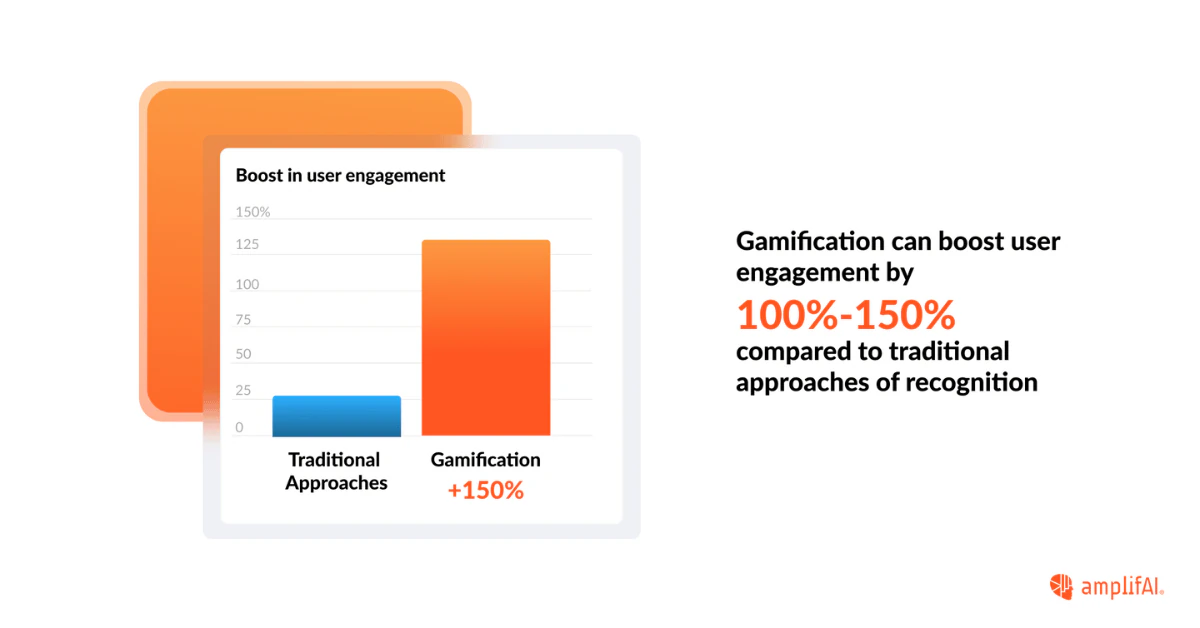
Gamification boosts user engagement by 100%-150% compared to traditional approaches of recognition. (15)
In customer service, gamification improves employee satisfaction, learning, sales, and customer engagement, with its clearest payoff in contact centers through lowering agent attrition and lifting frontline satisfaction. See where your call center KPI benchmarks stand in our latest 2026 guide, and how CX and AI pressures are reshaping the front line in the latest 2026 customer service statistics guide.
Looking to leverage Gamification in your call center? Check out the top call center gamification software of 2026.
Gamification Statistics on Benefit to Employees
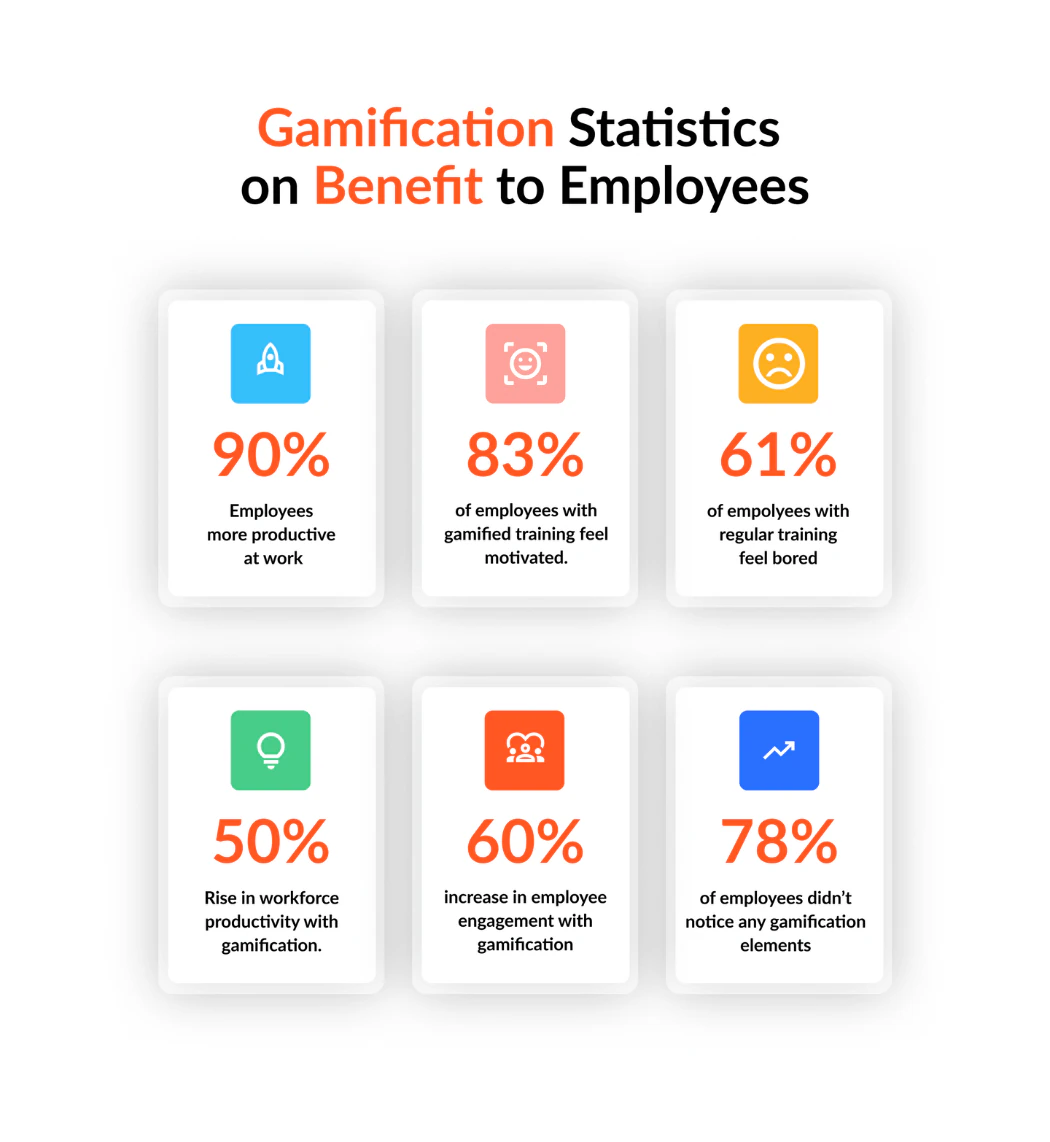
Gamification statistics on employee performance reveal how wide the gap is between what employees want from work and what most organizations currently deliver, with 90% of employees saying gamification makes them more productive (1) and 43% reporting they have never noticed any gamification at their workplace (4). Organizations that close that gap see measurable returns, with workforce productivity rising 50% and employee engagement climbing 60% in companies with the right gamification elements in place (3), while 52% of HR departments report better employee retention after integrating gamification into their workforce programs (10).
| Stat # | Gamification Statistics on Employee Performance and Motivation 2026 |
|---|---|
| 1 | 90% of employees say gamification makes them more productive at work. Cite source |
| 2 | 83% of employees who receive gamified training feel motivated at work, compared to 61% of those receiving non-gamified training who report feeling bored and unproductive. Cite source |
| 3 | Organizations with the right gamification elements in place see a 50% rise in workforce productivity and a 60% increase in employee engagement. Cite source |
| 4 | 43% of employees report they have not noticed any gamification elements at their workplace, signaling how much adoption opportunity remains. Cite source |
| 5 | A gamified recruiting process makes 78% of job applicants more motivated to pursue a role, giving employers a measurable edge in competitive hiring markets. Cite source |
| 6 | 89% of employees say they would be more productive if their work included more gamified elements. Cite source |
| 7 | 88% of employees report feeling happier at work when using gamified software, connecting engagement directly to workplace satisfaction. Cite source |
| 8 | 72% of workers report feeling motivated to work harder when gamification is present in their work environment. Cite source |
| 9 | A University of Colorado study found that employees in gamified learning environments scored 14% higher on skill-based knowledge assessments and 11% higher on factual knowledge tests than those in non-gamified environments. Cite source |
| 10 | 52% of HR departments report better employee retention after integrating gamification into their workforce management programs. Cite source |
| Gamification statistics on employee performance and motivation sourced from TalentLMS, Growth Engineering, University of Colorado, and Global Growth Insights. For data on how gamification drives business results, see Gamification Statistics on Benefit to Organizations below. | |
AmplifAI's Insights on Gamification and Employee Performance
Gamification statistics on employee performance reveal a clear demand signal from the workforce itself, with 90% of employees saying gamification makes them more productive (1), 89% saying they would be even more productive if their work included more gamified elements (6), and 43% reporting they have never noticed any gamification at their workplace (4). Gamification training research makes the cost of that gap measurable, with 83% of employees receiving gamified training feeling motivated compared to 61% of those in non-gamified programs who report feeling bored and unproductive (2), and a University of Colorado study finding gamified learners score 14% higher on skill assessments and 11% higher on factual knowledge tests (9). For workforce leaders managing retention, 52% of HR departments report measurable improvement in employee retention after integrating gamification into workforce management programs (10).
Gamification Statistics on Benefit to Organizations
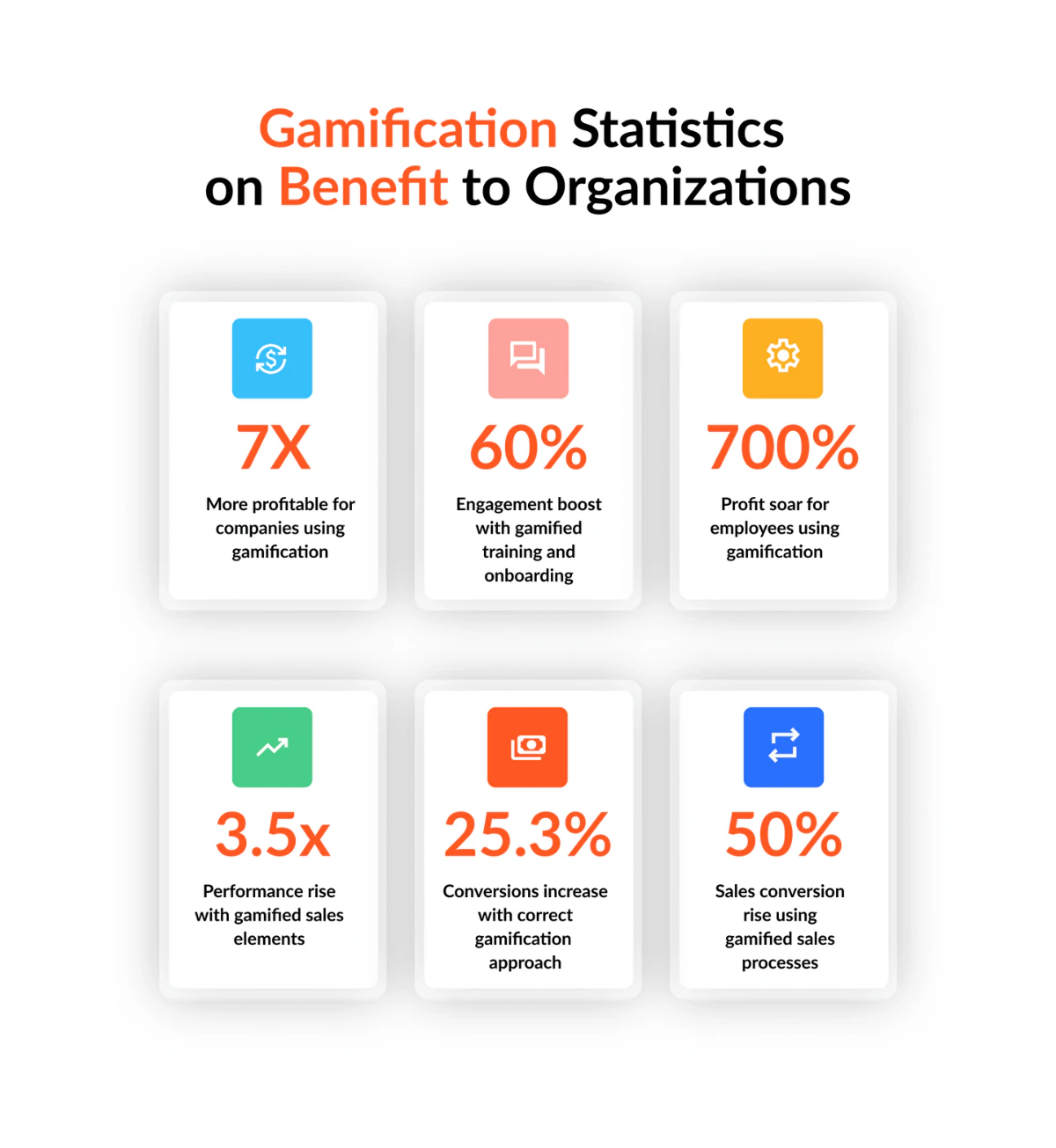
Gamification statistics on organizational performance reveal how wide the gap is between companies that have embedded game mechanics into their operations and those that haven't, with gamified organizations reporting 7x higher profitability (11) and a 50% reduction in training time (17) over organizations running traditional programs. The compounding effect shows up across sales output, training completion, and workforce retention, three cost centers where contact centers absorb the most margin pressure.
If you're exploring gamfication software for customer service, check out the top ranked call center gamification software guide for 2026.
| Stat # | Gamification Statistics on Business Growth and ROI 2026 |
|---|---|
| 11 | Companies using gamification are 7x more profitable than those that do not, whether measured through employee performance or customer engagement outcomes. Cite source |
| 12 | Adding gamified elements such as sales contests and leaderboards drives a 3.5x increase in sales performance levels. Cite source |
| 13 | Gamification drives a 50% increase in conversion rates when the right approach is matched to the right audience and buying context. Cite source |
| 14 | Companies deploying gamification in their sales processes see a 25.3% increase in sales conversion rates. Cite source |
| 15 | eLearning courses with gamified elements achieve a 90% completion rate, compared to 25% for courses without gamification. Cite source |
| 16 | 69% of employees are more likely to stay with an organization for three or more years when gamification is integrated into the work environment, according to a Forbes report. Cite source |
| 17 | Organizations using gamification in training programs report a 50% reduction in training time alongside measurable improvements in knowledge retention and employee performance. Cite source |
| Gamification statistics on business ROI and organizational impact sourced from Zippia, Forbes, GlobeNewswire, BuildEmpire, and Global Growth Insights. For gamification's effect on customer loyalty and engagement, see Gamification Statistics on Customer Engagement below. | |
AmplifAI's Insights on Gamification's Benefit to Organizations
Companies that embed gamification across training, sales, and onboarding outperform those that don't by a margin that compounds over time, with research showing gamified organizations are 7x more profitable (11) and sales teams using gamified contests and leaderboards seeing a 3.5x increase in performance (12). Those gains translate directly to revenue, with gamification driving a 50% increase in conversion rates (13) and sales conversion improvements of 25.3% (14) across organizations that deploy it with consistency.
Gamified eLearning reaches a 90% completion rate against 25% for non-gamified programs (15), cutting training time by 50% (17) while delivering content that agents and employees actually finish. Retention follows the same pattern, with 69% of employees staying three or more years at organizations using gamification (16), reducing the recruiting and onboarding costs that erode contact center margins. For contact center leaders, the numbers describe a compounding advantage, with higher sales output, faster training cycles, and a workforce that stays long enough to apply what it learns.
If you're evaluating the software behind these results across gamification, coaching, QA, and performance management, the best call center software guide for 2026 compares vendors across every layer of the contact center stack.
Gamification Statistics on Customer engagement
Gamification statistics on customer engagement reveal how game mechanics are reshaping the way brands build loyalty and drive digital interaction, with gamified campaigns producing engagement rates 100%-150% higher than traditional marketing (21) and gamified content being shared 12x more than non-gamified content (20). The conversion data is where the business case for gamification sharpens, with gamification lifting trial usage by 54% and buy clicks by 15% (24), turning passive audiences into active buyers at a pace that traditional loyalty programs and static content strategies have not been able to match.
| Stat # | Gamification Statistics on User Engagement and Loyalty 2026 |
|---|---|
| 18 | Businesses with gamified loyalty programs including virtual badges, points, and exclusive perks see a 22% increase in customer retention, driving repeat purchases and measurable brand loyalty. Cite source |
| 19 | Gamification leads to a 22% rise in social media sharing, expanding organic reach without additional ad spend. Cite source |
| 20 | Gamified content is shared 12x more than non-gamified content, with challenges, quizzes, and competitions motivating users to share achievements publicly and extend brand reach organically. Cite source |
| 21 | Gamified campaigns produce a 100%-150% jump in user engagement compared to traditional marketing approaches, measured across unique views, page views, community activities, and time on site. Cite source |
| 22 | Websites with gamification elements see a 29% increase in overall website engagement compared to sites without gamified features. Cite source |
| 23 | Customer engagement surges 48% with gamification, leading to increased time spent on platforms and stronger brand interaction across digital channels. Cite source |
| 24 | Gamification increases trial usage by 54% and buy clicks by 15%, with channel revenue rising 29% when free trial experiences include gamified elements. Cite source |
| 25 | 43% of marketers say gamification will be the most influential factor in customer loyalty over the next two to three years, outranking personalization and AI-powered recommendations. Cite source |
| 26 | 87% of retailers plan to implement gamification within the next five years, driven by proven gains in customer acquisition, loyalty program participation, and repeat purchase rates. Cite source |
| Gamification statistics on customer engagement and loyalty sourced from BeeLiked, Digital Silk, LXAHub, and EnterpriseAppsToday. For data on gamification market growth and industry adoption, see Statistics on the Gamification Industry below. | |
AmplifAI's Insights on Gamification and Customer Engagement
Gamification statistics on customer engagement show the compounding effect of game mechanics on brand loyalty and digital interaction, with gamified campaigns producing a 100%-150% jump in user engagement compared to traditional marketing (21), gamified content being shared 12x more than non-gamified content (20), and websites with gamification elements seeing a 29% increase in overall engagement (22).
Retention follows the same pattern, with gamified loyalty programs driving a 22% increase in customer retention through virtual badges, points, and exclusive perks (18), while gamification lifts trial usage by 54% and buy clicks by 15% (24), converting casual browsers into paying customers at a rate traditional funnels cannot match. The forward-looking gamification and customer engagement data reinforces why investment is accelerating, with 43% of marketers identifying gamification as the most influential factor in customer loyalty over the next two to three years (25) and 87% of retailers planning to implement gamification within the next five years (26).
Gamification drives engagement, but without proper quality assurance, even the best-designed programs fail to deliver results. See how contact centers combine gamification with automated QA to maximize agent performance in the Best Call Center Quality Assurance Software guide.
Statistics on the Gamification Industry
Gamification industry statistics show the market has scaled beyond experimentation, with the global gamification market reaching $19.42 billion in 2025 and 70% of Global 2000 companies already deploying gamified solutions across training, sales, and customer engagement (28). The growth trajectory is clear, but the implementation data tells a more nuanced story, with 80% of gamification programs falling short when organizations rely on surface-level mechanics instead of designing for the behavioral outcomes gamification is meant to drive (33).
| Stat # | Gamification Statistics on Market Growth and Adoption 2026 |
|---|---|
| 27 | The global gamification market was valued at $19.42 billion in 2025 and is projected to reach $92.5 billion by 2030, growing at a compound annual growth rate of 26% according to Mordor Intelligence. Cite source |
| 28 | 70% of Global 2000 companies use gamification in their business processes, spanning employee training, customer engagement, and sales performance. Cite source |
| 29 | The retail industry holds 28.6% of the gamification market, making it the most common adopter of gamified solutions, followed by the education sector. Cite source |
| 30 | North America holds 38% of the global gamification market share, driven by advanced enterprise adoption and digital infrastructure maturity across the United States and Canada. Cite source |
| 31 | 68% of companies have integrated gamification into at least one department, with the highest concentration in employee training, customer loyalty, and remote collaboration programs. Cite source |
| 32 | Cloud-based gamification platforms represent 58% of all deployments, with organizations prioritizing scalable, mobile-first engagement tools over on-premise installations. Cite source |
| 33 | An estimated 80% of gamification efforts fall short of expectations when organizations rely on generic point systems and leaderboards without designing for deeper behavioral engagement. Cite source |
| 34 | 50% of US-based startups are implementing gamification in their recruiting, sales, and customer engagement workflows. Cite source |
| 35 | Virtual reality-based learning games have the highest growth rate among all educational game types at 51.9%, followed by evaluation and assessment games at 46.2%, and language learning games at 41.8%. Cite source |
| 36 | Challenge-based gamification improved student performance by 89.45% compared to lecture-based education, according to research on gamified learning environments. Cite source |
| 37 | 45% of organizations face integration and scalability challenges when implementing gamification across multiple business platforms, citing compatibility with existing systems as the primary barrier. Cite source |
| Gamification industry and market statistics sourced from Mordor Intelligence, Fortune Business Insights, Global Growth Insights, Research and Markets, and Business Research Insights. For gamification's impact on learning and training outcomes, see Gamification Statistics on Learning & Training below. | |
AmplifAI's Insights on the Gamification Industry
Gamification industry growth in 2026 reflects a market that has moved well past early adoption, with the global market valued at $19.42 billion in 2025 and projected to reach $92.5 billion by 2030 (27), and 70% of Global 2000 companies already using gamification across their business processes (28). North America leads with 38% of the global market share (30), with 68% of companies integrating gamification into at least one department (31) and cloud-based deployments accounting for 58% of all deployments (32).
The scale of gamification adoption makes the failure data more important, with 80% of gamification efforts falling short when organizations default to generic point systems and leaderboards without designing for deeper behavioral engagement (33), and 45% citing integration and scalability challenges across existing platforms (37). The gap between companies deploying gamification at scale and those failing to see returns mirrors the same pattern visible across enterprise generative AI adoption, where it works when implementation matches the complexity of the problem, and falls short when organizations treat it as a surface-level addition to workflows.
See how the leading call center performance management software vendors integrate gamification into a complete performance management framework in the best call center performance management software for 2026 guide.
Gamification Statistics on Learning and Training
Gamification statistics on learning and training show why organizations are shifting investment toward gamified development programs, with gamified learning increasing knowledge retention by 45% (38) and VR trainees absorbing information 4x faster than classroom learners with 275% more confidence applying their skills on the job (39). The gamification education market reflects that momentum, growing at a 36.4% CAGR that outpaces the broader gamification market and signals sustained enterprise confidence in gamified training as a measurable performance driver (40).
| Stat # | Gamification Statistics on Learning and Training Outcomes 2026 |
|---|---|
| 38 | Gamified learning increases knowledge retention by 45% compared to non-gamified training programs, according to Global Growth Insights' 2025 market analysis. Cite source |
| 39 | VR trainees absorb information 4x faster than classroom learners and are 275% more confident applying their skills in real-world scenarios, according to a PwC study on immersive learning. Cite source |
| 40 | The gamification education market was valued at $1.14 billion in 2024 and is projected to reach $18.63 billion by 2033, expanding at a CAGR of 36.4%, outpacing the broader gamification market growth rate. Cite source |
| 41 | Microlearning modules with gamified elements achieve completion rates between 70% and 82%, significantly outperforming longer training formats where learner drop-off accelerates after the first session. Cite source |
| 42 | Microlearning is 17% more effective than traditional learning approaches, with learners retaining information up to 60% better when content is broken into smaller gamified segments. Cite source |
| 43 | SAP's AI-driven gamification module integrated into SuccessFactors boosted course completion rates by 48% and increased employee participation in learning and development programs by 36% within 60 days of rollout. Cite source |
| Gamification statistics on learning and training sourced from PwC, Global Growth Insights, Market Data Forecast, and BeeLiked. For gamification's impact on sales team performance and revenue, see Gamification Statistics on Sales below. | |
AmplifAI's Insights on Gamification in Learning & Training
Gamification statistics on learning and training point to a measurable shift in how organizations develop their workforce, with gamified learning increasing knowledge retention by 45% over non-gamified programs (38) and microlearning modules achieving completion rates between 70% and 82% where traditional formats see learner drop-off accelerate after the first session (41).
Gamified segments prove 17% more effective than traditional approaches and learners retaining information up to 60% better when content is broken into smaller units (42). Immersive training is compounding these gains, with PwC finding VR trainees absorb information 4x faster than classroom learners and report 275% more confidence applying their skills in real-world scenarios (39). Enterprise adoption reflects the returns, with SAP's AI-driven gamification module boosting course completion by 48% and L&D participation by 36% within 60 days of rollout (43), and the gamification education market itself projected to grow from $1.14 billion in 2024 to $18.63 billion by 2033 at a 36.4% CAGR that outpaces the broader gamification market (40).
For contact center leaders investing in agent development, gamified training delivers its strongest returns when paired with structured coaching programs that reinforce learning through consistent feedback loops and performance tracking. See how leading contact centers are combining gamification with AI-powered coaching in the best call center coaching software for 2026 guide.
Gamification Statistics on Sales Performance and Revenue
Gamification statistics on sales performance show a measurable link between game mechanics and revenue output, with US sales teams reporting a 40% productivity increase through gamified workflows (44) and enterprise deployments at Salesforce driving a 42% increase in engagement and 33% improvement in sales task completion rates (46). The case study data from Popchip, Autodesk, and LivingSocial reinforces the pattern, with gamification converting passive users into buyers and transforming low-participation processes into ones employees voluntarily engage in at rates above 90% (50).
| Stat # | Gamification Statistics on Sales Performance and Revenue 2026 |
|---|---|
| 44 | Sales teams using gamification in the US reported a 40% increase in productivity, with leaderboards, goal-setting badges, and real-time performance tracking driving consistent output gains. Cite source |
| 45 | 93% of marketers say they will continue implementing gamification in their campaigns, citing measurable improvements in lead generation, conversion rates, and customer acquisition. Cite source |
| 46 | Salesforce enhanced its sales cloud suite with gamified goal-setting badges and performance analytics in 2024, driving a 42% increase in user engagement and a 33% improvement in sales task completion rates across early-adopting enterprise clients. Cite source |
| 47 | Sales meetings and contact centers using gamification techniques reduce call time by 15% and improve sales output by approximately 10%, compounding over time as agents internalize competitive workflows. Cite source |
| 48 | Using gamification to personalize mobile advertising helped Popchip grow sales by 40%, reaching $100 million in total revenue through gamified customer engagement. Cite source |
| 49 | Autodesk implemented gamification in its product trial experience and saw trial utilization increase by 40% and conversion rates rise by 15%, turning passive trial users into paying customers. Cite source |
| 50 | LivingSocial gamified its annual performance reviews and saw more than 90% voluntary participation, replacing a process most employees previously avoided with one they actively engaged in. Cite source |
| Gamification statistics on sales performance sourced from Global Growth Insights, Jobera, LXAHub, Salesforce, Autodesk, and LivingSocial. For gamification's impact on contact center agent performance and CX, see Gamification Recognition and Incentives in Contact Centers for more details. | |
AmplifAI's Insights on Gamification in Sales Performance
Gamification statistics on sales performance show a consistent pattern across enterprise case studies and aggregate data, with US sales teams reporting a 40% productivity increase when gamification is embedded into daily workflows (44) and 93% of marketers committing to continued gamification investment based on measurable improvements in lead generation and conversion (45). The named enterprise results reinforce the aggregate data, with Salesforce's gamified sales enablement tools driving a 42% increase in user engagement and 33% improvement in sales task completion (46), Popchip reaching $100 million in revenue through gamified mobile advertising (48), and Autodesk converting passive trial users into paying customers with a 40% increase in trial utilization and 15% lift in conversion rates (49).
Efficiency gains extend into contact center sales environments, with gamification reducing call time by 15% and improving sales output by 10% (47), returns that compound as agents internalize competitive workflows and carry those behaviors into every interaction. LivingSocial's 90% voluntary participation rate in gamified performance reviews (50) signals something broader than sales output, with gamification transforming processes employees traditionally resist into ones they actively choose to engage in.
The Future of Gamification in 2026
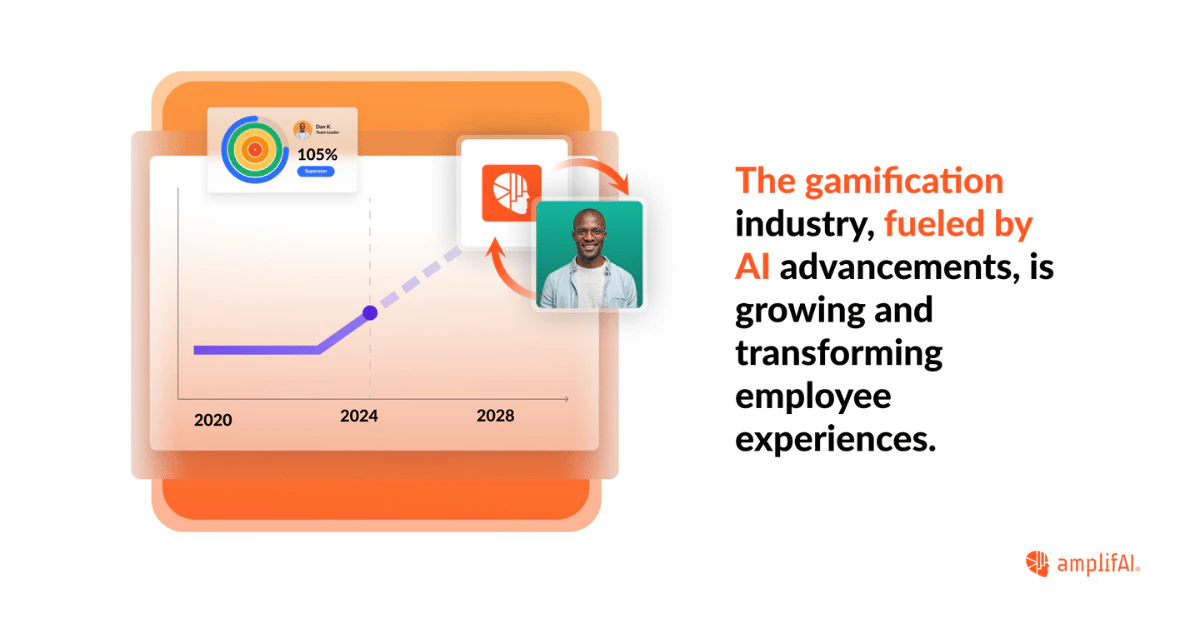
Gamification statistics across this report point to a market accelerating toward AI-powered personalization, with the global gamification market projected to reach $92.5 billion by 2030 (27) and 65% of gamification platforms already integrating AI and data analytics for personalized performance tracking. Academic research spanning 150 studies found that AI-enabled gamification achieves a 47% increase in user interaction frequency and a 38% rise in customer retention compared to gamification without AI, a gap that widens as organizations move from generic point systems toward data-driven engagement architectures.
For contact center leaders, AI-powered gamification is where agent coaching, performance management, and workforce engagement converge. Our guide to the best call center gamification software for 2026 compares the vendors and evaluation criteria that separate tools built for leaderboards from platforms built for measurable performance improvement.
If you're evaluating how gamification and AI fit into your contact center technology stack, speak to a CX leader at AmplifAI today.
Speak to a CX Leader at AmplifAI
Explore Contact Center Software for Gamification and Performance
Gamification metrics improve when engagement programs connect to coaching, QA, performance data, recognition workflows, and customer outcomes. These guides compare the vendors and features behind the software categories that shape agent engagement, motivation, and measurable performance improvement.
| Software Buyer's Guide | What It Covers | Top Vendors |
|---|---|---|
| Call Center Software | Complete taxonomy of call center software categories with top vendors for customer service and support | AmplifAI, NICE, Genesys, Verint, CallMiner |
| Contact Center as a Service (CCaaS) Software | Full review and comparison of the best Contact Center as a Service (CCaaS) software in 2026 | NICE CXone, Genesys Cloud CX, Five9, Zoom, Talkdesk |
| Call Center CRM Software | Full review and comparison of the best call center CRM software in 2026 | Salesforce Service Cloud, Microsoft Dynamics 365, HubSpot Service Hub, Zoho CRM, Oracle CX |
| Contact Center AI Software | Full review and comparison of the best contact center AI software in 2026 | AmplifAI, Dialpad, Five9, Genesys, NICE |
| AI Agent Management Software | Full review and comparison of the best AI agent management software for customer service in 2026 | AmplifAI, Cresta, NICE, Observe.AI, Kore.ai |
| Call Center Workforce Management Software | Full review and comparison of the best call center workforce management software in 2026 | NICE CXone, Verint, Genesys Cloud, Assembled, Five9 |
| Call Center Speech Analytics Software | Full review and comparison of the best call center speech analytics software in 2026 | AmplifAI, CallMiner, NICE, Observe.AI, Verint |
| Call Center Analytics Software | Full review and comparison of the best call center analytics software in 2026 | AmplifAI, NICE CXone, Verint, Genesys Cloud, CallMiner |
| Call Center QA Software | Full review and comparison of the best call center QA software in 2026 | AmplifAI, CallMiner, Dialpad, NICE, Observe.AI |
| Call Center Performance Management Software | Full review and comparison of the best call center performance management software in 2026 | AmplifAI, Calabrio One, Genesys, NICE, Verint |
| Call Center Coaching Software | Full review and comparison of the best call center coaching software in 2026 | AmplifAI, CallMiner, Dialpad, Genesys, Verint |
| AI-Powered Call Center Coaching Software | Full review and comparison of the best AI-powered call center coaching software in 2026 | AmplifAI, Centrical, Cresta, EvaluAgent, Observe.AI |
| Call Center Gamification Software | Full review and comparison of the best call center gamification software in 2026 | AmplifAI, Centrical, Cresta, Genesys, NICE |
| Customer Insights Software | Full review and comparison of the best customer insights software in 2026 | AmplifAI, CallMiner, Cresta, Observe.AI, Tethr |