
100+ Generative AI Statistics You Need to Know in 2026

- Published:
- Updated:
- Authored by
-
 Richard James Director of Organic Growth and CX
 - Reviewed by
-
 Sean Minter Founder, CEO
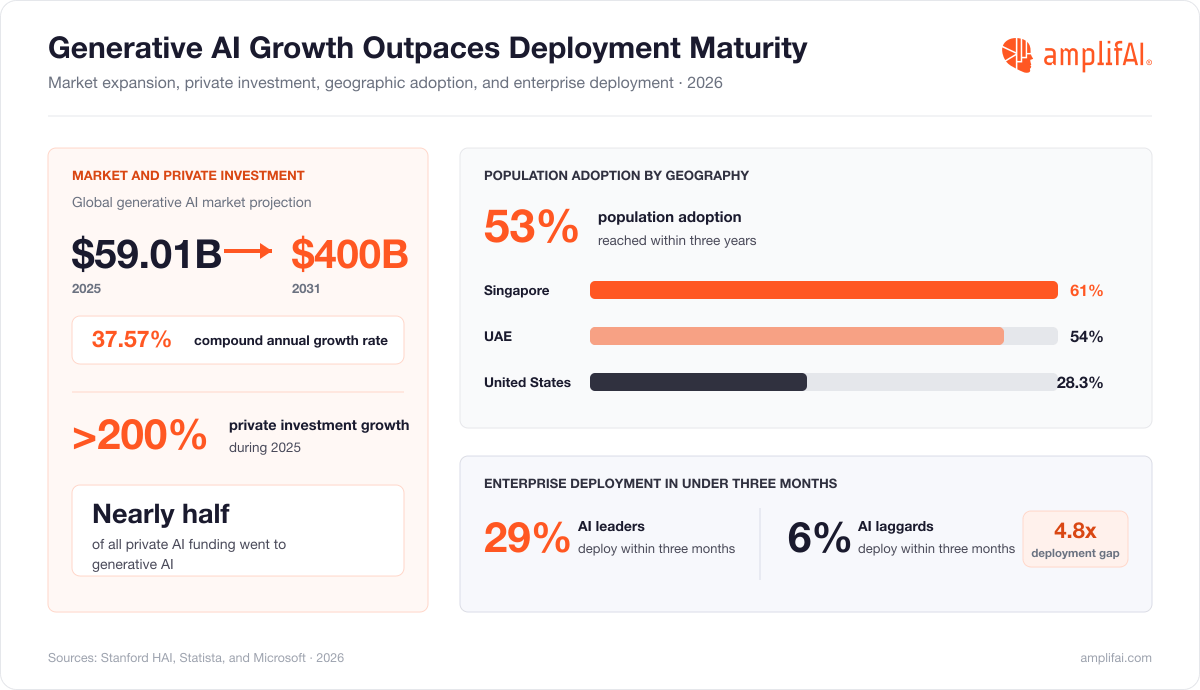
Generative AI statistics in 2026 show adoption and investment reaching scale before workflow integration, with generative AI reaching 53% population adoption within three years (95) while private investment grew more than 200% in 2025 and captured nearly half of all private AI funding (93).
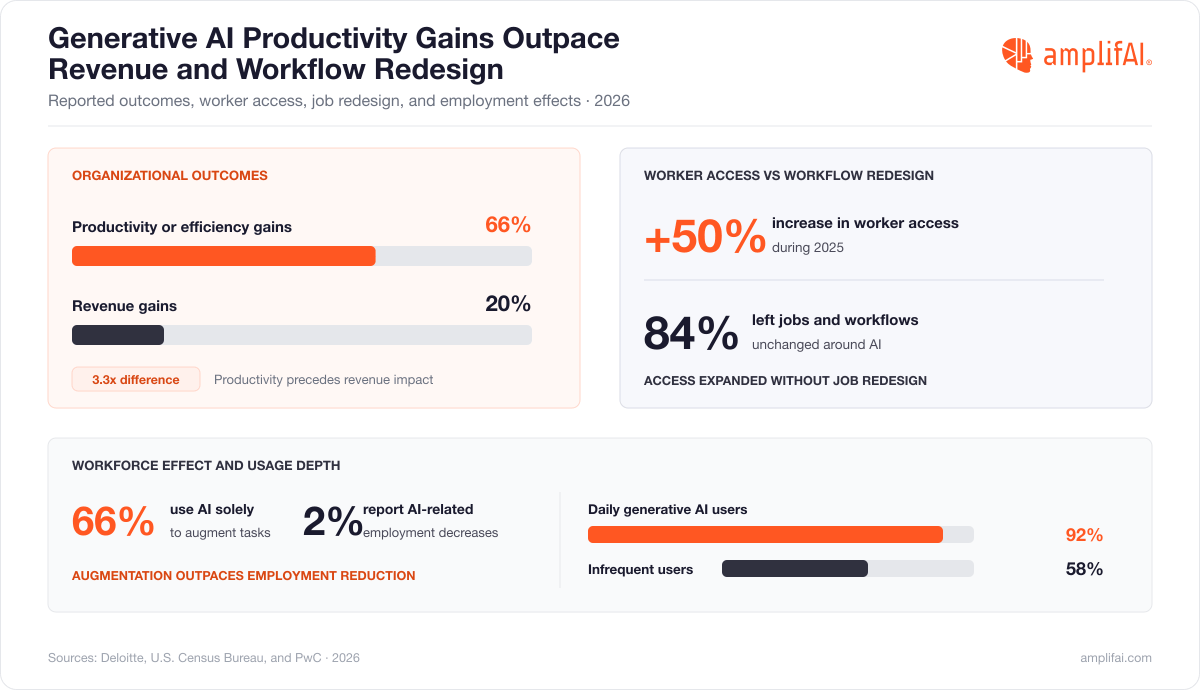
Operational gains outpace financial returns, with 66% of organizations reporting productivity or efficiency gains and only 20% reporting revenue gains (100), while more than 80% report no measurable enterprise-level EBIT impact from generative AI (16).
Workforce access has expanded without corresponding job redesign, with 84% of organizations leaving jobs and workflows unchanged despite a 50% increase in worker access during 2025 (99), while 66% of AI-using U.S. businesses use AI solely to augment tasks and only 2% report AI-related employment decreases (97).
Agentic AI adoption is moving faster than governance, with Cisco projecting 56% of customer support interactions will involve agentic AI by mid-2026 (83) while only one in five organizations has a mature governance model for autonomous AI agents (102).
Customer service and support leaders invested a median 12% of 2025 budgets in AI while only 24% reported positive financial returns (104), with customers approximately three times more likely to use third-party generative AI tools than company-provided chatbots for service resolution (103).
Generative AI statistics in 2026 point toward one operating reality, with workflow redesign, governance, multi-function deployment, and implementation depth separating generative AI access from measurable business value.
AmplifAI's 2026 customer service statistics guide extends generative AI evidence into customer expectations, agent experience, service channels, and contact center investment. Use AmplifAI's latest call center KPI benchmarks by industry guide to compare performance across 11 industries.
Generative AI Statistics on Market Size and Geography
Generative AI statistics on market size and geography show investment accelerating alongside uneven adoption, with private generative AI investment growing more than 200% in 2025 and capturing nearly half of all private AI funding (93), while estimated U.S. consumer surplus reached $172 billion annually by early 2026 (94).
Generative AI reached 53% population adoption within three years, with adoption reaching 61% in Singapore and 54% in the United Arab Emirates compared with 28.3% in the United States (95), while 29% of enterprise AI leaders deploy generative AI in under three months compared with 6% of laggards (5).
| Stat # | Generative AI Statistics on Market Size and Geography 2026 |
|---|---|
| 1 | Generative Adversarial Networks (GANs) accounted for over 74% of the global gen AI market share in 2023, with Transformer-based models making up the remainder. Cite source |
| 2 | 71% of organizations regularly use generative AI in at least one business function, up from 65% in early 2024, according to McKinsey's 2025 State of AI report. Cite source |
| 3 | 31% of North American companies qualify as AI leaders, while 16% remain AI laggards. Cite source |
| 4 | The global generative AI market reached $59.01 billion in 2025, and is projected to grow to $400 billion by 2031 at a compound annual growth rate of 37.57%. Cite source |
| 96 | Worldwide spending on AI models is forecast to reach $32.6 billion in 2026, representing 110% year-over-year growth. Cite source |
| 5 | 29% of AI leaders deploy gen AI in less than three months, compared to only 6% of laggards. Cite source |
| 6 | Private investment in generative AI reached $33.9 billion in 2024, a 19% increase over 2023, as part of $252 billion in total private AI investment worldwide. Cite source |
| 93 | Private investment in generative AI grew more than 200% in 2025, capturing nearly half of all private AI funding. Cite source |
| 94 | Estimated U.S. consumer surplus from generative AI reached $172 billion annually by early 2026, up from $112 billion one year earlier. Cite source |
| 95 | Generative AI reached 53% population adoption within three years, with adoption reaching 61% in Singapore and 54% in the United Arab Emirates while the United States ranked 24th at 28.3%. Cite source |
| 7 | 88% of organizations now use AI in at least one business function, up from 78% the previous year, with gen AI adoption concentrated in marketing and sales, product development, service, and software engineering. Cite source |
| 8 | 92% of Fortune 500 companies use OpenAI's technology. Cite source |
| 9 | 70% of Gen Z have tried generative AI tools, the highest adoption rate of any generation. Cite source |
| Generative AI market size and adoption statistics sourced from McKinsey, Stanford HAI, Statista, and Microsoft. For the latest generative AI statistics on how these market trends are translating into ROI, see Gen AI Investment and ROI statistics below. | |
AmplifAI's Analysis on Generative AI Market Size and Geography
Generative AI market expansion doesn't represent uniform adoption maturity, with private investment growing more than 200% in 2025 (93) while population adoption ranged from 61% in Singapore to 28.3% in the United States (95). Enterprise adoption adds a deployment divide, with 29% of AI leaders deploying generative AI in under three months compared with 6% of laggards (5), despite 88% of organizations using AI in at least one business function (7). Generative AI access has become common, with deployment speed, workflow integration, and organizational readiness separating use from enterprise capacity.
Generative AI Statistics on Investment and ROI
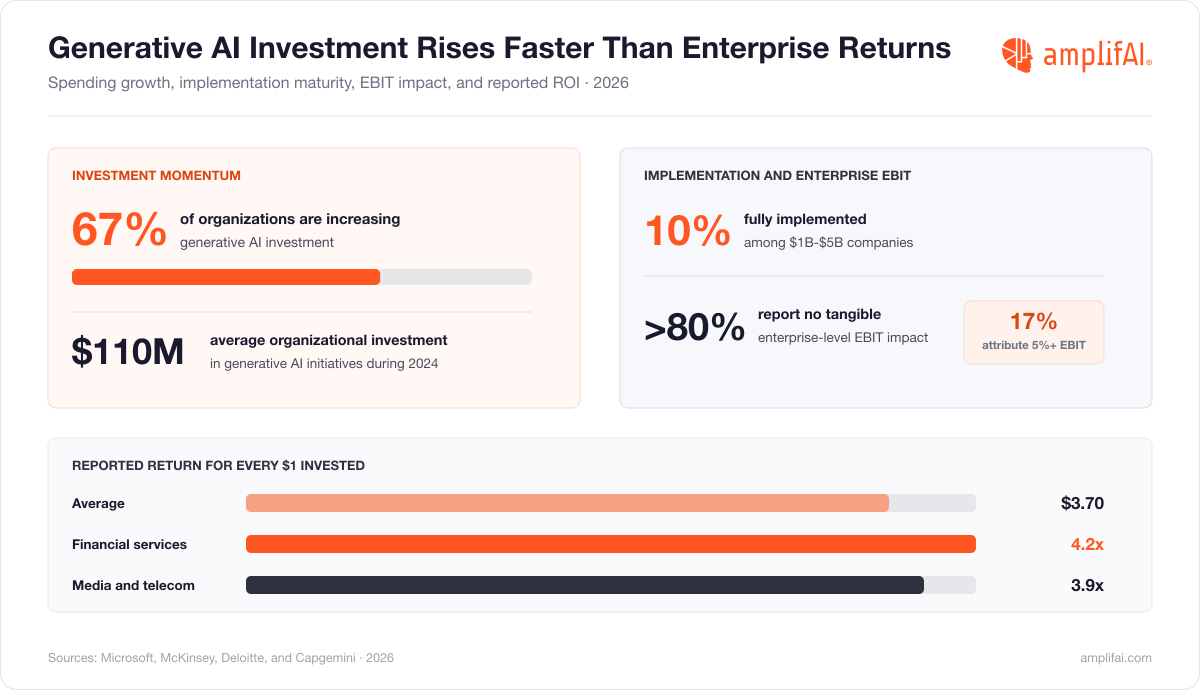
Generative AI statistics on investment and ROI show spending expanding faster than enterprise returns, with 67% of organizations increasing generative AI investment (21) and average organizational investment reaching $110 million in 2024 (24), while more than 80% report no enterprise-level EBIT impact and only 17% attribute at least 5% of EBIT to generative AI (16).
Reported returns remain substantial but uneven, averaging $3.70 for every $1 invested (10) while reaching 4.2x in financial services (11) and 3.9x in media and telecommunications (12).
| Stat # | Generative AI Statistics on Investment and ROI |
|---|---|
| 10 | For every $1 invested in generative AI, companies see an average return of $3.70. Cite source |
| 11 | Financial services have the highest generative AI ROI at 4.2x. Cite source |
| 12 | Media and telecommunications have the second-highest generative AI ROI at 3.9x. Cite source |
| 13 | More than two-thirds of organizations use AI in multiple business functions, with half using AI in three or more functions. Cite source |
| 14 | 92% of companies use generative AI for marketing and PR. Cite source |
| 15 | 60% of organizations say they are prepared to take advantage of generative AI capabilities over the next 24 months. Cite source |
| 16 | More than 80% of organizations report no tangible impact on enterprise-level EBIT from generative AI, and only 17% attribute 5% or more of their EBIT to gen AI. Cite source |
| 17 | 45% of technology infrastructure and 41% of data management companies say they are ready to adopt generative AI tools. Cite source |
| 18 | Organizations plan to invest more than 5% of their digital budgets in generative AI. Cite source |
| 19 | 55% of companies adopted gen AI in 2023, increasing to 72% in 2024. Cite source |
| 20 | 34% of companies using generative AI reported significant productivity increases. Cite source |
| 21 | 67% of organizations are increasing investments in generative AI applications compared to last year. Cite source |
| 22 | Businesses adopting gen AI are projected to achieve 15.2% cost savings. Cite source |
| 23 | Only 10% of companies with annual revenue between $1 billion and $5 billion have fully implemented generative AI. Cite source |
| 24 | Organizations invested an average of $110 million in generative AI initiatives in 2024. Cite source |
| 25 | McKinsey estimates generative AI could unlock between $2.6 trillion and $4.4 trillion in additional economic value annually. Cite source |
| Generative AI investment and ROI statistics sourced from McKinsey, Microsoft, Deloitte, Gartner, and Capgemini. For how these investments are reshaping customer service, see Gen AI in Customer Service statistics below. | |
AmplifAI's Analysis on Generative AI Investment and ROI
Generative AI investment isn't translating into implementation maturity at the same rate, with 67% of organizations increasing spending (21) while only 10% of companies earning $1 billion to $5 billion annually have fully implemented generative AI (23). Deployment depth remains uneven, with more than two-thirds using AI across multiple business functions but only half reaching three or more functions (13). Productivity gains can coexist with limited EBIT impact when organizations measure isolated task savings without tracing customer outcomes, operating cost, and workforce performance.
Measuring generative AI returns in contact centers requires consistent KPI definitions, with AmplifAI's call center productivity guide mapping formulas for FCR, average handle time, CSAT, cost per contact, occupancy, and attrition.
Generative AI Statistics on Customer Service
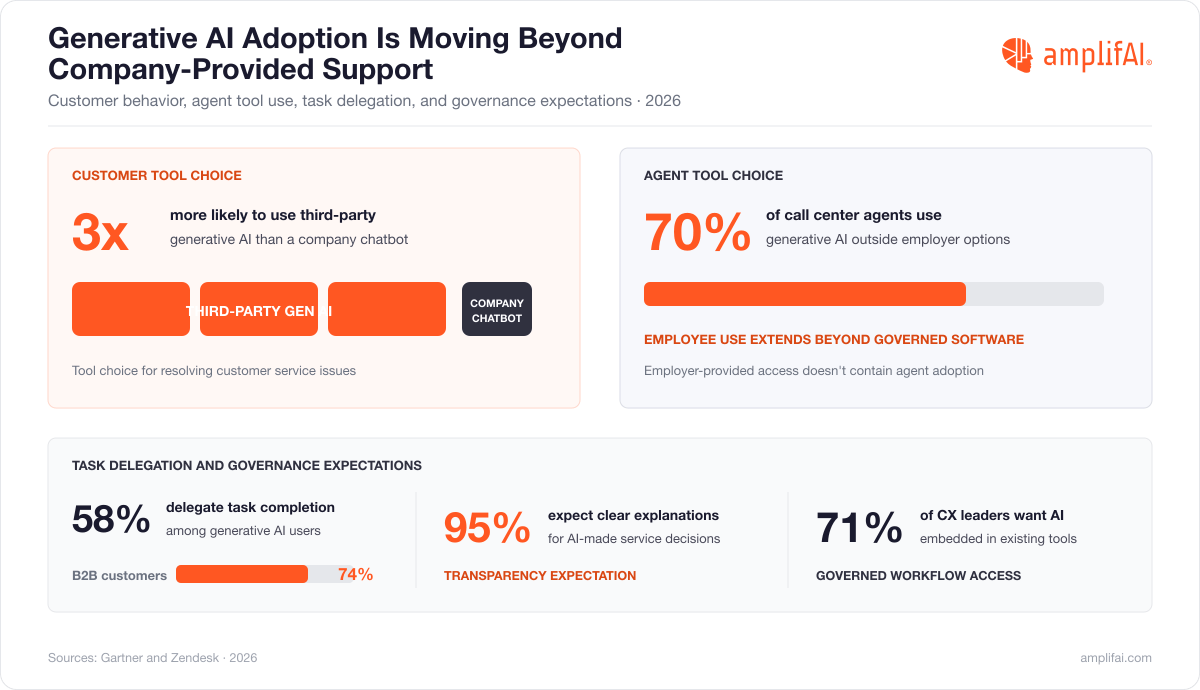
Generative AI statistics on customer service show executive pressure converting into budget before financial returns, with 91% of customer service and support leaders facing pressure to implement AI (50), while leaders invested a median 12% of 2025 budgets in AI and only 24% reported positive financial returns (104).
Customer and agent adoption also extends beyond company-provided tools, with 70% of call center agents using generative AI outside employer-provided options (40), while customers are approximately three times more likely to use third-party generative AI tools than company-provided chatbots for service resolution (103). Governance expectations remain high, with 95% of consumers expecting clear explanations for AI-made customer service decisions (37).
| Stat # | Generative AI Statistics on Customer Service |
|---|---|
| 26 | 70% of CX leaders plan to integrate generative AI into many of their touchpoints by 2026. Cite source |
| 27 | 43% of people are excited about using generative AI in their personal life, while 70% are excited to use it in the workplace. Cite source |
| 28 | 59% of companies expect generative AI to transform customer interactions. Cite source |
| 29 | 70% of support leaders say their trust in AI has increased since 2023. Cite source |
| 30 | 57% of CX leaders see chat-based customer support as a major area influenced by generative AI. Cite source |
| 103 | Customers are approximately three times more likely to use third-party generative AI tools than company-provided chatbots when resolving customer service issues. Cite source |
| 105 | 58% of customers using generative AI have delegated task completion to generative AI, rising to 74% among B2B customers. Cite source |
| 31 | 56% of CX leaders are exploring new generative AI vendors for enhancing customer experience. Cite source |
| 32 | 76% of companies considered adding generative AI to their customer support in 2024. Cite source |
| 33 | 42% of support leaders plan to use generative AI solutions in 2025. Cite source |
| 34 | 70% of CX leaders feel they've provided enough training for using gen AI tools, but less than half of agents agree. Cite source |
| 35 | 53% of customers say generative AI will help companies serve customers better. Cite source |
| 36 | 71% of CX leaders believe generative AI tools should be embedded into existing call center tools. Cite source |
| 37 | 95% of consumers expect a clear explanation for AI-made decisions in customer service. Cite source |
| 38 | 42% of CX leaders expect generative AI to influence voice-based customer interactions. Cite source |
| 39 | Customer service trendsetters adopt generative AI tools nearly 2.5x more than traditionalists. Cite source |
| 40 | 70% of call center agents use gen AI tools outside of what their company has provided. Cite source |
| 41 | 83% of CX leaders say memory-rich AI agents are the key to truly personalized customer journeys. Cite source |
| 42 | 69% of organizations believe generative AI can help humanize digital interactions. Cite source |
| 43 | 70% of CX leaders believe generative AI makes digital customer interactions more efficient. Cite source |
| 44 | 75% of consumers who have used generative AI expect it will change their customer service experiences. Cite source |
| 45 | Over 60% of customer service companies plan to invest in generative AI solutions. Cite source |
| 46 | 70% of CX leaders say generative AI made them re-evaluate their entire customer experience. Cite source |
| 47 | 67% of customers predict generative AI will be integral to customer support. Cite source |
| 48 | Content creation (40%) and classifying customer interactions (31%) are top generative AI use cases in call centers. Cite source |
| 49 | 88% of customers expect faster response times than they did just one year ago. Cite source |
| 50 | 91% of customer service and support leaders are under executive pressure to implement AI, not just for efficiency but to directly improve customer satisfaction. Cite source |
| 51 | 77% of service and support leaders feel pressure from senior executives to deploy AI, and 75% report increased budgets for AI initiatives compared to last year. Cite source |
| 104 | Customer service and support leaders invested a median 12% of their 2025 budgets in AI, while 24% reported positive financial returns across AI use cases. Cite source |
| 52 | 58% of customer service leaders plan to upskill agents as knowledge management specialists to review and curate AI-generated content. Cite source |
| Generative AI customer service statistics sourced from Zendesk, Gartner, Salesforce, BCG, and Deloitte. For how generative AI is reshaping contact center workflows and team performance, see Gen AI Business Impact statistics below. | |
AmplifAI's Analysis on Generative AI in Customer Service
Generative AI adoption in customer service isn't limited by leadership intent, with 70% of CX leaders believing AI training is sufficient while less than half of frontline agents agree (34), and 70% of call center agents using generative AI tools outside employer-provided options (40). Embedding generative AI inside existing call center tools addresses access and governance together, matching 71% of CX leaders who prefer AI integrated into existing software (36), while 58% of customer service leaders plan to upskill agents as knowledge management specialists responsible for reviewing and curating AI-generated content (52).
AmplifAI's best contact center AI software vendors guide compares providers across data integration, human-agent enablement, governance, workflow integration, and outcome measurement for contact centers evaluating embedded AI.
Generative AI Statistics on Business Impact
Generative AI statistics on business impact show productivity gains outpacing revenue and workforce change, with 66% of organizations reporting productivity or efficiency gains while only 20% report revenue gains (100), and 66% of AI-using U.S. businesses using AI solely to augment tasks while 2% report AI-related employment decreases (97).
Workflow redesign remains limited, with 84% of organizations leaving jobs and workflows unchanged despite a 50% increase in worker access during 2025 (99), while daily generative AI users report productivity gains at 92% compared with 58% among infrequent users (60).
| Stat # | Generative AI Statistics on Business Impact |
|---|---|
| 53 | 60% of AI-related job postings in 2023 were specifically tied to generative AI roles. Cite source |
| 54 | 37.4% of U.S. workers now use generative AI at work, up from 33.3% twelve months earlier. Cite source |
| 55 | The most common generative AI use cases are information capture and delivery through conversational interfaces, content support for marketing strategy, and contact center or customer service automation. Cite source |
| 56 | Generative AI is expected to drive employment declines in service functions (54%), supply chain management (45%), and HR (41%). Cite source |
| 97 | 66% of AI-using U.S. businesses use AI solely to augment tasks, while 2% report AI-related employment decreases. Cite source |
| 98 | More than 80% of nearly 6,000 firms surveyed across the United States, United Kingdom, Germany, and Australia reported no employment or productivity impact from AI during the previous three years. Cite source |
| 99 | 84% of organizations have not redesigned jobs or workflows around AI despite a 50% increase in worker access during 2025. Cite source |
| 57 | 54% of organizations are creating guidelines for the responsible use of generative AI. Cite source |
| 58 | Workers using generative AI save an average of 5.4% of their work hours each week, equal to a 33% productivity gain for each hour spent using the technology. Cite source |
| 100 | 66% of organizations report productivity or efficiency gains from AI, while 20% report revenue gains. Cite source |
| 59 | 78% of organizations reported using AI in 2024, up from 55% the year before, the sharpest single-year jump in enterprise AI adoption ever recorded. Cite source |
| 60 | Daily generative AI users report productivity gains at 92% compared to just 58% for infrequent users, based on a PwC survey of nearly 50,000 workers across 48 countries. Cite source |
| 61 | Daily generative AI users report higher job security (58% vs 36%) and salary increases (52% vs 32%) compared to infrequent users. Cite source |
| 62 | Generative AI adoption three years after ChatGPT's launch (54.6%) already exceeds personal computer adoption three years after the IBM PC (19.7%) and internet adoption three years after commercial launch (30.1%). Cite source |
| Generative AI business impact statistics sourced from Stanford HAI, Federal Reserve Bank of St. Louis, McKinsey, PwC, and Capgemini. For the challenges organizations face implementing generative AI, see Gen AI Implementation Challenges statistics below. | |
AmplifAI's Analysis on Generative AI Business Impact
Generative AI business impact isn't determined by access alone, with daily users reporting productivity gains more often than infrequent users (60), while 84% of organizations haven't redesigned jobs or workflows around AI despite a 50% increase in worker access (99). Organizational results remain uneven, with 66% reporting productivity or efficiency gains while only 20% report revenue gains (100). Individual time savings can remain isolated when performance data, coaching, quality management, and operating workflows don't convert productivity into customer, workforce, or financial outcomes.
AmplifAI's guide to the best gen AI-powered call center performance management software compares providers across performance data, coaching workflows, quality management, role-based visibility, and outcome measurement.
Generative AI Statistics on AI Implementation Challenges
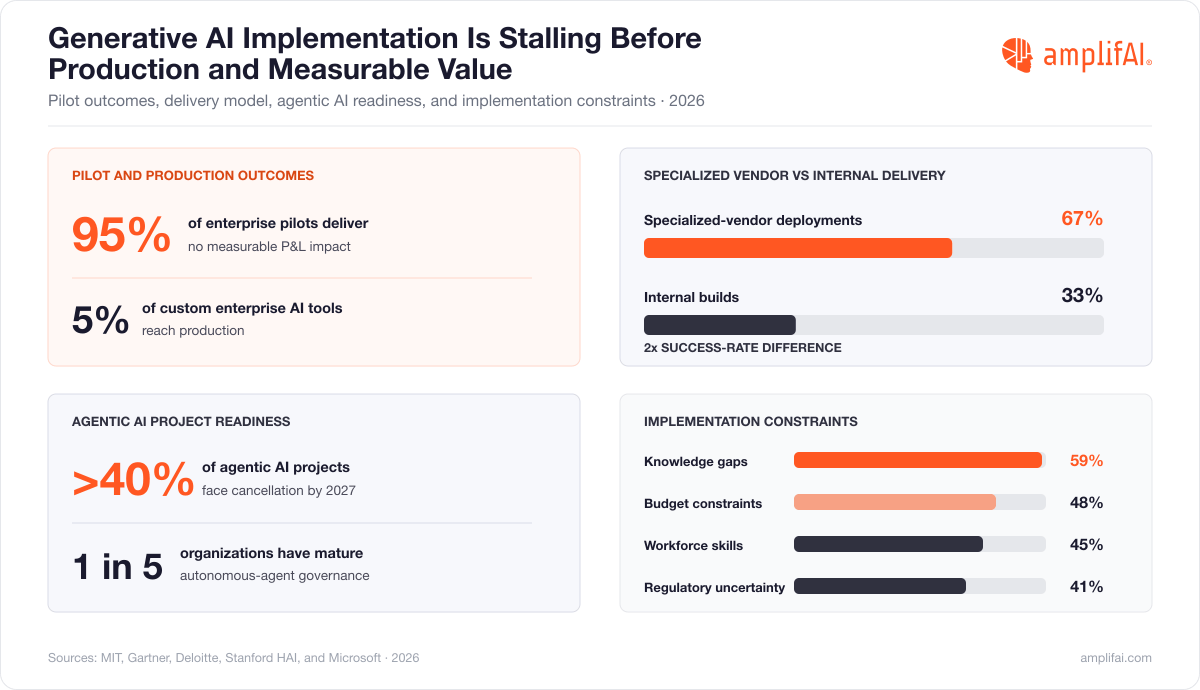
Generative AI statistics on AI implementation challenges show production and financial value remaining rare, with 95% of enterprise generative AI pilots delivering no measurable P&L impact and only 5% of custom enterprise AI tools reaching production (71), while more than 40% of agentic AI projects are forecast for cancellation by 2027 because of cost, unclear value, and technical complexity (72).
Implementation outcomes differ by sourcing and governance maturity, with specialized-vendor deployments succeeding 67% of the time compared with 33% for internal builds (73), while only one in five organizations has a mature governance model for autonomous AI agents (102). Workforce capability remains a separate constraint, with 45% of organizations naming limited AI skills as their leading challenge (63).
| Stat # | Generative AI Statistics on AI Implementation Challenges |
|---|---|
| 63 | Lack of a skilled workforce and the capabilities to use AI has been cited as the top challenge by 45% of organizations worldwide. Cite source |
| 64 | 75% of customers feel generative AI introduces new data security risks. Cite source |
| 65 | 45% of brands cite hiring and training as the biggest challenge when implementing generative AI. Cite source |
| 66 | 53% of sales representatives are unsure how to extract the most value from generative AI in their daily work. Cite source |
| 67 | 63% of customers believe generative AI could lead to unintended societal consequences. Cite source |
| 101 | Businesses without responsible AI policies fell from 24% to 11% between 2024 and 2025, while knowledge gaps affected 59%, budget constraints 48%, and regulatory uncertainty 41%. Cite source |
| 102 | One in five organizations has a mature governance model for autonomous AI agents. Cite source |
| 68 | 44% of manufacturing leaders are wary of AI "hallucinations," leading to cautious deployment. Cite source |
| 70 | Three out of four companies that build agentic AI architectures on their own will fail, according to Forrester, due to the complexity of multi-model systems, advanced data architectures, and specialized expertise required. Cite source |
| 71 | 95% of enterprise generative AI pilots deliver no measurable P&L impact, with only 5% of custom enterprise AI tools reaching production, according to MIT's GenAI Divide report. Cite source |
| 72 | More than 40% of agentic AI projects will be canceled by 2027 due to escalating costs, unclear value, and technical complexity. Cite source |
| 73 | Organizations that purchase AI tools from specialized vendors succeed 67% of the time, while internal builds succeed only 33% of the time. Cite source |
| Generative AI implementation challenge statistics sourced from McKinsey, MIT, Forrester, Gartner, Salesforce, and Reuters. For how generative AI is projected to reshape markets and industries, see Gen AI Future Growth statistics below. | |
AmplifAI's Analysis on Generative AI Implementation Challenges
Generative AI implementation failure isn't a single technical problem, with knowledge gaps affecting 59% of businesses, budget constraints 48%, and regulatory uncertainty 41% (101), while 45% of organizations identify workforce skills and AI capabilities as their leading implementation challenge (63). Agentic AI increases architecture risk, with Forrester predicting three out of four internal builds will fail because of multi-model systems, advanced data architectures, and specialized expertise (70).
For contact centers, implementation readiness depends on complete data, connected workflows, and outcome measurement. AmplifAI's guide to the best call center analytics software compares providers across data integration, analytics depth, action workflows, role-based delivery, and outcome measurement.
Generative AI Statistics on Future Growth
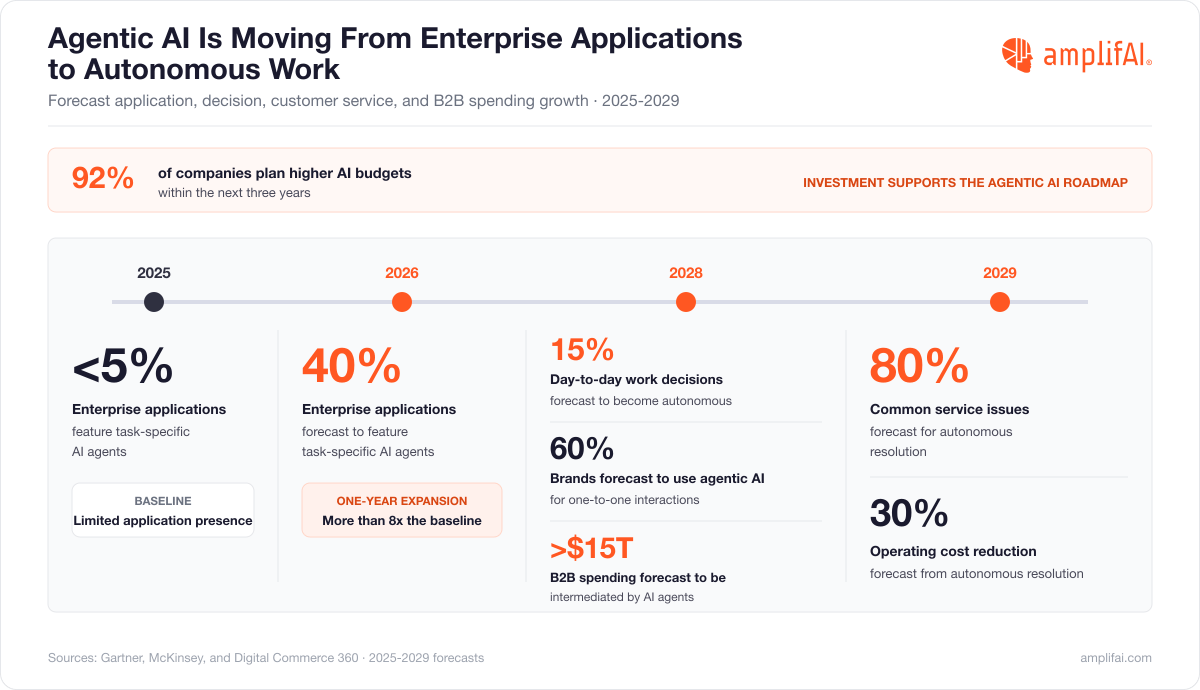
Generative AI statistics on future growth show budgets and enterprise software roadmaps shifting toward agentic AI, with 92% of companies planning higher AI budgets within three years (79), while task-specific AI agents are forecast to expand from less than 5% of enterprise applications in 2025 to 40% by the end of 2026 (78).
Autonomous execution is forecast to reach 15% of day-to-day work decisions by 2028 (81), with Gartner projecting agentic AI will resolve 80% of common customer service issues without human intervention by 2029 and reduce operating costs by 30% (77), while AI agents are forecast to intermediate more than $15 trillion in B2B spending by 2028 (80).
| Stat # | Generative AI Statistics on Future Growth |
|---|---|
| 74 | By 2030, companies investing in AI adoption will have a cumulative global economic impact of $19.9 trillion and contribute to 3.5% of the global GDP. Cite source |
| 75 | The generative AI market is expected to grow at a CAGR of 46%, reaching $356 billion by 2030. Cite source |
| 76 | Generative AI is projected to increase total factor productivity and GDP by 1.5% by 2035, nearly 3% by 2055, and 3.7% by 2075, according to the Wharton Penn Budget Model. Cite source |
| 77 | Gartner predicts agentic AI will autonomously resolve 80% of common customer service issues without human intervention by 2029, leading to a 30% reduction in operational costs. Cite source |
| 78 | 40% of enterprise applications will feature task-specific AI agents by end of 2026, up from less than 5% in 2025, and 33% of enterprise software will include agentic AI by 2028. Cite source |
| 79 | 92% of companies plan to increase their AI budgets within the next three years. Cite source |
| 80 | AI agents will intermediate more than $15 trillion in B2B spending by 2028, with organizations using AI agents for 80% of customer-facing processes expected to outperform competitors. Cite source |
| 81 | At least 15% of day-to-day work decisions will be made autonomously through agentic AI by 2028, up from 0% in 2024. Cite source |
| 82 | 60% of brands will use agentic AI to deliver streamlined one-to-one customer interactions by 2028. Cite source |
| Generative AI future growth statistics sourced from Gartner, McKinsey, Wharton, and Microsoft. For how agentic AI is reshaping customer service in 2026, see Agentic AI in Customer Service statistics below. | |
AmplifAI's Analysis on Generative AI Future Growth
Generative AI future growth isn't equivalent to realized business value, with 92% of companies planning budget increases (79), while more than 80% currently report no enterprise-level EBIT impact (16) and 95% of enterprise pilots deliver no measurable P&L impact (71). Agentic forecasts measure expected software and workflow change rather than guaranteed returns, placing governance, data integration, workforce redesign, and outcome measurement between autonomous capability and business value.
Autonomous-resolution forecasts don't establish workforce replacement, check out AmplifAI CEO Sean Minter's analysis of AI agents replacing human agents in customer service comparing labor costs, job postings, augmentation evidence, and implementation outcomes.
Generative AI Statistics on Agentic AI in Customer Service
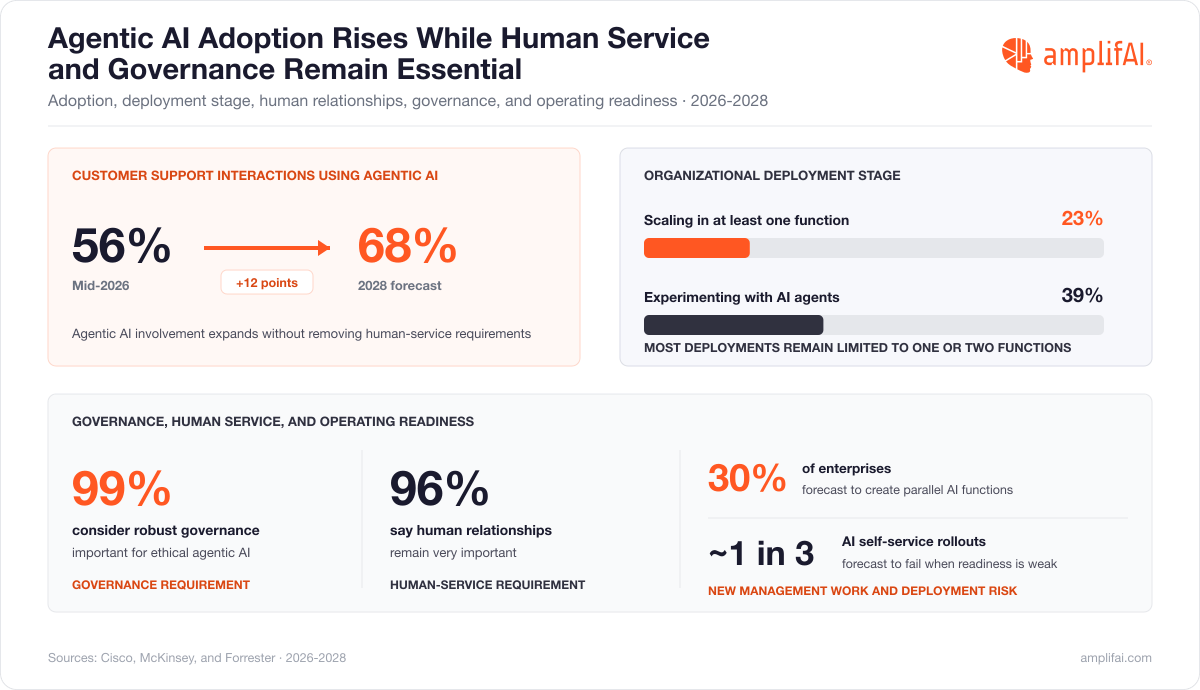
Generative AI statistics on agentic AI in customer service show adoption expanding alongside governance and human-service requirements, with Cisco projecting agentic AI involvement in 56% of customer support interactions by mid-2026 and 68% by 2028 (83), while 23% of organizations are scaling agentic AI and another 39% are experimenting (87).
Deployment speed doesn't remove trust or readiness constraints, with 99% of respondents considering robust governance important (86) and 96% maintaining that human relationships remain very important (85), while approximately one-third of brands deploying AI self-service are forecast to fail when cost pressure overrides deployment readiness (92).
| Stat # | Generative AI Statistics on Agentic AI in Customer Service |
|---|---|
| 83 | 56% of customer support interactions will use agentic AI by mid-2026, rising to 68% by 2028, according to Cisco's survey of 7,950 global business and technical decision-makers across 30 countries. Cite source |
| 84 | 93% of global respondents believe agentic AI will enable B2B technology vendors to deliver more personalized, proactive, and predictive services. Cite source |
| 85 | 96% of respondents say human relationships remain very important when interacting with B2B technology partners, even as agentic AI adoption accelerates. Cite source |
| 86 | 99% of respondents say it is important for technology partners to demonstrate robust governance arrangements for the ethical use of agentic AI. Cite source |
| 87 | 23% of organizations are scaling agentic AI in at least one business function, and an additional 39% have begun experimenting with AI agents, though most limit deployment to one or two functions. Cite source |
| 88 | Forrester predicts 30% of enterprises will create parallel AI functions that mirror human service roles, including managers to onboard and coach AI agents, teams to optimize AI performance, and specialists to resolve AI failures. Cite source |
| 89 | 1 in 4 brands will see a 10% increase in successful self-service interactions by end of 2026, with daily agent workloads expected to drop by an average of 1 hour as AI automates narrow tasks. Cite source |
| 90 | Agent assist tools powered by generative AI have been adopted by 73% of organizations, giving frontline agents real-time insights and suggested responses during customer interactions. Cite source |
| 91 | 81% of respondents predict that vendors who successfully deliver agentic AI-led customer experience will gain a competitive edge over those who delay deployment. Cite source |
| 92 | About one-third of brands that roll out AI in customer self-service will fail, having pushed AI solutions into production before they were ready, most often due to cost pressures overriding readiness. Cite source |
| Agentic AI statistics sourced from Cisco, McKinsey, Forrester, and Gartner. | |
AmplifAI's Analysis on Agentic AI in Customer Service
AI agent deployment creates new customer service management work alongside automation, with Forrester predicting 30% of enterprises will create parallel AI functions responsible for onboarding, coaching, optimizing, and resolving failures across AI agents (88), while 73% of organizations already use generative AI agent assist to support frontline decisions (90). Evaluating agentic AI requires shared quality standards across chatbots, voicebots, AI agents, and human agents, keeping resolution, compliance, and customer experience comparable across service types.
AmplifAI's guide to the best call center quality assurance software compares providers across AI agent quality management, automated evaluation, scorecards, calibration, compliance, omnichannel coverage, coaching, and workflow integration.
Generative AI Trends in 2026
Generative AI trends in 2026 show adoption growing faster than operating value, with 92% of companies planning higher AI budgets (79), while more than 80% report no enterprise-level EBIT impact (16) and 95% of enterprise pilots deliver no measurable P&L impact (71). Workflow redesign, governance, specialized expertise, and outcome measurement separate generative AI tooling access from business capacity, with 84% of organizations leaving jobs and workflows unchanged (99), only one in five maintaining mature autonomous-agent governance (102), and specialized-vendor deployments succeeding twice as often as internal builds (73).
AI agent governance connects quality, compliance, coaching, performance, and customer experience across automated and human service.
See how leading contact center AI software vendors approach AI agent quality, compliance, and governance, or speak to a CX leader at AmplifAI.
Generative AI Statistics and Benchmarking Research
AmplifAI research extends generative AI statistics into customer service adoption, industry performance benchmarks, workforce engagement, productivity formulas, and analytics methods for measuring AI operating value across contact centers.
| Research Guide | Research Type | What It Covers |
|---|---|---|
| Generative AI Statistics | Technology statistics | 104 sourced statistics covering market size, geography, investment, ROI, customer service, business impact, implementation challenges, future growth, and agentic AI |
| Call Center KPI Benchmarks by Industry | Industry benchmarks | 2026 CMP median benchmarks across 11 industries covering customer experience, resolution, cost, self-service, workforce, and frontline satisfaction |
| Customer Service Statistics | Category statistics | 140 sourced statistics covering customer expectations, customer experience, agents, AI, channels, quality assurance, call centers, and service recovery |
| Gamification Statistics | Workforce statistics | Gamification research across engagement, motivation, learning, recognition, performance, and retention |
| Call Center Productivity | KPI and formula guide | Formulas and improvement methods for FCR, AHT, CSAT, cost per contact, occupancy, attrition, and productivity |
| Call Center Analytics | Measurement guide | Analytics types, data sources, root-cause analysis, performance actions, and outcome measurement |
Customer Service and Support Software Buyer’s Guides
Our CX specialists at AmplifAI research and evaluate customer service and support software for CX leaders, AI program owners, workforce planners, QA teams, and contact center decision-makers. For teams moving from generative AI research to vendor evaluation, AmplifAI’s buyer’s guides compare vendors within customer service and support software categories across features, best-fit use cases, key considerations, and evaluation criteria for developing your shortlist.
| Software Buyer's Guide | What It Covers | Top Vendors |
|---|---|---|
| Call Center Software | Complete taxonomy of call center software categories with top vendors for customer service and support | AmplifAI, NICE, Genesys, Verint, CallMiner |
| Contact Center as a Service (CCaaS) Software | Full review and comparison of the best Contact Center as a Service (CCaaS) software in 2026 | NICE CXone, Genesys Cloud CX, Five9, Zoom, Talkdesk |
| Call Center CRM Software | Full review and comparison of the best call center CRM software in 2026 | Salesforce Service Cloud, Microsoft Dynamics 365, HubSpot Service Hub, Zoho CRM, Oracle CX |
| Contact Center AI Software | Full review and comparison of the best contact center AI software in 2026 | AmplifAI, Dialpad, Five9, Genesys, NICE |
| AI Agent Management Software | Full review and comparison of the best AI agent management software for customer service in 2026 | AmplifAI, Cresta, NICE, Observe.AI, Kore.ai |
| Call Center Workforce Management Software | Full review and comparison of the best call center workforce management software in 2026 | NICE CXone, Verint, Genesys Cloud, Assembled, Five9 |
| Call Center Speech Analytics Software | Full review and comparison of the best call center speech analytics software in 2026 | AmplifAI, CallMiner, NICE, Observe.AI, Verint |
| Call Center Analytics Software | Full review and comparison of the best call center analytics software in 2026 | AmplifAI, NICE CXone, Verint, Genesys Cloud, CallMiner |
| Call Center QA Software | Full review and comparison of the best call center QA software in 2026 | AmplifAI, CallMiner, Dialpad, NICE, Observe.AI |
| Call Center Performance Management Software | Full review and comparison of the best call center performance management software in 2026 | AmplifAI, Calabrio One, Genesys, NICE, Verint |
| Call Center Coaching Software | Full review and comparison of the best call center coaching software in 2026 | AmplifAI, CallMiner, Dialpad, Genesys, Verint |
| AI-Powered Call Center Coaching Software | Full review and comparison of the best AI-powered call center coaching software in 2026 | AmplifAI, Centrical, Cresta, EvaluAgent, Observe.AI |
| Call Center Gamification Software | Full review and comparison of the best call center gamification software in 2026 | AmplifAI, Centrical, Cresta, Genesys, NICE |
| Customer Insights Software | Full review and comparison of the best customer insights software in 2026 | AmplifAI, CallMiner, Cresta, Observe.AI, Tethr |